Independent economic analysis from ANZ also highlights differences in government spending priorities, healthcare investment and climate commitments that could influence New Zealand’s economic direction over the next three years.
For ordinary New Zealanders, the outcome of these negotiations could matter every time they visit a supermarket, seek medical treatment or consider their household finances.
Seven seats that changed the political landscape
Opportunity did not gain a single additional parliamentary seat between election night and Friday’s official declaration. Yet its negotiating influence increased substantially.
|
Political party
|
Preliminary seats
|
Official seats
|
Change
|
|
National
|
42
|
40
|
-2
|
|
Labour
|
36
|
36
|
0
|
|
Green Party
|
16
|
17
|
+1
|
|
ACT
|
13
|
13
|
0
|
|
New Zealand First
|
12
|
12
|
0
|
|
Opportunity
|
7
|
7
|
0
|
|
Te Pāti Māori
|
5
|
5
|
0
|
|
Total Parliament
|
131
|
130
|
-1
|
|
Majority required
|
66
|
66
|
0
|
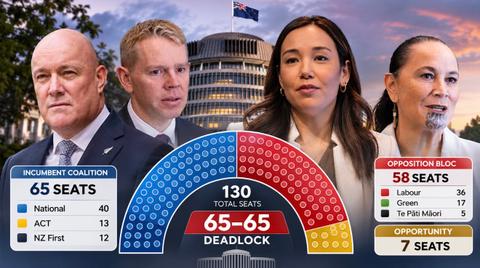
On election night, the existing coalition held 67 seats. It now holds 65.
Adding Opportunity’s seven MPs would produce a combined parliamentary majority of 72 seats.
However, securing that support could require National, ACT and New Zealand First to reconsider some of their own election promises.
The policies that could divide the next government
Opportunity has identified five minimum policy conditions for entering a coalition or confidence and supply agreement.
Several directly intersect with the priorities of the existing coalition parties.
|
Policy area
|
Opportunity’s position
|
Potential negotiating challenge
|
|
Climate change
|
Protect existing climate commitments
|
ACT and NZ First favour changes to international climate arrangements
|
|
Supermarkets
|
Strengthen competition regulation
|
Differences over government intervention and deregulation
|
|
Healthcare
|
Establish a 10-year health plan
|
Funding requirements and government spending limits
|
|
Commercial fishing
|
Phase out bottom trawling
|
Environmental protection versus commercial interests
|
|
Political accountability
|
Regulate lobbying and cap political donations
|
Agreement on new political financing rules
|
These are negotiating positions, not confirmed government policies.
The eventual governing agreement will reveal which proposals survive, which are modified and which are abandoned.
Climate policy: National and Opportunity could find common ground
One of the clearest differences between the prospective governing partners concerns New Zealand’s international climate commitments.
New Zealand First has campaigned on withdrawing from the Paris Agreement, while ACT has advocated changes to the agreement and raised the possibility of withdrawal.
Opportunity wants New Zealand to maintain its climate commitments and protect the independence of the Climate Change Commission.
National has also supported remaining within the Paris Agreement.
|
Political party
|
Parliamentary seats
|
Climate policy position
|
|
National
|
40
|
Remain within the Paris Agreement
|
|
Opportunity
|
7
|
Protect existing climate commitments
|
|
ACT
|
13
|
Seek changes to the agreement or consider withdrawal
|
|
New Zealand First
|
12
|
Withdraw from the agreement
|
National and Opportunity collectively hold 47 seats, compared with ACT and New Zealand First’s combined 25.
Coalition policy is not determined through a simple vote between governing partners. Nevertheless, Opportunity’s involvement could reinforce National’s existing climate position during negotiations.
Wong has indicated that maintaining existing climate arrangements could satisfy her party’s minimum requirements, suggesting there may be room for agreement.
For businesses, farmers and investors, the outcome could influence regulatory certainty and future environmental obligations.
Supermarket competition: Four parties, different solutions
Grocery affordability is likely to be one of the most relevant issues for New Zealand households.
There is broad agreement among the prospective governing parties that supermarket competition needs improvement. However, their approaches differ.
National and New Zealand First have supported structural reforms to address market concentration, while ACT has emphasised reducing regulatory barriers for new competitors.
Opportunity wants stronger competition regulation and greater powers to address excessive market influence.
|
Political party
|
Broad policy approach
|
|
National
|
Structural supermarket reform
|
|
ACT
|
Reduce barriers to market entry and encourage competition
|
|
New Zealand First
|
Address market concentration through structural changes
|
|
Opportunity
|
Strengthen competition regulation
|
The negotiations could determine whether the next government prioritises stronger regulation, deregulation or a combination of both.
For consumers, the important question is whether these reforms will create meaningful competition and improve grocery affordability.
No proposed supermarket reform guarantees an immediate reduction in prices. Implementation, investment and the response of existing retailers will all influence the eventual outcome.
The $400 million difference between National and ACT
Perhaps the most consequential disagreement concerns government spending.
ANZ’s economic assessment published on November 27 identifies differences between National and ACT’s proposed fiscal programmes.
|
Financial indicator
|
National
|
ACT
|
|
Proposed annual Budget operating allowance
|
$2.4 billion
|
$2 billion
|
|
Targeted return to operating surplus
|
2028/29
|
2027/28
|
|
Difference in operating allowance
|
|
$400 million
|
Source: ANZ Research, 27 November 2026.
ACT’s proposed operating allowance is approximately 16.7 percent lower than National’s.
An operating allowance represents funding available for additional operating expenditure and other policy changes through the Budget process. It is not the government’s entire annual spending budget.
This distinction becomes particularly important when Opportunity enters negotiations seeking commitments involving healthcare and environmental policy.
Every new spending commitment would need to be accommodated through available funding, savings elsewhere, additional revenue or changes to existing fiscal targets.
The difference between National and ACT’s proposed spending allowances illustrates the financial challenge facing the prospective coalition.
How additional healthcare spending could affect the Budget
Opportunity wants a 10-year health plan supported across political parties, with greater emphasis on primary and preventative healthcare.
The intention is to provide greater continuity in healthcare planning rather than allowing priorities to change with every election cycle.
However, long-term planning must be supported by credible funding arrangements.
Webfit News has modelled three hypothetical annual funding commitments to illustrate how additional expenditure could interact with National and ACT’s proposed operating allowances.
|
Illustrative additional annual funding
|
Share of National’s $2.4bn allowance
|
Share of ACT’s $2bn allowance
|
|
$100 million
|
4.2%
|
5%
|
|
$250 million
|
10.4%
|
12.5%
|
|
$500 million
|
20.8%
|
25%
|
These are illustrative calculations, not official cost estimates for Opportunity’s healthcare policies.
Even a relatively modest additional funding commitment could consume a meaningful proportion of the money available for new government initiatives.
That could require compromises over other spending priorities.
For patients waiting to see specialists, struggling to access GPs or concerned about hospital capacity, the most important outcome will be whether the eventual agreement delivers funded commitments rather than another strategic document.
New Zealand First faces significant policy differences
Winston Peters enters negotiations with 12 MPs and considerable experience in government formation.
However, several New Zealand First policy positions differ from Opportunity’s wider programme.
These include approaches to climate commitments, environmental regulation and the future of Treaty-related institutions.
New Zealand First has proposed replacing the Waitangi Tribunal with a Treaty of Waitangi Completion Commission, while Opportunity has expressed support for a partnership approach under Te Tiriti.
This is separate from Opportunity’s five published minimum coalition conditions, but it illustrates the wider differences between the parties.
There is also the unresolved question of Peters’ ministerial responsibilities.
Wong has maintained that Opportunity would not enter a coalition or confidence and supply agreement with a government in which Peters remains Foreign Minister.
That creates a potentially difficult negotiation for Luxon, who needs to accommodate Opportunity without losing the support of his existing partners.
No agreement resolving the issue has been publicly confirmed.
Two major Opportunity policies are missing from its minimum demands
While attention has focused on Opportunity’s five negotiating conditions, two of its best-known economic proposals have not been included among those minimum requirements.
|
Opportunity policy
|
Included in its five minimum negotiating conditions?
|
|
Stronger supermarket competition
|
Yes
|
|
Political donation and lobbying reform
|
Yes
|
|
Long-term healthcare plan
|
Yes
|
|
Phasing out bottom trawling
|
Yes
|
|
Protecting climate commitments
|
Yes
|
|
Land value tax
|
No
|
|
Citizens’ income
|
No
|
This distinction is particularly important for homeowners, property investors and businesses.
Opportunity’s involvement in government formation does not automatically mean New Zealand will introduce a land value tax or a citizens’ income scheme.
These proposals remain part of the party’s wider policy programme, but their implementation would require separate political agreement.
Why Luxon cannot simply replace ACT or New Zealand First
Despite Opportunity’s emergence as a pivotal negotiating party, National remains dependent on its existing partners if it wants to establish an outright majority through the proposed four-party arrangement.
|
Potential governing arrangement
|
Combined seats
|
Majority position
|
|
National + ACT + NZ First
|
65
|
One seat short
|
|
National + ACT + Opportunity
|
60
|
Six seats short
|
|
National + NZ First + Opportunity
|
59
|
Seven seats short
|
|
National + ACT + NZ First + Opportunity
|
72
|
Outright majority
|
|
Labour + Greens + Te Pāti Māori + Opportunity
|
65
|
One seat short
|
The numbers explain why David Seymour and Winston Peters retain considerable negotiating influence.
Opportunity can provide the additional support required by the existing coalition, but it cannot simply replace either of the other smaller parties and preserve an outright majority.
Similarly, its seven MPs would not independently deliver a majority to a Labour-led grouping.
Other cross-party arrangements and minority government options remain constitutionally possible.
Could Opportunity influence government without joining Cabinet?
A formal four-party coalition is not the only available solution.
Opportunity could negotiate an arrangement allowing it to remain outside Cabinet while supporting or abstaining on essential parliamentary votes.
Consider the following hypothetical confidence vote.
|
Parliamentary grouping
|
Votes
|
|
National, ACT and NZ First supporting the government
|
65
|
|
Labour, Greens and Te Pāti Māori opposing the government
|
58
|
|
Opportunity abstaining
|
7
|
|
Total MPs
|
130
|
Under this scenario, a confidence motion could pass by 65 votes to 58.
Opportunity would not necessarily have to support every government policy. Instead, ministers could be required to negotiate additional support for ordinary legislation.
Such an arrangement could preserve greater political independence for Opportunity while changing how the government develops and passes legislation.
Its effectiveness would depend on the terms of the agreement and the willingness of the parties to cooperate.
What could this mean for ordinary New Zealanders?
The eventual coalition agreement could affect a wide range of issues that households and businesses encounter every day.
|
Area
|
What New Zealanders should watch
|
|
Grocery prices
|
Whether supermarket reforms produce stronger competition
|
|
Healthcare
|
Whether long-term plans are backed by additional funding
|
|
Government spending
|
Whether fiscal targets and Budget allowances change
|
|
Business investment
|
Whether regulatory and economic policies provide greater certainty
|
|
Environment
|
Whether existing climate commitments are retained
|
|
Political accountability
|
Whether new lobbying and donation regulations are introduced
|
|
Taxation
|
Whether wider tax proposals become part of the governing agreement
|
None of these outcomes is guaranteed.
The negotiations will determine which election commitments become government priorities and which remain party policies.
The 2027 Budget could be the first major test
While coalition agreements will establish the incoming government’s political priorities, the 2027 Budget will provide a clearer indication of how those commitments are funded.
Several important milestones lie ahead.
|
Date or milestone
|
Significance
|
|
2 December 2026
|
Judicial recount application deadline
|
|
3 December 2026
|
Scheduled return of the election writ, subject to recounts
|
|
Government formation agreement
|
Confirmation of negotiated policies and ministerial responsibilities
|
|
Early 2027
|
Parliamentary and legislative programme becomes clearer
|
|
Budget Policy Statement 2027
|
Government’s financial priorities and fiscal direction
|
|
Budget 2027
|
Actual funding allocations for agreed policy commitments
|
ANZ’s economic assessment suggests that the broader fiscal direction could remain relatively consistent if coalition concessions are accommodated within existing spending allowances.
However, the final agreement will determine whether those assumptions remain valid.
The first Budget of the next government could therefore become one of the most important indicators of Opportunity’s actual influence.
Familiar political leaders, potentially a different government
New Zealand’s election has produced an unusual political situation.
National could remain the leading governing party. ACT and New Zealand First could retain their positions as political partners. Yet Opportunity could substantially influence the policies that determine how the country is governed.
That does not necessarily mean New Zealand will abandon its existing economic direction. Nor does it guarantee that Opportunity will secure every concession it seeks.
The parties have areas of common interest, particularly around supermarket competition and economic improvement, alongside substantial differences concerning environmental policy, government expenditure and institutional reform.
For New Zealanders, the eventual governing agreement deserves scrutiny beyond ministerial appointments and political personalities.
Which promises have survived? Which have been compromised? How much will the new commitments cost? And when will households begin to experience their effects?
Those are the questions that will determine whether the negotiations produce a government capable of delivering meaningful results.
Seven MPs may represent only a small proportion of New Zealand’s Parliament, but their involvement could influence decisions affecting the entire country for the next three years.
The election has determined who sits in Parliament. The negotiations will determine what that Parliament delivers.
Webfit News | New Zealand Election 2026 | Political and Economic Analysis
Sources: Electoral Commission official election results; published election policies of National, ACT, New Zealand First and Opportunity; ANZ Research, NZ Insight: Election 2026 – Final Vote Count, 27 November 2026; NZ Herald opinion by Heather du Plessis-Allan, 29 November 2026; 1News; Reuters.
Information reflects the political situation as of 29 November 2026. Financial scenarios are illustrative calculations by Webfit News. Proposed policies and potential governing arrangements are not confirmed government decisions.