Official results: What has changed?
|
Party
|
Preliminary
|
Official
|
Change
|
|
National
|
42
|
40
|
-2
|
|
Labour
|
36
|
36
|
0
|
|
Green
|
16
|
17
|
+1
|
|
ACT
|
13
|
13
|
0
|
|
NZ First
|
12
|
12
|
0
|
|
Opportunity
|
7
|
7
|
0
|
|
Te Pāti Māori
|
5
|
5
|
0
|
|
Total
|
131
|
130
|
-1
|
National has lost Wairarapa and Hamilton East to Labour, while the Greens have taken Wellington Bays from Labour and gained additional overall parliamentary representation.
Labour’s total representation remains unchanged at 36 seats despite its electorate gains.
National’s 40 MPs are all electorate representatives, meaning the party has no list MPs under the official allocation.
Why Opportunity cannot simply choose either government
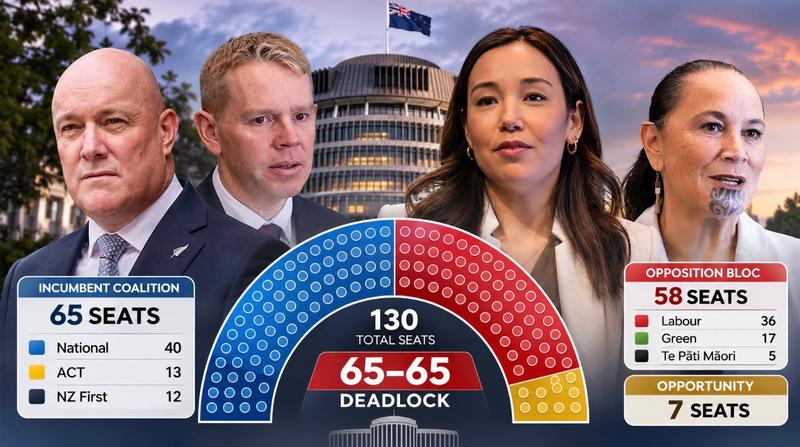
The official results create a particularly unusual political situation.
|
Potential arrangement
|
Seats
|
|
National + ACT + NZ First
|
65
|
|
Labour + Green + Te Pāti Māori
|
58
|
|
Opportunity
|
7
|
|
Incumbent coalition + Opportunity
|
72
|
|
Opposition bloc + Opportunity
|
65
|
|
Outright majority required
|
66
|
The distinction is significant.
Opportunity could provide the incumbent coalition with a comfortable parliamentary majority through a support agreement or formal coalition arrangement.
However, its seven seats would not independently give Labour, the Greens and Te Pāti Māori an outright majority.
A Labour-led minority administration would require some additional parliamentary arrangement, potentially involving abstentions or support from outside that grouping.
The result therefore gives Opportunity considerable negotiating influence without providing two equally straightforward routes to government.
National’s electorate losses carry national consequences
The official count has overturned National’s preliminary leads in Wairarapa and Hamilton East.
Labour’s Kieran McAnulty and Georgie Dansey have emerged ahead in the respective electorates, although judicial recounts remain possible.
Under New Zealand’s MMP system, National’s electorate overhang means losing electorate seats can directly reduce its total parliamentary representation.
Labour’s electorate gains, meanwhile, do not automatically increase its total number of MPs because electorate representation is balanced against its list allocation.
That distinction explains how Labour can win additional electorates without increasing its overall parliamentary strength, while National loses two MPs.
Does Opportunity have to join the coalition?
Not necessarily.
New Zealand’s constitutional arrangements provide several mechanisms through which a government can obtain parliamentary confidence.
Opportunity could formally join a coalition, negotiate a confidence and supply agreement, or remain outside government while agreeing to abstain on specified parliamentary votes.
It could also retain independence on ordinary legislation while providing sufficient support for a government to remain in office.
The differences between these arrangements would have important implications for ministerial appointments, Budget negotiations, policy commitments and the passage of legislation.
An outright majority of 66 MPs is not the only mechanism through which a government can operate. Parliamentary confidence can also be established through arrangements involving abstentions.
Recounts could still change the political landscape
Despite today’s official declaration, the electoral process may not yet be complete.
The closely contested Wairarapa and Hamilton East results could be subject to judicial recounts.
Candidates have three working days following the official declaration to submit an application for a recount.
The significance of these contests extends beyond the identity of their local MPs.
Because National’s representation includes electorate overhangs, a change in an electorate result could alter both the party’s parliamentary strength and the total size of Parliament.
With the current balance so finely divided, even one electorate changing hands could have consequences for government formation.
Does a hung Parliament mean another election?
Not automatically.
The incumbent government continues operating under the caretaker convention until a new administration is established.
Political parties can negotiate coalition agreements, confidence and supply arrangements or other forms of parliamentary support.
Another election becomes a possibility if no viable government can ultimately be formed, but today’s result does not itself trigger a return to the polls.
New Zealanders will continue to have a functioning administration while negotiations take place.
From counting votes to negotiating power
Twenty days after New Zealand went to the polls, the official results have established a parliamentary composition in which neither of the two broad political blocs holds an outright majority on its own.
The immediate focus now shifts to discussions between National, ACT, New Zealand First and Opportunity, alongside any alternative arrangements that could emerge.
The terms of those negotiations could shape not only the identity of the next government but also its ability to pass legislation and implement its policy programme.
Webfit News will continue following electorate recounts, government formation negotiations and changes to parliamentary representation.
Follow our dedicated election results platform:
https://poll.webfitnews.co.nz/results-2026
This is a developing story.