Labour’s Helen White has opened a substantial preliminary lead over Melissa Lee. But the result carries another twist: third-placed Qiulae Wong is projected to enter Parliament, while Lee faces losing her place.
By Webfit News | 9 November 2026
Labour’s Helen White has opened a substantial preliminary lead over Melissa Lee.
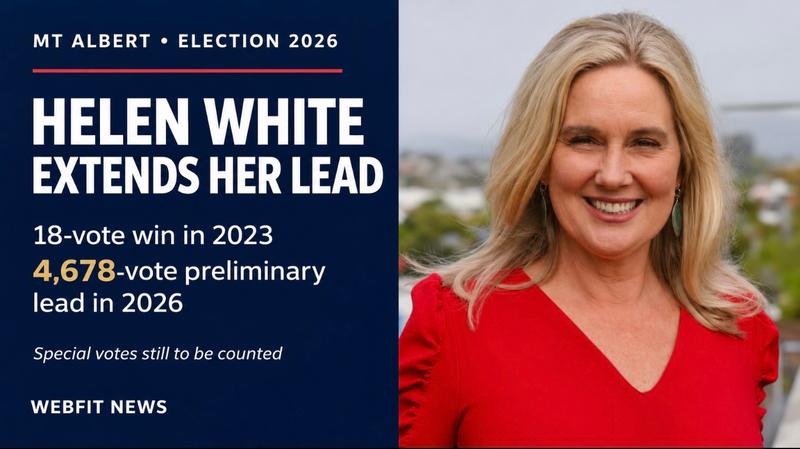
Labour’s Helen White has opened a substantial preliminary lead over Melissa Lee. But the result carries another twist: third-placed Qiulae Wong is projected to enter Parliament, while Lee faces losing her place.
By Webfit News | 9 November 2026
Three years ago, Helen White held Mt Albert by just 18 votes after a judicial recount.
This time, the preliminary count puts the Labour MP 4,678 votes ahead of National’s Melissa Lee.
The Electoral Commission’s figures show White on 14,067 candidate votes and Lee on 9,389, with all 102 voting-place results reported. Special votes remain outstanding, and the result has not been formally declared.
It is a much stronger position for White than in 2023. For Lee, however, the consequences extend beyond another unsuccessful electorate campaign.
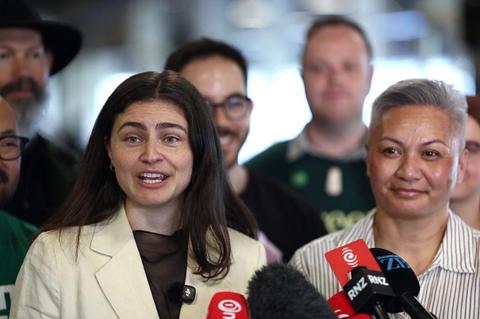
National currently has no projected list seats. That leaves Lee facing departure from Parliament, while Opportunity leader Qiulae Wong, who finished third in Mt Albert, is projected to enter through her party’s list.
The preliminary result
|
Candidate |
Party |
Candidate votes |
|
Helen White |
Labour |
14,067 |
|
Melissa Lee |
National |
9,389 |
|
Qiulae Wong |
Opportunity |
3,960 |
|
Ricardo Menéndez March |
Green |
3,595 |
|
Sheldon Eden-Whaitiri |
New Zealand First |
703 |
|
Alex Price |
ACT |
668 |
|
Luke Bones |
Independent |
87 |
White received approximately 43.3 percent of valid candidate votes, compared with Lee’s 28.9 percent.
Wong finished third, 365 votes ahead of the Greens’ Ricardo Menéndez March.
These are votes for the local representative. They should not be confused with the separate party vote used to calculate parliamentary representation.
A very different position from 2023
Mt Albert’s final 2023 result was among the country’s closest.
White received 13,238 votes and Lee 13,220. A judicial recount confirmed White’s victory, reducing the previously reported 20-vote margin to 18.
The current preliminary lead is substantially wider, but the comparison needs two qualifications.
First, the 2023 figures are final and include special votes. The 2026 figures do not yet include them.
Second, Mt Albert’s boundaries changed before this election. The two contests were not fought across exactly the same electorate.
The result shows White in a stronger position. It does not, on its own, establish how many voters changed their allegiance.
Boundary changes matter
The Representation Commission redrew electorate boundaries for the 2026 election.
Its final decisions included moving part of Arch Hill from Auckland Central into Mt Albert. An area around Balmoral remained in Epsom rather than moving into Mt Albert as initially proposed.
Changes to an electorate’s population can affect its political balance.
That makes it premature to attribute White’s entire improvement to her campaign, National’s performance or tactical voting. Establishing the contribution of each factor would require a closer examination of voting-place results and the revised boundaries.
Why Lee could miss out despite finishing second
The Electoral Commission’s preliminary allocation projects 42 National MPs, all elected through electorates, with no additional list MPs.
Lee does not appear in that preliminary allocation.
For a politician who first entered Parliament in November 2008, the figures threaten to end an 18-year parliamentary career.
Under MMP, an unsuccessful electorate candidate can return through their party’s list only if the party’s seat entitlement and their list position provide a place.
Finishing second locally does not create a separate entitlement to enter Parliament.
Lee’s position therefore depends on changes to the electorate result or National’s final allocation. Neither currently provides her with a seat.
Why Wong can enter without winning Mt Albert
Wong’s position demonstrates the other side of the system.
Opportunity crossed the five-percent party-vote threshold nationally and is projected to receive seven list seats. Wong appears among its projected MPs.
She does not need to defeat White to enter Parliament.
Menéndez March is also projected to return through the Green Party list despite finishing fourth locally.
The same electorate contest therefore produces three different prospects: White leading towards an electorate return, Wong heading towards a parliamentary debut and Lee facing departure.
The distinction is straightforward. The candidate vote chooses the local MP. The party vote determines parties’ proportional entitlement to seats, subject to the electoral rules.
What the result does not prove
The figures do not establish that Green or Opportunity supporters deliberately voted for White to prevent Lee from winning.
Differences between candidate totals and party totals can show that split voting occurred overall. They cannot reveal how individual voters combined their choices or why.
Likewise, adding candidates’ totals together does not show what would have happened if one had withdrawn.
Claims about tactical voting or a decisive “split vote” need evidence beyond the final rankings.
What can be said confidently is that White has established a substantial preliminary lead in a crowded contest, while the national party vote is shaping very different outcomes for her opponents.
The count is not finished
All voting places reporting does not mean all eligible votes have been counted.
Special votes must still be checked and counted, ordinary votes are recounted, and parliamentary allocations remain provisional.
Official results are scheduled for Friday, 27 November.
For now, White has breathing room that was absent from her final 2023 result. Lee faces a much more difficult route back to Parliament, while Wong’s national breakthrough shows why winning an electorate is only one path to political influence.
Sources: Electoral Commission preliminary results and parliamentary allocations, official 2023 results and recount records, and Representation Commission boundary decisions.
Was this article useful?