|
Party
|
Party vote
|
Projected seats
|
|
Labour
|
29.36%
|
36
|
|
National
|
29.21%
|
42
|
|
Green Party
|
13.30%
|
16
|
|
ACT
|
10.92%
|
13
|
|
NZ First
|
9.78%
|
12
|
|
Opportunity Party
|
5.96%
|
7
|
|
Te Pāti Māori
|
0.57%
|
5
|
|
Total Parliament
|
|
131
|
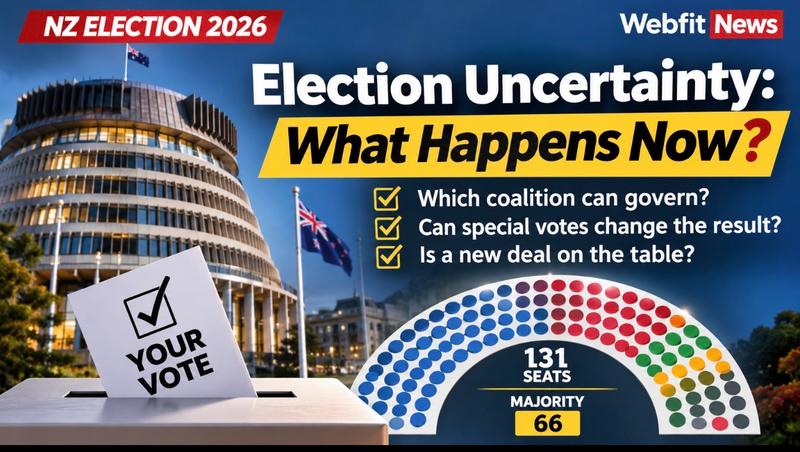
Majority required: 66 seats.
These figures exclude special votes and are not the final election result.
2. Who can form the next government?
The current parliamentary arithmetic creates several possibilities, although not all are politically realistic.
|
Possible grouping
|
Seats
|
Position
|
|
National + ACT + NZ First
|
67
|
Majority by 1 seat
|
|
Labour + Greens + Te Pāti Māori
|
57
|
9 short
|
|
Labour + Greens + Te Pāti Māori + Opportunity
|
64
|
2 short
|
|
National + ACT + Opportunity
|
62
|
4 short
|
|
Labour + Greens + NZ First + Opportunity
|
71
|
Majority mathematically, but significant political barriers
|
The key finding: The existing National-led coalition has a narrow majority. Labour cannot currently reach 66 seats even with the Greens, Te Pāti Māori and Opportunity.
However, these calculations could change after the official count.
3. Why are 399,365 special votes so important?
The Electoral Commission estimates 399,365 special votes remain to be processed, including approximately 96,947 overseas and dictation votes.
Special votes include ballots from people voting outside their electorate, overseas voters, people on the unpublished roll and certain voters unable to attend ordinary polling places.
The official count also involves checking voter rolls and recounting ordinary votes.
Historically, special votes have changed parliamentary seat allocations.
In 2017, 2020 and 2023, National lost two seats between the preliminary and official results. But this historical pattern does not establish what will happen in 2026.
An important difference this year is that enrolment closed three weeks before election day, changing the composition of the special-vote pool.
The final count could affect party-list allocations, electorate winners and the size of Parliament itself.
4. Six electorates could influence the result
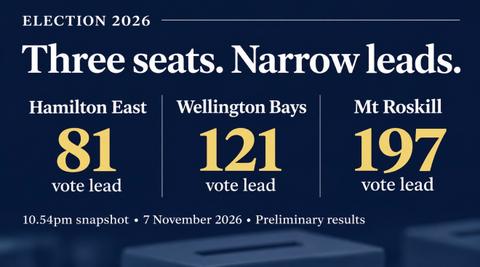
RNZ’s election analysis identifies six electorates where the preliminary winning margin is fewer than 1,000 votes.
These contests matter because a change in electorate winners could alter the number of overhang seats.
National is projected to win 42 electorate seats, more than its party-vote entitlement. Te Pāti Māori is also projected to win more electorate seats than its party vote would ordinarily provide.
The result is an unusually large projected Parliament.
|
Overhang calculation
|
Seats
|
|
Standard Parliament
|
120
|
|
National overhang
|
+7
|
|
Te Pāti Māori overhang
|
+4
|
|
Projected Parliament
|
131
|
If electorate results change, the overhang and parliamentary majority threshold may change too.
This makes close electorate races particularly important.
5. Could Opportunity become kingmaker?
The Opportunity Party, led by Qiulae Wong, is projected to enter Parliament with seven MPs after securing almost 6% of the party vote.
But there is a distinction between having influence and holding the balance of power.
On the preliminary numbers:
- National, ACT and NZ First already have 67 seats without Opportunity.
- Labour, Greens, Te Pāti Māori and Opportunity have only 64.
- National and ACT with Opportunity would have 62.
Opportunity cannot currently deliver a majority to either major bloc simply by joining it.
Its negotiating importance could increase if special votes change the numbers or the existing coalition cannot agree on governing arrangements.
Luxon has previously ruled out governing with Opportunity, adding another complication to any alternative arrangement.
6. What about the Greens and NZ First?
The Greens have increased their party vote to 13.30% and are projected to hold 16 seats.
They would be essential to the most obvious Labour-led grouping, but Labour, Greens and Te Pāti Māori still need additional support to reach a majority.
NZ First, meanwhile, has increased its representation from eight seats at the 2023 election to a projected 12.
Its participation is essential to the existing National-ACT-NZ First majority.
That gives NZ First an important role in any renewed coalition negotiations, although its exact demands and agreements remain to be established.
7. How does 2026 compare with the previous government?
|
Party
|
2023 election
|
2026 preliminary
|
|
National
|
48
|
42
|
|
ACT
|
11
|
13
|
|
NZ First
|
8
|
12
|
|
Three-party coalition
|
67
|
67
|
|
Labour
|
34
|
36
|
|
Greens
|
15
|
16
|
|
Te Pāti Māori
|
6
|
5
|
|
Opportunity
|
0
|
7
|
The governing parties collectively retain 67 seats in the preliminary calculation, but the distribution has changed significantly.
National has six fewer seats, while ACT and NZ First have gained six between them.
This could affect coalition negotiations even if the existing government retains its parliamentary majority.
8. What happens next?
|
Date
|
Next step
|
|
8 November
|
Official counting process begins
|
|
8–27 November
|
Special votes checked, ordinary votes recounted and electorate totals verified
|
|
27 November
|
Official election results scheduled for release
|
|
Within three days of official results
|
Eligible candidates or party secretaries can apply for recounts
|
|
By 3 December
|
Deadline for final declaration following the recount process, as outlined in election reporting
|
Political parties do not need to wait until 27 November to begin discussions about forming a government.
Until the political situation is resolved, the incumbent government continues under caretaker conventions.
9. What should New Zealand watch now?
Three developments matter most.
First, the special votes. Their distribution will determine whether the existing coalition retains its narrow majority and whether other combinations become mathematically possible.
Second, the close electorates. A small change in candidate votes could affect the overhang, the total number of MPs and the majority threshold.
Third, coalition negotiations. Even a parliamentary majority requires parties to agree on how they will govern.
The bottom line
Labour has narrowly won the preliminary party vote. National has more seats and, together with ACT and NZ First, currently holds a parliamentary majority.
But the result is not final.
With approximately 399,000 special votes still to be processed, six closely contested electorates and a Parliament projected to expand to 131 seats, the official count remains important.
New Zealand knows how election night ended. It does not yet know the final shape of its next government.
Webfit News will continue following the Electoral Commission’s official count and coalition developments.
Follow live results: https://poll.webfitnews.co.nz/results-2026