As the preliminary count progressed towards 90%, National was polling at approximately 29.3% of the party vote, with Labour close behind on 29.1%.
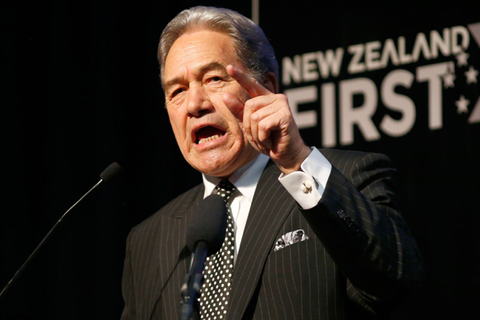
The Greens were attracting approximately 13.1%, ACT around 11%, and New Zealand First approximately 9.8%.
The emerging Opportunity Party was also polling close to 5.9%, putting it in a position to enter Parliament and potentially influence negotiations over the next government.
These figures reflect an election-night snapshot rather than a final declaration.
The narrow margin between the major parties underlines how little separates their electoral support, even as their possible paths to government differ substantially.
Why Labour’s strong performance may not be enough
New Zealand’s Mixed Member Proportional electoral system means the largest party does not automatically form the government.
Instead, the decisive question is whether a party or combination of parties can secure enough parliamentary seats to command a majority.
Election-night projections indicated that National, ACT and New Zealand First could collectively hold approximately 66 seats in a 129-seat Parliament, giving the incumbent bloc a majority of just one seat above the 65 required.
That advantage remains vulnerable to changes in electorate results and the eventual counting of special votes.
For Hipkins, the challenge is therefore political as well as mathematical. Labour needs not only a competitive party vote but a workable parliamentary majority involving parties willing to support a change of government.
Smaller parties emerge as major players
One of the defining developments of the election has been the influence of parties outside the traditional National-Labour contest.
The Greens have recorded a strong performance, while ACT and New Zealand First remain essential to the incumbent governing bloc’s parliamentary calculations.
The Opportunity Party’s apparent breakthrough introduces another dimension.
If its vote remains above the 5% threshold in the official result, it could secure parliamentary representation without winning an electorate.
That would give the party a potential role in negotiations, depending on the final distribution of seats.
For both National and Labour, the outcome may depend on conversations that cannot be completed until the parliamentary numbers become clearer.
Individual electorates could change the balance
The national party vote is only part of the story.
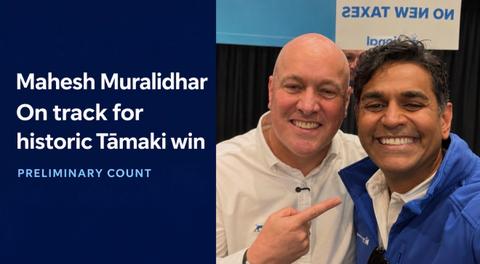
Several electorate contests have remained exceptionally close, with some candidates separated by only dozens or hundreds of votes.
Those margins matter because the final electorate allocation can affect the overall size and composition of Parliament.
The unusual possibility of overhang seats adds another complication. Under MMP, a party that wins more electorates than its party-vote entitlement can retain those seats, potentially increasing the size of Parliament and changing the number required for a majority.
Consequently, a change in one closely contested electorate could have consequences extending beyond that constituency.
An election shaped by economic pressure
The election has unfolded against widespread public concern about living costs, employment, household finances and New Zealand’s economic performance.
National has campaigned on continuing its economic programme and argued that more time is needed to deliver improvements.
Labour has sought to persuade voters that a change of government would provide a different response to the pressures facing households and public services.
The close result suggests neither major party has secured an overwhelming mandate.
Both now face the task of interpreting a divided electorate while considering the practical demands of governing under MMP.
The final decision may take weeks
The Electoral Commission’s election-night count is preliminary and does not include all special votes.
These votes include overseas ballots and other votes requiring additional eligibility checks.
Their inclusion can change party-vote percentages, electorate margins and the final allocation of parliamentary seats.
The Electoral Commission expects to declare the official result on Friday, 27 November 2026.
Until then, projected majorities should be treated with caution.
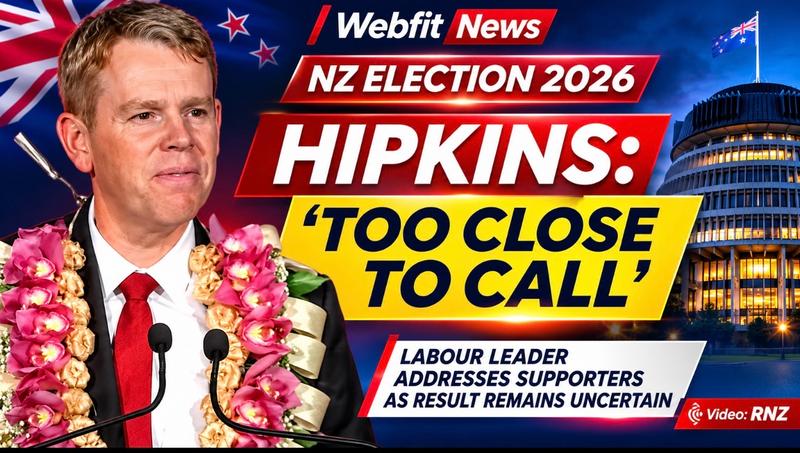
For Hipkins and Labour, the political contest is not necessarily settled by the first election-night projections. For National and its existing partners, a narrow lead offers an advantage but not a guaranteed continuation in government.
New Zealand has voted, but the question of who will govern remains open.
Video source: RNZ (Radio New Zealand), election-night coverage, 7 November 2026.
Election results source: New Zealand Electoral Commission.
Follow Webfit News’ election coverage and live results at:
https://poll.webfitnews.co.nz/results-2026
The political figures and coalition context are supported by contemporary election reporting. theguardian.com +3 The official-result timetable comes from the Electoral Commission. Elections NZ +1