From 11.6% to around 13%: What the numbers show
The Greens entered the 2026 election seeking to build on their 2023 performance, when they secured 330,915 party votes and 15 parliamentary seats.
Their official vote share at that election was 11.6%.
During Saturday’s preliminary count, the party’s share rose above 14% at one stage before moving closer to 13% as additional results arrived.
That movement is important. Election-night figures change as votes from different parts of the country are reported, and early percentages should never be mistaken for final results.
Even at approximately 13%, however, the Greens were polling above their previous official result.
The increase is particularly relevant in an election where National and Labour have each attracted less than 30% of the party vote.
The figures demonstrate that a substantial proportion of New Zealanders are choosing parties outside the country’s two largest political organisations.
For the Greens, that has meant an increased national vote share and the prospect of additional representation in Parliament.
Chlöe Swarbrick remains central to the Greens’ Auckland campaign
Auckland Central has again become an important electorate for the Green Party.
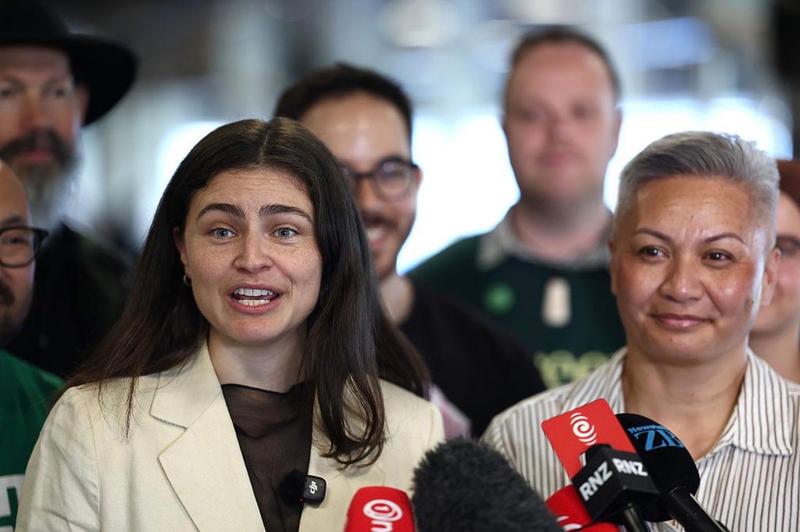
Chlöe Swarbrick, who first won the seat in 2020, was leading National candidate Candace Kinser during Saturday’s preliminary count.
Swarbrick’s position in Auckland Central reflects the party’s development beyond relying entirely on list MPs elected through the nationwide party vote.
Under New Zealand’s Mixed Member Proportional electoral system, voters cast two votes: one for a political party and another for their local electorate candidate.
The party vote generally determines each party’s overall entitlement to seats, while electorate results decide which local candidates enter Parliament directly.
Winning electorate seats therefore matters for the Greens’ local representation, even though an electorate victory does not normally add an extra seat on top of the party’s proportional entitlement.
Swarbrick’s Auckland Central contest remains an important part of the party’s election story, alongside its nationwide vote.
Wellington Bays becomes one of election night’s closest contests
If Auckland Central has provided an established Green electorate contest, Wellington Bays has delivered one of the night’s most closely watched races.
Green candidate Julie Anne Genter and Labour’s Craig Renney have been separated by exceptionally small margins during the count.
At one stage, Genter was ahead by just 62 votes, with more than 97% of voting places reporting.
Later updates showed the lead changing again as additional results were counted.
The contest is particularly interesting because it involves two parties that could potentially cooperate in Parliament but are competing directly for the same electorate.
For Genter and Renney, the outcome could ultimately be decided by a relatively small number of ballots.
Special votes remain outstanding, meaning even a completed preliminary count cannot necessarily determine the final winner in such a close contest.
Wellington Bays is a reminder that election night is not only about national party percentages. Individual electorate races can produce significant changes when the margins are this narrow.
Tamatha Paul and the Greens’ Wellington presence
The Greens have also been closely watched in Wellington North, where Tamatha Paul was leading during preliminary counting.
Wellington has become an important area of Green electoral support, particularly among voters who have previously elected Green candidates in central-city constituencies.
The party’s ability to compete in both Auckland and Wellington is significant because electorate representation gives it a direct constituency connection alongside its nationwide list representation.
However, these individual results remain subject to the official count.
Why the Greens’ result matters beyond the number of seats
A projected 16-member caucus would give the Green Party additional parliamentary representation compared with the 2023 official result.
That matters for the everyday work of Parliament.
MPs participate in select committees, examine proposed legislation, question ministers, represent constituents and contribute to parliamentary debates.
The Greens have campaigned on climate change, environmental protection, housing, public services and economic inequality.
Additional parliamentary representation could provide more capacity to pursue those policy priorities and scrutinise government decisions.
It would not, however, guarantee that the party could implement its programme.
That would depend on the final parliamentary composition, the positions of other parties and any agreements reached after the election.
Nor can the election-night figures establish exactly why individual voters supported the Greens. The party’s vote share is measurable, but conclusions about voter motivation require separate evidence.
The difficult reality: More Green votes do not necessarily mean a change of government
One of the most important distinctions emerging from the election is the difference between electoral gains and the ability to form a government.
Late preliminary projections indicated National, ACT and New Zealand First collectively holding approximately 66 seats in a 129-seat Parliament.
That would give the existing governing parties a narrow majority, with 65 seats required to govern.
Labour, the Greens and Te Pāti Māori remained short of that threshold on the same projections.
The Opportunity Party’s apparent entry into Parliament has added another complication, with approximately seven projected seats.
Its presence could become relevant to future parliamentary negotiations, particularly if special votes change the final distribution of seats.
But no party’s projected seat total should be treated as a confirmed coalition arrangement.
The Greens may emerge with more MPs and a stronger nationwide vote while still remaining outside government.
That is one of the central political realities of New Zealand’s proportional electoral system.
A changing political landscape
The Green Party’s performance is part of a wider election in which support has been spread across several parties.
National and Labour remain the two largest parties, but neither has commanded the level of nationwide support traditionally associated with a dominant election victory.
ACT and New Zealand First continue to hold substantial shares of the vote, while the Opportunity Party has emerged as another potentially significant parliamentary presence.
This distribution means the formation of a government depends on more than the relative performance of National and Labour.
It depends on the combined seat totals of parties prepared to work together.
For the Greens, increased representation would strengthen their presence in those parliamentary discussions, regardless of whether they ultimately participate in government.
The final count could still change the result
Election-night figures remain preliminary.
Special votes, including overseas votes, are counted after election day and can affect party-vote percentages, electorate margins and the allocation of parliamentary seats.
This is particularly important in closely contested electorates such as Wellington Bays.
The final size of Parliament may also be affected by overhang seats under MMP, which can change the majority threshold.
The Electoral Commission expects to declare the official election result on Friday, 27 November 2026.
Until then, projected seat numbers and closely contested electorate results remain provisional.
A significant election night for the Greens, but the bigger question remains
The Green Party’s election-night performance has delivered a clear development: its share of the national vote is higher than in 2023, and preliminary projections point towards an increase in parliamentary representation.
Chlöe Swarbrick’s Auckland Central contest, Tamatha Paul’s position in Wellington North and Julie Anne Genter’s closely fought Wellington Bays race have also placed Green candidates at the centre of several important electorate stories.
The result reflects a wider election in which smaller parties are playing an increasingly prominent role in the parliamentary arithmetic.
Yet the Greens’ gains have not produced a definitive answer to the question facing New Zealand.
Who will form the next government?
That answer depends on the official results and the political decisions that follow.
For the Greens, the vote share has increased. For New Zealand, the government question remains unresolved.
This report is based on preliminary election-night results from 7 November 2026. Party-vote percentages, seat projections and electorate margins are subject to change following the official count.
Sources: New Zealand Electoral Commission; RNZ election-night coverage; Associated Press; The Guardian.