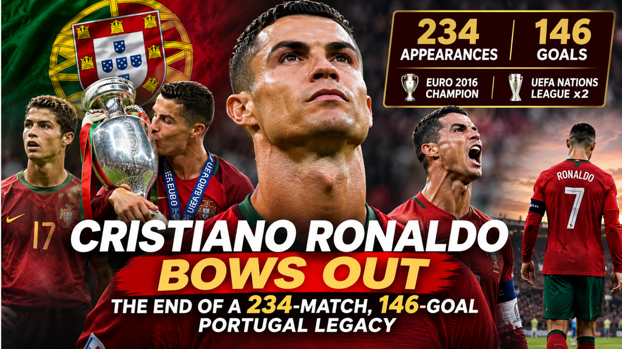
For a player who had been central to Portugal's footballing identity for more than two decades, it was an uncomfortable conclusion.
The man who once seemed indispensable had reached a point where his place in the team was being questioned.
And that brings us to the central issue behind Ronaldo's remarkable international career.
Was Portugal successful because everything revolved around Cristiano Ronaldo, or did the team eventually become strong enough to succeed without depending on him?
The answer is more revealing than any record.
A Farewell That Was About More Than Football
Ronaldo announced his decision through a social media message addressed to the Portuguese people.
He spoke of the privilege of representing his country, the responsibility of wearing its famous number seven shirt and the emotional difficulty of stepping away.
The announcement was significant not simply because a footballing icon was retiring, but because of what had happened in the weeks leading up to it.
Reports of his disagreement with Jorge Jesus exposed a difficult question facing almost every successful national team with an ageing superstar.
How do you manage a player whose reputation, achievements and influence are greater than those of almost everyone around him, while still making decisions based on the team's present needs?
A football manager must consider fitness, tactical balance, opposition, pressing intensity and the development of younger players.
A national icon, meanwhile, carries expectations built over decades.
Those priorities do not always align.
Ronaldo had already experienced a similar challenge during the 2022 World Cup, when his reduced starting role generated enormous attention.
The debate intensified again after Euro 2024, when questions were raised about his effectiveness in Portugal's attack.
His subsequent goals and Portugal's 2025 Nations League triumph demonstrated that he could still contribute.
But they did not eliminate the broader issue.
Portugal's future could no longer be organised indefinitely around one footballer.
That reality does not erase Ronaldo's achievements. It explains why the ending became so difficult.
The Records Are Extraordinary, but What Do They Actually Tell Us?
Ronaldo's international career began on 20 August 2003 against Kazakhstan.
He was 18 years old, had recently joined Manchester United and was entering a Portugal squad containing established stars such as Luís Figo and Rui Costa.
By the time his international journey reached its conclusion in 2026, he had played alongside several generations of Portuguese footballers.
His record is remarkable:
234 international appearances
146 international goals
10 international hat-tricks
Goals against 49 national teams
Goals in 23 consecutive calendar years, from 2004 to 2026
Six World Cup appearances
Six European Championship appearances
One European Championship title
Two UEFA Nations League titles
His average of approximately 0.624 goals per international appearance is impressive.
But the most extraordinary statistic may not be his scoring average.
It is the combination of scoring and longevity.
International football offers far fewer matches than club football. Players must remain fit, selected and effective across years of changing managers, tactics and teammates.
Ronaldo managed that for more than two decades.
His 200th appearance, against Iceland in June 2023, offered a perfect illustration of his career. Rather than simply reaching another milestone, he scored an 89th-minute winner.
For Ronaldo, records were rarely enough on their own.
He wanted to influence the result.
The 146-Goal Question: Where Did the Goals Come From?
One of the most important ways to understand Ronaldo's international career is to examine the distribution of his goals.
According to UEFA's statistical records, his 146 goals included:
41 in World Cup qualifying
41 in European Championship qualifying
22 in international friendlies
15 in the UEFA Nations League
14 at European Championship finals
11 at World Cup finals
2 at the FIFA Confederations Cup
This breakdown reveals something that is often missing from debates about Ronaldo's greatness.
More than half of his international goals, approximately 56%, came in World Cup and European Championship qualifying matches.
His 82 qualifying goals are an exceptional achievement.
But they also show that the international scoring record was built primarily through sustained performances across qualification campaigns, rather than through a handful of unforgettable World Cup matches.
That distinction matters.
A qualifying goal against a lower-ranked opponent and a winning goal in a World Cup knockout match both count as one international goal.
Their sporting significance, however, may be very different.
This is not an argument for dismissing qualification goals.
Portugal had to qualify for tournaments, and Ronaldo repeatedly delivered across those campaigns.
It is an argument for analysing records properly.
A player's international legacy involves both the volume of goals and the circumstances in which those goals were scored.
The Opposition Debate Nobody Should Ignore
Ronaldo's most productive international opponent was Luxembourg, against whom he scored 11 goals.
He scored nine against Hungary, seven each against Armenia, Lithuania and Sweden, and six against Andorra.
Critics have frequently pointed to goals against smaller nations when questioning his international scoring record.
The criticism deserves examination, but not exaggeration.
European qualification frequently places established football nations against teams with substantially fewer resources and a smaller pool of professional players.
Elite goalscorers benefit from those opportunities.
That is true of Ronaldo, and it is true of many other international stars.
However, the suggestion that Ronaldo built his reputation exclusively against weaker opposition does not survive scrutiny.
Consider his performances against Sweden in the 2013 World Cup play-offs.
Portugal were fighting for qualification, and Ronaldo scored all four of his country's goals across the two matches, including a hat-trick in Stockholm.
Those were not meaningless goals accumulated in an easy fixture.
They directly helped secure Portugal's place at the 2014 World Cup.
Or consider his hat-trick against Spain at the 2018 World Cup.
Against one of the strongest football nations in the world, Ronaldo scored three times in a 3-3 draw, including a late free-kick that remains one of the tournament's defining moments.
His Nations League hat-trick against Switzerland in 2019 also demonstrated his ability to influence major competitive fixtures.
The fair conclusion is neither that all 146 goals were equally important nor that the record was inflated beyond recognition.
Ronaldo scored against a wide range of opponents, in very different circumstances, over an extraordinarily long period.
The record deserves respect.
Its individual components deserve analysis.
The Most Revealing Statistic May Be Portugal's Results
Ronaldo scored in 96 different international matches.
Portugal won 81 of those games, drew eight and lost seven.
That means Portugal won approximately 84% of the matches in which he scored.
At first glance, this appears to demonstrate the enormous influence of his goals.
But there is an important statistical limitation.
Teams are generally more likely to win matches in which their leading striker scores.
To establish Ronaldo's precise effect on Portugal's results, researchers would need to compare those outcomes with Portugal's performance when he played but did not score, and when he did not play at all.
They would also need to account for the strength of the opposition.
Without those comparisons, the 84% figure demonstrates a strong association between his scoring and Portugal's victories, but not how many wins he personally caused.
This distinction is important because Ronaldo's career has generated an enormous amount of statistical debate.
Too often, numbers are used to support conclusions they cannot establish on their own.
The strongest assessment of his influence must examine the football as well as the statistics.
The 2004 Heartbreak That Defined a Generation
Ronaldo's first major international tournament was Euro 2004, hosted by Portugal.
He scored his first international goal against Greece in the opening match, but Portugal lost 2-1.
The hosts recovered and reached the final.
Waiting for them was Greece again.
Portugal entered the match carrying enormous expectations. A home European Championship triumph would have been a historic achievement.
Instead, Greece won 1-0.
Ronaldo was visibly devastated.
It was the first major international disappointment of a career that would contain several more.
The significance of that tournament becomes clearer when viewed alongside Euro 2016.
In 2004, Ronaldo was a young player in a team led by established stars.
By 2016, he was the captain, the most recognisable player and the figure around whom much of Portugal's international identity had developed.
Twelve years separated the two finals.
The emotional distance between them was even greater.
Euro 2016: Portugal's Greatest Victory and Ronaldo's Most Complicated Triumph
Portugal's European Championship victory in 2016 remains the defining collective achievement of Ronaldo's international career.
Yet the final against France presents an interesting contradiction.
Ronaldo began the match as captain but suffered an injury and was forced off during the first half.
He watched much of the contest from the sidelines.
In extra time, Éder scored the winner.
Portugal defeated France 1-0 and became European champions for the first time.
For Ronaldo, the triumph was deeply personal.
He had experienced the disappointment of losing the 2004 final as a teenager.
Now, as captain, he had helped lead his country to the trophy.
But the manner of victory also demonstrated something important.
Portugal could win its biggest match without Ronaldo on the pitch.
That does not diminish his contribution throughout the tournament.
It highlights the essential role of the wider team.
Football's greatest international achievements are rarely the work of one individual, regardless of how influential that player may be.
Portugal's victory required defensive organisation, resilience, tactical discipline and contributions from players who received far less international attention.
The 2016 final therefore offers two legitimate interpretations.
It was the crowning achievement of Ronaldo's international career.
And it was proof that Portugal's greatest success depended on more than Ronaldo.
Both can be true.
Six World Cups, 11 Goals and the Trophy That Never Came
Ronaldo appeared at six consecutive World Cups between 2006 and 2026.
He scored in every one of them, becoming the first male footballer to find the net at six different World Cup final tournaments.
He finished with 11 World Cup goals.
It is an extraordinary achievement, particularly given the physical demands of remaining internationally competitive across two decades.
Yet his World Cup career also contains a significant absence.
He never won the tournament.
Portugal reached the semi-finals in 2006, but Ronaldo never lifted the trophy that defines the careers of many of football's greatest international players.
His World Cup record also invites closer examination of his knockout-stage influence.
The distinction between scoring in group matches and deciding elimination matches is relevant when evaluating tournament performances.
Ronaldo's unforgettable hat-trick against Spain in 2018 came in the group stage.
His overall World Cup contribution cannot be measured by that performance alone.
Portugal's inability to turn his presence into a World Cup title was not solely his responsibility.
But neither should his individual scoring record be presented as though it settled every question about his impact at the tournament.
The missing World Cup is not a reason to dismiss Ronaldo's greatness.
It is a reminder that individual brilliance and collective achievement are not interchangeable.
How Ronaldo Reinvented Himself to Survive 23 Years
The Ronaldo who debuted for Portugal in 2003 was a very different footballer from the one who represented his country in 2026.
Early in his career, he was an explosive winger.
His game was built around acceleration, dribbling, creativity and the ability to beat defenders in wide areas.
Over time, his role changed.
He became increasingly focused on finishing, movement inside the penalty area, attacking crosses and finding space between defenders.
His aerial ability became one of his greatest weapons.
So did his capacity to recognise scoring opportunities before defenders reacted.
That transformation helped extend his career.
It also changed the demands he placed on the teams around him.
A younger Ronaldo could create chances through individual runs and repeated bursts of speed.
An older Ronaldo increasingly depended on teammates to deliver the ball into dangerous areas.
This was not necessarily a weakness.
It was a tactical evolution.
But it meant Portugal's coaches had to consider whether building attacks around his finishing ability remained the best approach as other attacking players developed.
That question became increasingly important during his later international years.
And it helps explain why his role eventually became a source of disagreement.
The Difficult Question: Did Portugal Become Too Dependent on Ronaldo?
For much of Ronaldo's career, Portugal's attacking identity was closely connected to his presence.
That relationship brought obvious benefits.
He was a reliable goalscorer, a commanding personality and a player capable of producing decisive moments under enormous pressure.
But dependence on an exceptional individual can create tactical problems.
If a team's attacking structure is designed primarily to create opportunities for one player, it may become less adaptable when that player is unavailable or ineffective.
As Ronaldo aged, Portugal developed a new generation of attacking talent.
Bruno Fernandes, Bernardo Silva, Rafael Leão and other players offered different qualities.
They could create chances, operate between defensive lines and contribute to more fluid attacking combinations.
The question facing Portugal's managers was no longer whether Ronaldo was a great player.
That had been established long ago.
The question was whether his role continued to maximise the effectiveness of the team.
Those are fundamentally different questions.
A manager can respect a player's achievements while concluding that another tactical arrangement is preferable.
Equally, a player with Ronaldo's record may reasonably believe his experience and scoring ability remain valuable.
The difficulty arises when those views cannot be reconciled.
The reported disagreement preceding his retirement illustrates that tension.
It would be simplistic to portray Ronaldo as solely responsible for the dispute without knowing the complete private discussions.
It would be equally simplistic to ignore the significance of a national captain leaving camp amid disagreement over his role.
The episode deserves scrutiny precisely because both the player's legacy and the team's future matter.
Ronaldo and Messi: Why the Greatest-of-All-Time Debate Needs Better Questions
Ronaldo's international retirement will inevitably revive comparisons with Lionel Messi.
The two have dominated discussions about footballing greatness for nearly two decades.
Ronaldo finished with 146 international goals in 234 appearances.
UEFA's figures as of 5 November 2026 list Messi with 126 goals in 208 appearances.
That gives Ronaldo an international scoring average of approximately 0.624 goals per appearance, compared with Messi's 0.606.
But international goalscoring averages cannot settle the debate.
Ronaldo and Messi played in different confederations, faced different qualification structures and operated within national teams with different tactical identities.
Their major international achievements also differ.
Ronaldo won Euro 2016 and the Nations League in 2019 and 2025.
Messi won the 2022 World Cup and Copa América titles with Argentina.
One player's record cannot simply be substituted for the other's.
Ronaldo's strongest case rests on his extraordinary scoring volume, longevity and repeated reinvention.
Messi's international achievements include reaching the pinnacle of world football with Argentina.
The debate is likely to continue because the two players excelled in different ways.
A more useful question is not simply which footballer accumulated the better numbers.
It is how each influenced the teams, opponents and generations around him.
Why Indian Football Fans Should Pay Attention to Sunil Chhetri
There is another international goalscoring story that deserves attention, particularly among Indian football supporters.
Former India captain Sunil Chhetri scored 95 goals in 157 international appearances.
UEFA's November 2026 records place him fourth among the leading scorers in men's international football, behind Ronaldo, Messi and Iran's Ali Daei.
His scoring average of approximately 0.605 goals per appearance is remarkably close to Ronaldo's international rate.
The comparison requires context.
India and Portugal operate in different football environments, with different competitive standards, resources and qualification systems.
But Chhetri's achievement remains exceptional.
He maintained an international scoring record that placed him among the most prolific players in football history despite representing a country where the sport has historically received less attention and investment than cricket.
For Indian football, his record should be more than a source of national pride.
It should prompt questions about why the country has struggled to convert individual achievement into sustained international progress.
A great goalscorer can inspire a generation.
Building a successful football nation requires much more.
That lesson applies to India just as it applies to Portugal.
What Ronaldo's Departure Means for Portugal
Portugal now faces an important transition.
For the first time in more than two decades, its national team must establish an identity without Ronaldo as its defining figure.
That will involve more than replacing his goals.
Ronaldo brought experience, leadership, international recognition and an ability to command attention from opponents.
He also brought expectations that influenced team selection, tactics and public discussion.
His departure removes both the benefits and the complications associated with that influence.
Portugal's next generation will have greater freedom to develop its own attacking identity.
But it will also face the pressure of delivering results without the player who had become synonymous with the national team.
The responsibility now rests with the coaching staff and emerging leaders.
They must demonstrate that Portugal's footballing progress is sustainable beyond one extraordinary individual.
That is the real test of the legacy Ronaldo leaves behind.
Will Anyone Ever Reach 234 Caps and 146 Goals Again?
Records are made to be broken, but Ronaldo's combination of appearances and goals presents a formidable challenge.
To reach 147 international goals at Ronaldo's scoring rate, another player would need approximately 236 appearances.
A player averaging ten internationals per year would require more than 23 years to reach 234 appearances.
Modern footballers face intense club schedules, injuries, changing international calendars and increasingly demanding tactical systems.
Maintaining elite international performance for more than two decades is therefore exceptionally difficult.
Younger stars such as Kylian Mbappé and Erling Haaland possess extraordinary scoring ability.
But neither talent nor a prolific start guarantees the longevity required to approach Ronaldo's records.
The eventual challenger would need sustained fitness, regular selection, international opportunities and exceptional consistency across several generations of teammates.
That combination is what makes Ronaldo's achievement so unusual.
His record was not built in one tournament or one remarkable season.
It was built over 23 years.
The Final Verdict: Portugal's Greatest Football Icon, but Not a Career Without Questions
Cristiano Ronaldo's international career deserves admiration.
He helped transform Portugal's sporting profile, scored more international goals than any other man and contributed to the country's greatest footballing achievements.
His longevity was extraordinary.
His determination to remain competitive into his forties was remarkable.
His influence on Portuguese football will extend far beyond his retirement.
But a serious assessment of his legacy must also acknowledge the difficult chapters.
Portugal never won a World Cup with him.
His effectiveness in major tournaments varied.
His later international role became increasingly controversial.
And his departure followed a reported disagreement over whether he should continue occupying a central place in the team.
None of those facts cancels his achievements.
They make the story more complete.
Great athletes are not defined only by their finest moments.
They are also defined by how their careers evolve, how they respond to changing circumstances and how their teams move forward when their influence begins to fade.
Ronaldo's 146 goals will remain in the record books.
His 234 appearances will remain a benchmark for future generations.
The 2016 European Championship and two Nations League titles will remain part of Portugal's footballing history.
But the most important measure of his legacy may emerge only after he has gone.
Can Portugal continue winning major trophies without him?
Can its younger players build a new identity without constantly being compared with the famous number seven?
And can the country celebrate everything Ronaldo achieved while accepting that even its greatest footballer could not remain indispensable forever?
Those questions will shape the next chapter of Portuguese football.
For 23 years, Cristiano Ronaldo carried Portugal's hopes.
Now Portugal must discover what it can become without him.
The records belong to Ronaldo. The future belongs to Portugal.
Sources and References
This article draws on official football records and international reporting available as of 6 November 2026.
FIFA, 5 November 2026: Ronaldo's international retirement, 234 appearances, 146 goals, six World Cups and major international trophies.
UEFA, 5 November 2026: All-time international scoring and appearance records, career milestones and international goalscoring rankings.
Reuters, 5 November 2026: Ronaldo's retirement announcement, his reported disagreement with Portugal coach Jorge Jesus and the circumstances surrounding his departure.
Sky Sports, 5 November 2026: Analysis of Ronaldo's Portugal career, international achievements and questions surrounding his later role.
The Guardian and Associated Press, 5 November 2026: International retirement reporting, historical context and national-team dispute.
UEFA historical statistical records: Ronaldo's goals by competition, opponents, European Championship achievements and international milestones.
Editorial disclosure: This is an independently written Webfit News analysis based on published reporting and official statistics. Interpretations concerning Ronaldo's tactical influence, team dependence and legacy are editorial analysis, not statements attributed to Ronaldo or Portugal's coaching staff.
Webfit News | International Sports Desk