It was used for regular two-hour scenic trips around Akaroa Harbour and surrounding coastal areas, taking passengers to see wildlife and geological features.
On the morning of 31 January, the vessel was moved to Akaroa's main wharf at about 10.07am.
The master and two crew members began boarding 38 passengers.
At about 10.45am, the Black Cat departed.
The master gave passengers a safety briefing covering the vessel's layout, emergency equipment and what passengers should expect in an emergency.
Nothing at that stage suggested the trip would become a serious accident.
The weather was described as calm.
The route before the accident
The Black Cat first travelled south along the eastern side of Akaroa Harbour.
At about 11.04am, it reached the Spotted Shag Rookery, where it remained for roughly 13 minutes while the master provided commentary.
It then continued to Cathedral Cave, arriving at about 11.25am and staying there for around 10 minutes.
Because conditions were calm, the master decided to take the vessel outside the harbour and visit Scenery Nook.
The catamaran arrived there at about 11.52am.
After spending about 15 minutes in the area, the master decided the vessel would visit Archway Rock while heading back towards Akaroa.
That decision led into the critical part of the journey.
Crew member noticed an unusual approach
As the vessel approached Archway Rock, one crew member noticed something that concerned them.
According to the interim report, the crew member looked through a window and saw that the Black Cat appeared to be approaching Archway Rock from an unusual direction.
They told the second crew member they were going to the bridge to discuss the concern with the master.
The second crew member went to the foredeck, where passengers were gathered, and began taking photographs of the scenery.
At about 12.12pm, that crew member took photographs of Archway Rock on a mobile phone.
Seconds later, people onboard felt a bump followed by a scraping sound.
Vessel's position aligned with a charted submerged rock
Investigators later used two independent sources to establish the Black Cat's position around the time of the impact.
One was the geolocation information stored in photographs taken immediately before the accident.
The second was data from a GPS tracker installed onboard the vessel.
According to TAIC, the location established from those sources aligned with a submerged rock shown on the chart.
The chart symbol identified an underwater rock for which the depth was unknown but which was considered dangerous to surface navigation.
At first, the master thought the vessel may have hit the float of a crayfishing pot.
Nothing obvious could be seen in the water.
Then, about a minute after the scraping sound, the vessel's bilge alarm activated.
That was the first clear indication onboard that something more serious had happened.
Water already near the top of the engine
The master handed the helm to one crew member and went below to investigate.
After entering the aft compartment and opening the starboard engine-room bulkhead door, the master discovered that seawater had already entered the engine room.
The water level was around the top of the engine.
The master immediately closed and secured the bulkhead door and returned to the bridge.
The flooding had become serious very quickly.
As the vessel passed the harbour entrance, smoke or steam could be seen entering the main cabin.
Passengers began to realise something was wrong.
Crew called nearby vessels for help
The master used VHF radio to contact two company vessels operating nearby.
The initial plan was to get the Black Cat close to a suitable beach where the vessel could either be beached or passengers could be evacuated more safely.
There were limited suitable beaches nearby, and the master chose a beach near Nikau Palm Gully.
But the vessel's systems were already deteriorating.
According to the report:
-
normal steering stopped working
-
the CCTV system failed
-
the public address system stopped working
-
the starboard engine and propulsion system stopped operating
-
the emergency steering system did not respond
The Black Cat was now taking on water while losing important control systems.
Additional bilge pump was not activated
One of the most important factual details contained in the interim report concerns the vessel's bilge pumping arrangements.
The Black Cat was equipped with four independent bilge-pumping systems:
-
a 24-volt electrically powered pump
-
a 230-volt electrically powered pump
-
an engine-driven pump
-
a manually operated bilge pump
The master instructed the two crew members to go to the aft compartment and start the engine-driven bilge pump.
However, TAIC says the crew members were not confident in how to operate the system.
As a result, that pump was not engaged.
The Commission has not yet published its final analysis of what role this played in the accident's outcome.
That distinction matters.
This interim report sets out established facts. The Commission's eventual final report will determine contributing factors, identify safety issues and make recommendations where appropriate.
Passengers ordered into lifejackets
The crew then shifted their attention to the passengers.
They began reassuring people and helping them put on lifejackets.
Passengers were initially mustered on the port side of the bridge deck.
TAIC estimates it took about 10 to 15 minutes for passengers and crew to finish putting on lifejackets.
By then, several other vessels had responded and were standing by to help.
Meanwhile, conditions onboard the Black Cat were getting worse.
Smoke or steam was filling the cabin.
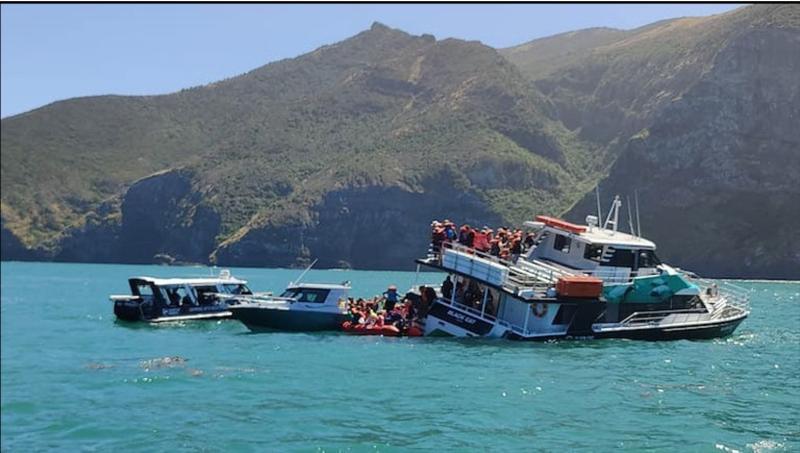
The vessel had developed a heavy list to starboard, and water was appearing on the starboard aft deck.
Most passengers had moved towards the port side.
Pan-Pan call broadcast at about 12.32pm
At about 12.32pm, the master transmitted a Pan-Pan urgency call over VHF radio.
A Pan-Pan signal indicates an urgent safety situation, although not necessarily one requiring an immediate distress declaration.
The radio message stated that the Black Cat was taking on water.
The report notes that the message referred to 38 people onboard, although the vessel had originally departed with 38 passengers and three crew.
By this stage, the master decided the passengers needed to leave the vessel.
38 passengers evacuated within minutes
The evacuation began soon afterwards.
Several nearby vessels assisted.
Smaller boats moved alongside the Black Cat's port stern and transported groups of passengers onto larger responding vessels.
By approximately 12.40pm, all passengers and one crew member had been evacuated.
The report says the evacuation was completed without significant issue.
That was a crucial outcome.
At one stage there had been 41 people aboard a flooding passenger vessel with a severe list, partial propulsion, failed steering and smoke or steam inside the cabin.
Yet no passenger suffered a reported injury.
Master and crew member remained onboard
After the passengers were off, the master and one crew member remained aboard.
The crew member checked the vessel to make sure nobody had been left behind and reported back to the master.
The master then continued trying to move the damaged vessel towards the beach.
Only the port-side propulsion system was still working.
That naturally caused the Black Cat to turn towards starboard, so the master occasionally used astern power to counter the turn.
Coastguard joined the response
A local Coastguard vessel, Ihenga Rescue, happened to be exercising outside Akaroa Harbour when its crew heard the Pan-Pan transmission.
There were five Coastguard volunteers and two potential recruits aboard.
They immediately headed towards the Black Cat.
When they arrived, Coastguard personnel could see the damaged vessel was settling lower in the water.
Ihenga Rescue carried a portable petrol-powered pump.
One Coastguard volunteer and one potential recruit boarded the Black Cat after passengers had been evacuated and attempted to pump water from the vessel.
They could see water moving around the starboard side of the aft deck.
But the flooding continued.
Seawater began flowing over the deck
As the master continued trying to reach the beach, the starboard hull sank progressively lower.
The vessel's starboard list increased.
Eventually, seawater began flowing over the top of the vessel's bulwark and onto the aft deck.
At that point, the remaining crew member and the two Coastguard personnel decided it was no longer safe to remain onboard.
They evacuated to nearby vessels.
The master continued trying to move the Black Cat towards shore.
Vessel grounded again at about 12.47pm
At approximately 12.47pm, the Black Cat grounded while approaching the beach near Nikau Palm Gully.
The master shut down the remaining port engine.
The master then left the vessel using a jet ski that had been standing by.
Every passenger and crew member was subsequently transferred safely back to Akaroa.
No injuries were reported.
What happened to the Black Cat afterwards?
The incident did not end when the passengers reached safety.
At 1.45pm, Environment Canterbury declared a Tier 2 regional oil-spill response.
Black Cat Cruises and its marine insurer then began salvage efforts over the following days.
Attempts to refloat and recover the vessel were unsuccessful.
Heavy weather eventually caused the Black Cat to break apart.
By 19 March 2026, all vessel fragments considered safe to collect had been recovered.
Environment Canterbury told TAIC that the environmental impact from the accident was minimal.
The vessel was ultimately recorded as a total loss.
What do we know about the vessel?
The Black Cat was built in Australia in 1994 and originally operated in Queensland's Whitsunday Islands.
Black Cat Cruises later brought the vessel to New Zealand.
It began operating from Akaroa in 2004.
The catamaran was 17.3 metres long and 7.1 metres wide.
It had two Yanmar diesel engines, one in each hull, each driving a conventional shaft and propeller.
What does the report say about the crew?
TAIC's report does not name the master or the two crew members publicly.
The Commission refers to the crew members as C1 and C2.
The master had significant maritime experience.
According to the report, the master gained an Australian Skipper 3 certificate in 1988 while working around the Great Barrier Reef.
After later moving to New Zealand, the master was issued a New Zealand Inshore Launch Master certificate in 2013.
They joined Black Cat Cruises in February 2025 and began sailing as master of the Black Cat on 1 December 2025, around two months before the accident.
Crew member C1 had worked aboard Black Cat since 2012 after earlier maritime experience in Doubtful Sound and Lake Manapouri.
Crew member C2 had worked in the company's office during the summer of 2025 before beginning work aboard Black Cat in November 2025.
Why has this report been released now?
This is an important distinction for readers.
The document released by TAIC is a Final Interim Report, not the Commission's final investigation report.
TAIC says interim reports can be issued during complex and continuing investigations to give the industry and public verified factual information before the entire inquiry is complete.
The Commission described this as a serious accident in which 41 people were at risk of significant harm, saying the level of public interest justified releasing factual information while the investigation continues.
TAIC began the inquiry on the same day as the accident after being notified by Maritime New Zealand.
Investigators travelled to Akaroa the following day and spent several days collecting evidence and conducting interviews.
A draft interim report was approved in May and circulated to interested parties for comment and factual checking.
The Commission received three submissions.
Any resulting changes were incorporated before commissioners approved the final interim report for publication on 31 July 2026.
What investigators have not decided yet
Readers should be careful not to treat today's report as TAIC's final judgment on why the accident happened.
The Commission has established important facts, including:
-
the vessel approached Archway Rock from a direction one crew member considered unusual
-
the impact location aligned with a charted submerged rock of unknown depth
-
the starboard hull was ruptured
-
flooding disabled several vessel systems
-
crew members were not confident operating the additional engine-driven bilge pump
-
the vessel developed a major starboard list
-
all passengers were successfully evacuated
But TAIC says its investigation remains ongoing.
Its eventual final report will contain the deeper analysis of the accident, its contributing factors, identified safety issues and recommendations.
Those conclusions could differ from information or interpretations based solely on this factual interim report.
A serious accident with a fortunate human outcome
The Black Cat grounding could have ended very differently.
Thirty-eight passengers and three crew members were aboard a vessel taking on seawater after one hull had been ruptured.
Steering failed.
One propulsion system stopped.
Emergency steering was unavailable.
The vessel developed a severe list.
Smoke or steam entered the passenger cabin.
And an additional pumping system was not successfully brought into operation.
Yet nearby vessels responded, passengers were moved into lifejackets and the evacuation was completed before the vessel's condition deteriorated further.
There were no reported injuries and no loss of life.
That is the most important human outcome from the events of 31 January.
The remaining question is what the maritime industry can learn from an accident that placed 41 people at serious risk.
That is the question TAIC's continuing investigation will now seek to answer.
Source
This report is based on the Transport Accident Investigation Commission's Final Interim Report MO-2026-201: Passenger vessel Black Cat grounding, entrance to Akaroa Harbour, New Zealand, 31 January 2026, published in August 2026.
Editorial note: TAIC investigates accidents to improve transport safety and prevent recurrence. Its statutory purpose is not to determine criminal, civil or regulatory liability.