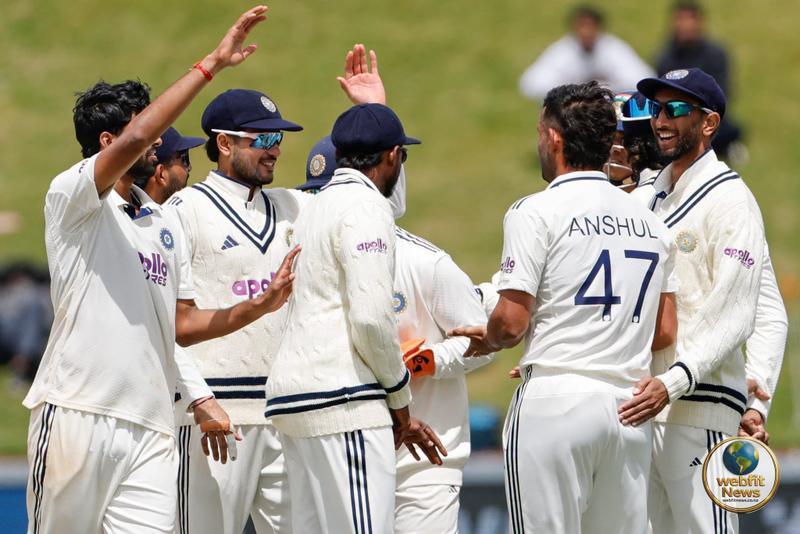
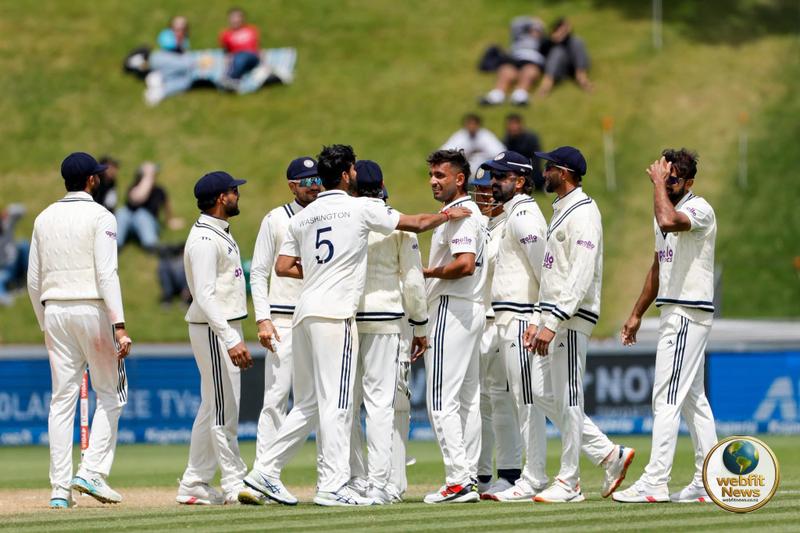
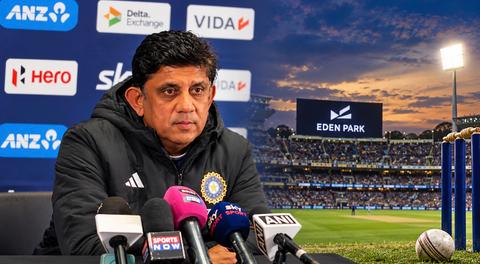
India made 720 and still could not win: Wellington draw leaves Test cricket with bigger questions
India dominated the scoreboard, New Zealand refused to disappear, and by the end both captains were questioning a ball that went soft and a Basin Reserve surface that seemed to...
India dominated the scoreboard, New Zealand refused to disappear, and by the end both captains were questioning a ball that went soft and a Basin Reserve surface that seemed to lose its teeth. Webfit News was in Wellington as a remarkable Test finished without a winner.
By Webfit News Sports Desk | Wellington | 24 November 2026
There are draws in Test cricket that feel inevitable.
This was not one of them.
India scored 720 for 9 declared.
They led by 352 runs.
They had New Zealand 70 for 5 in the first innings.
They bowled 241 overs across the match.
And with more than a session remaining on the final afternoon, New Zealand were five wickets down and still behind.
Yet India could not win.
New Zealand finished at 239 for 5 after 120 overs in their second innings, with Daryl Mitchell unbeaten on 49 from 186 balls and Glenn Phillips 26 not out from 126.
The first Test at the Basin Reserve ended in a draw.
On paper, that sentence looks ordinary.
Nothing about the five days that produced it was.
India won almost every contest except the result
India’s first-innings 720 was the highest Test total ever made in New Zealand.
KL Rahul made 136.
Rishabh Pant counter-attacked for 128.
Captain Shubman Gill fell two runs short of a century.
Yashasvi Jaiswal made 85, Devdutt Padikkal 80 and Dhruv Jurel 78.
India’s top order did not merely dominate. It exhausted New Zealand.
Jacob Duffy went for 201 runs from 33 overs. Glenn Phillips, called on for 24 overs of off-spin, took three wickets but conceded 154.
The visitors batted for 166 overs and left New Zealand needing to survive rather than realistically chase.
But this Test had already given one warning against assuming the scoreboard would behave normally.
New Zealand themselves had been 70 for 5 on the opening day.
Henry Nicholls then made an unbeaten 175, Glenn Phillips 118, and together they dragged the hosts to 368.
That partnership kept New Zealand alive.
Four days later, another partnership saved them.
Mitchell and Phillips did not chase the game. They killed the clock.
At 176 for 5 in the second innings, New Zealand were still vulnerable.
India had broken through often enough to believe the final five wickets might follow.
They did not.
Mitchell and Phillips batted together for 43 overs.
Their unbeaten sixth-wicket partnership produced just 63 runs from 258 balls.
Normally, those numbers would look painfully slow.
On Monday, they were exactly what New Zealand needed.
Mitchell finished one short of a half-century. Phillips scored 26.
Neither appeared interested in aesthetics.
The job was survival.
New Zealand captain Tom Latham later described the pair as calm and clear about what was required.
That was exactly how it looked from the ground.
There was no attempt to manufacture a dramatic finish. No interest in chasing a target that had long since disappeared.
They simply made India bowl again.
And again.
And again.
Eventually, the pitch won the argument.
The strange sight of Wellington without slips
Perhaps the most revealing image of India’s frustration was not the scoreboard.
It was the field.
For long periods, India bowled without a conventional slip cordon.
Gill said after the match that India bowled roughly 100 overs of New Zealand’s second innings without slips.
Think about that for a moment.
A Test match in Wellington.
Fast bowlers operating with a Kookaburra ball.
And almost no expectation that an outside edge would carry.
That tells you more about the surface than any adjective can.
The Basin Reserve traditionally offers pace, carry and enough movement to keep wicketkeepers and slip fielders interested.
This surface behaved differently.
The grass remained.
The menace disappeared.
Gill said India expected far more assistance when the match began.
“On day three, four and five, it just went flatter and flatter,” he said after the draw.
The surface did not break up in the way India hoped.
There were no significant cracks or rough areas creating unpredictable bounce.
Instead, the pitch slowed.
Occasionally a delivery stayed low, but because the surface itself lacked pace, batters often had enough time to adjust.
India were not beaten by New Zealand in the conventional sense.
They were gradually denied the tools normally used to finish a Test.
Then came Gill’s bigger question: what is happening to the cricket ball?
Gill did not restrict his concern to the pitch.
He also questioned the durability of the Kookaburra ball.
“The quality of the ball matters a lot,” Gill said.
He said India found their first ball becoming noticeably soft after only 25 to 30 overs.
That, he argued, changes the entire geometry of dismissing a batter.
A hard ball can swing.
It can seam.
An outside edge can carry to the wicketkeeper or slips.
Once the ball becomes soft, particularly on a slow surface, those possibilities disappear quickly.
Gill said he could understand a ball becoming softer after 50 overs.
What concerned him was how early it happened.
“I don’t know whether the quality of the balls is not what it used to be, or whether something else is happening,” he said.
This was not simply post-match frustration from the losing side.
Because India did not lose.
And more importantly, New Zealand captain Tom Latham agreed with him.
Latham said Gill was “spot on” about the ball becoming soft.
He noted that after the first ten overs or so with the new ball, it did not retain the hardness, carry or swing generally associated with New Zealand conditions.
When captains from both sides are raising the same issue, the discussion deserves to move beyond the result.
Gill also wants cricket to reconsider the saliva ban
The Indian captain went further.
He questioned why players are still prohibited from using saliva to maintain the ball.
The restriction originated during the Covid-19 period and was later incorporated permanently into cricket’s laws.
Gill believes the game should revisit it. “We are way past Covid times,” he said.
His argument is straightforward.
If the ball is losing its condition too quickly, and players are limited in how they can maintain one side of it, bowlers are being progressively removed from the contest.
On a responsive pitch, that may matter less.
On a surface like Wellington’s, it can become decisive.
The debate is unlikely to end with one press conference.
But Gill has put it back on cricket’s agenda.
Sourav Ganguly sees another problem: where was the specialist spinner?
Former India captain Sourav Ganguly approached the draw from another direction.
He praised India’s performances across the tour but questioned the balance of the Test side.
In comments following the Wellington match, Ganguly argued that touring teams still need a frontline specialist spinner, particularly on surfaces that become flatter as a Test progresses.
“India have played excellent cricket throughout this series, whether white-ball or red-ball cricket, and the batters have also performed very well,” Ganguly said.
“But the team has to understand that if you want to win Test matches overseas, you need a good specialist spinner, especially on pitches that flatten out with time.”
Ganguly said Washington Sundar can play as an all-rounder but questioned the absence of a specialist option.
“In Test cricket, you should play a specialist spinner. Washington Sundar can play as an all-rounder, but where are Kuldeep Yadav or Manav Suthar?”
It is a legitimate selection debate.
But Wellington also showed the limits of assuming one different player would automatically have changed the result.
Washington bowled 55 overs across the match, including 35 in New Zealand’s second innings.
He dismissed Conway on the final day and repeatedly attacked into the wind.
Yet even spin found little deterioration to work with.
A specialist spinner may have asked different questions.
Whether the surface would have answered them is another matter.
Harsha Bhogle: “Not a good thing for cricket”
Commentator Harsha Bhogle also focused on the combination of pitch and ball.
He backed Gill’s concerns about balls becoming soft too quickly and called for the issue to be examined seriously.
Bhogle said a ball “should not become soft within 25 or 30 overs” and argued that cricket authorities need to pay attention.
His concern was broader than India’s inability to win.
On the final day in Wellington, there was almost nothing in the surface for the bowlers, he noted: little pace, little movement and a ball that had already lost much of its effectiveness.
His conclusion was simple.
That balance, he said, is “not a good thing for cricket”.
Could Gill have attacked harder?
There will still be questions about India.
There should be.
Gill rotated his quicks frequently on the final day.
Jasprit Bumrah bowled only 11 overs across four short spells.
Prasidh Krishna, arguably India’s most threatening bowler once the surface flattened, also operated in controlled bursts.
Could India have pushed harder?
Could Bumrah have bowled one longer spell?
Could the field have stayed more aggressive?
Could short leg have been used earlier against Mitchell?
One moment in particular will sting.
Mitchell, on 12, was involved in a mix-up that could have produced a run-out, but Akash Deep failed to gather the ball cleanly.
Later, Mitchell gloved a Prasidh delivery into an area where a short leg might have been stationed.
There was no fielder there.
Those are the tiny moments through which drawn Tests are debated afterwards.
Gill, however, made the calculation clear.
India’s fast bowlers had already shouldered enormous workloads.
Bumrah finished the match with 49 overs.
Prasidh bowled 45.
Anshul Kamboj 45.
Akash Deep 43.
The second Test begins at Hagley Oval in Christchurch on 27 November.
India could chase five wickets at any physical cost.
Or they could recognise what the pitch was telling them.
Gill chose the latter.
“You see how many chances or half-chances your bowlers are creating,” he explained.
“If that’s not happening that often, it becomes a difficult job for the bowlers.”
That was less surrender than risk management.
New Zealand know they escaped
There was no triumphalism from the Black Caps.
Latham acknowledged the pressure his team had been under.
New Zealand were five down for 70 on the opening morning and eventually conceded a 352-run first-innings lead.
They spent 166 overs in the field.
Then they were asked to bat for survival.
Latham said his side was understandably pleased to come away with a draw from that position.
Player of the Match Henry Nicholls described it as a pleasing result after an “attritional” five days.
Nicholls deserved the award.
His unbeaten 175 was the innings that prevented India from effectively ending the Test on day one.
Phillips’ 118 beside him turned 70 for 5 into 286 for 6 before New Zealand eventually reached 368.
Without that stand, there may have been no fifth-day escape to discuss.
The scoreboard says draw. The match says something more complicated.
India were the better team for much of this Test.
That should not be controversial.
They reduced New Zealand to 70 for 5.
They took a 352-run lead.
They scored 720.
They created enough pressure to have New Zealand five wickets down with more than a session remaining.
But Test cricket is not awarded on dominance.
It is awarded on 20 wickets.
India took 15.
New Zealand found a way to protect the remaining five.
That is why dismissing the result simply as a “bad pitch” also does New Zealand a disservice.
Mitchell still had to survive 186 deliveries.
Phillips still had to survive 126.
Conway made 65 from 165.
Rachin Ravindra occupied 129 balls for 37.
There was skill in that resistance.
There was discipline.
There was also a surface increasingly unwilling to punish mistakes.
All three things can be true at once.
Wellington has reopened an argument Test cricket cannot ignore
The debate coming out of this Test should not be reduced to whether India selected the wrong spinner or whether Gill should have bowled Bumrah for another five overs.
Those are tactical questions.
The more important one is structural.
In the World Test Championship era, teams are repeatedly told that every Test matters.
Winning carries enormous value.
Yet a surface that becomes progressively slower, combined with a ball both captains believe loses its effectiveness too early, can gradually remove the possibility of a result regardless of how dominant one team becomes.
That is the uncomfortable question Wellington has left behind.
A good Test pitch does not have to produce a result.
Nor should every fifth-day surface become a minefield.
Batters are entitled to succeed.
Defence is part of Test cricket.
So is survival.
But the game works best when both disciplines retain a realistic route to victory.
At the Basin Reserve, by late Monday afternoon, one of those routes had almost disappeared.
India could still bowl.
New Zealand could still defend.
But the surface had largely stopped negotiating.
Christchurch now becomes more than a series decider
The series moves to Hagley Oval on Friday with the score still 0-0.
Both teams received four World Test Championship points from Wellington.
For New Zealand, the draw was a recovery from a position that could easily have become a heavy defeat.
For India, it will feel much closer to an opportunity left behind.
And for the people responsible for preparing the next surface, Wellington has supplied plenty to think about.
Nobody should want a manufactured result.
But nobody should want five days of high-level cricket to reach a point where bowlers can operate for 100 overs without slips because nobody seriously expects the edge to carry.
India made 720 and still could not win.
New Zealand survived 120 overs and deserved their draw.
Both captains then agreed the ball was losing its hardness too quickly.
Perhaps that is the real story of Wellington.
Not that one side failed to finish the job.
Not that the other somehow escaped.
But that after five days, the players themselves were asking whether the equipment and the surface had allowed the contest to remain balanced for long enough.
That is a question bigger than one drawn Test.
And cricket would be unwise to ignore it.
Final score: New Zealand 368 and 239/5 drew with India 720/9 declared. Henry Nicholls was named Player of the Match for 175 not out and 31.