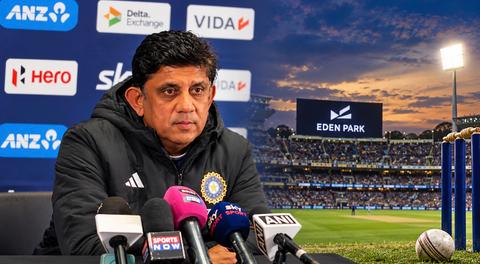
Asked whether the draw felt like a win, Latham smiled at the suggestion.
“I guess so, yeah, looking at the position we were in,” he said.
Then came the line that best summed up New Zealand’s week.
“Yeah, I guess that’s one we’ve probably got away with.”
It was honest.
And it was accurate.
New Zealand had to save the Test twice
The first rescue came on day one.
With India’s quicks exploiting the early movement, New Zealand slipped to 70 for 5 and appeared in danger of being dismissed cheaply.
Henry Nicholls and Glenn Phillips changed that.
Their partnership carried New Zealand back into the match, with Nicholls eventually finishing unbeaten on 175 and Phillips making 118.
Latham said New Zealand took confidence from the way they absorbed that pressure.
“The amount of pressure that we were put under, to then be in a position where we got 360 or 370, we were reasonably happy,” he said.
He highlighted Nicholls and Phillips for rebuilding in conditions that still offered assistance to the bowlers.
That first recovery kept New Zealand alive.
The second saved the Test.
Mitchell and Phillips turned survival into an art
By the final afternoon, runs were almost irrelevant.
Time was everything.
Daryl Mitchell and Glenn Phillips understood that immediately.
Mitchell finished unbeaten on 49 from 186 balls.
Phillips made 26 not out from 126.
Together, they batted for 43 overs and closed the door on India.
Latham praised the clarity of their approach.
“They looked really clear, looked really calm,” he said.
He said New Zealand had not been in that type of situation for some time, where the task was not to chase a total but simply to absorb pressure and survive.
“They adapted to what was required and played what was in front of us,” Latham said.
That, more than anything, was the difference on day five.
There was no need for heroics.
No need to counterattack.
No need to win a session.
They just had to remain there.
“He’s a guy for a bit of a crisis”
Mitchell’s innings drew particular praise from his captain.
Latham described him as one of New Zealand’s most dependable players when a match becomes difficult.
“He’s a guy for a bit of a crisis,” Latham said.
“He’s played some really important innings for us all around the world, in different situations, whether it be attacking, whether it be defending.”
Latham said Mitchell’s love of Test cricket showed in the way he approached the final day.
“He put his hand up today, which was great.”
That phrase could describe much of Mitchell’s Test career.
His value is not always measured by how quickly he scores.
Sometimes it is measured by how long he refuses to leave.
Latham agrees: this was not a traditional Basin pitch
Latham was also candid about the surface.
He said it was not the sort of Basin Reserve wicket New Zealand had become accustomed to.
“A traditional Basin wicket is where it keeps its pace and bounce,” he said.
“We probably didn’t necessarily see that from day two onwards.”
That assessment closely matched Shubman Gill’s.
The Indian captain had already said the surface became flatter and slower as the match progressed.
Latham did not complain.
His point was simpler.
Adapt.
“You’ve got to find a way at the end of the day,” he said.
That became New Zealand’s theme across the five days.
When the ball moved, they survived.
When India scored 720, they stayed patient.
When the equation became purely about time, they changed their batting accordingly.
Latham backs Gill on the soft ball
There was one issue on which both captains were almost completely aligned.
The Kookaburra ball.
Gill said after the match that the ball had been going soft unusually early, sometimes after only 25 or 30 overs.
Latham agreed.
“I think he’s spot on in terms of the ball,” he said.
Latham said that after the first 10 overs with the new ball, conditions changed significantly.
In traditional New Zealand conditions, the ball tends to remain harder, carry better and swing for longer.
That did not happen in Wellington.
“As you saw throughout the game, the ball tended to get soft,” Latham said.
He stopped short of joining Gill’s call to restore the use of saliva, saying those rules were not for him to determine.
But on the condition of the ball itself, there was little disagreement between the captains.
India’s unusual fields told New Zealand everything
India’s desperation for wickets produced some unusual fields.
For long periods they operated without slips and crowded catching positions in front of the bat.
Latham understood why.
The pitch had stopped offering the traditional outside-edge dismissal.
Instead, India tried to bring bowled and lbw into play.
Latham said match situations dictate those plans and acknowledged that India had the freedom to be far more aggressive because of their enormous lead.
“They’re well ahead of the game, plenty of runs to play with, so you’re able to do things slightly differently,” he said.
New Zealand had faced the opposite problem while India were batting.
Their bowlers needed wickets but also had to control the scoring.
India, on day five, had only one objective.
Take five wickets.
They could not find them.
A draw that matters in the World Test Championship
There was also a wider significance to New Zealand’s survival.
Latham believes the World Test Championship has changed the value of draws.
“The introduction of the World Test Championship has put a lot of context into Test cricket,” he said.
New Zealand had recently been near the top of the standings, and every point now matters.
That meant avoiding defeat was not simply an emotional victory.
It had championship value.
“It was nice to come away with the draw here,” Latham said.
“Not just falling over and ending the game. Draws become important as well.”
For a side that spent large portions of the match under pressure, four points were far better than none.
Nicholls’ return has given New Zealand something important
Latham also reserved praise for Henry Nicholls.
The left-hander’s unbeaten 175 was the innings that prevented India from taking complete control on the opening day.
Latham said Nicholls had effectively forced his way back into the side through domestic performances.
“He’s just really clear in what he’s doing, knows his role,” he said.
The captain praised Nicholls’ ability to absorb pressure early and then counterattack when the opportunity arrived.
For New Zealand, that matters beyond Wellington.
Nicholls brings experience to a batting group that will face more difficult Test cricket over the coming months.
And after this performance, his place looks considerably more secure.
Christchurch will ask a different question
The series now moves to Hagley Oval.
Latham expects conditions there to be more familiar.
Traditionally, Christchurch offers more pace and assistance for seam bowling than Wellington provided after the opening day.
But he was reluctant to make assumptions.
New Zealand will inspect the surface before deciding whether to alter the balance of their attack.
The workload of the fast bowlers will also be monitored carefully.
Latham said New Zealand have depth in their pace resources and will assess each bowler before the second Test.
That is important after India forced them to spend 166 overs in the field.
New Zealand did not win. But they refused to lose.
That distinction matters.
A draw can sometimes feel empty.
This one did not.
New Zealand were behind for almost the entire Test.
India were the better side for long stretches.
They batted longer.
They scored far more runs.
They created the stronger winning position.
But New Zealand survived every point at which the match threatened to break completely away from them.
Nicholls and Phillips rescued the first innings.
Conway and Ravindra absorbed pressure in the second.
Mitchell and Phillips finished the job.
And Latham was honest enough afterwards not to dress it up as anything more than it was.
They escaped.
But escaping a Test from that position still requires skill.
It requires patience.
It requires players willing to bat differently from how they normally would.
And it requires accepting that sometimes the most valuable thing a Test team can do is simply refuse to disappear.
New Zealand did exactly that in Wellington.
They did not win the Test. But by the end of day five, India had done almost everything possible and still could not beat them.
Photo courtesy: New Zealand Cricket