KL Rahul's 136 against New Zealand completed a rare achievement for an Indian Test opener. After waiting more than a decade for his first Test in New Zealand, he now has centuries in South Africa, England, New Zealand and Australia. But his story goes beyond one innings or one format of cricket.
By Webfit News | Wellington | 21 November 2026
WELLINGTON: Some cricketing achievements become even more impressive when you consider how long a player has waited for the opportunity.
KL Rahul made his Test debut in December 2014. Yet it took until November 2026 for him to play his first Test match in New Zealand.
And when that opportunity finally arrived, he made it count.
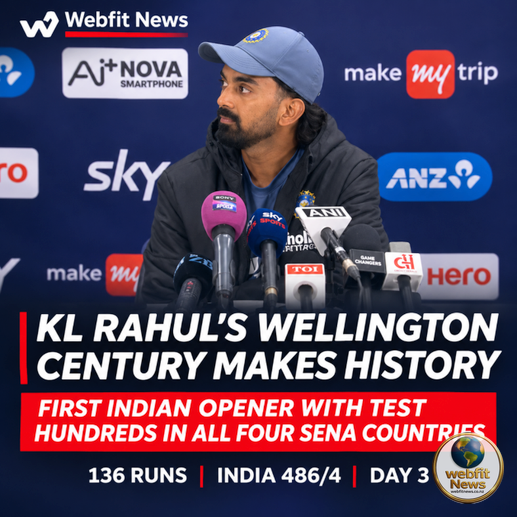
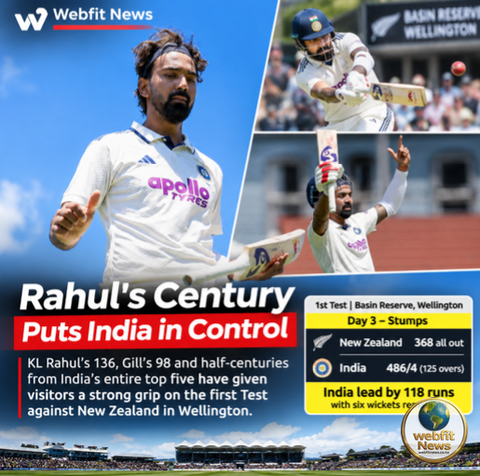
Rahul scored a composed 136 at Wellington's Basin Reserve on Saturday, helping India reach 486/4 at stumps on Day 3 and establish a 118-run first-innings lead.
It was his 13th Test century, but this one carried a special distinction.
Rahul became the first Indian opening batter to score Test centuries in all four SENA countries: South Africa, England, New Zealand and Australia.
Among Asian opening batters, only Pakistan's Saeed Anwar had previously completed that particular achievement.
For a cricketer who has moved between batting positions, experienced periods outside India's Test XI and adapted to different formats, the milestone says a great deal about his ability.
A long wait for New Zealand, a century on his first opportunity
Rahul's achievement becomes more interesting when viewed against his career.
Despite playing Test cricket for more than a decade, he had never previously appeared in a Test in New Zealand.
That does not mean he had never been considered good enough. Selection combinations, injuries, form and scheduling can all affect when an international player gets an opportunity in a particular country.
But it does underline something remarkable about his career.
Rahul has had to adapt repeatedly, both to his place in the team and to the demands of international cricket.
When his chance finally came in Wellington, he arrived prepared.
Speaking after Day 3, Rahul revealed that he had been thinking about playing Test cricket in New Zealand for six or seven months.
He studied footage of successful overseas batters, worked on his technique and spent considerable time in the nets.
He also arrived early to become familiar with local conditions.
The preparation was extensive, but his approach during the innings remained simple.
Trust the defence. Leave the deliveries that do not need to be played. Make the bowlers work.
Then score when the opportunities arrive.
The record that puts Rahul in rare company
SENA is the cricketing abbreviation for South Africa, England, New Zealand and Australia.
These countries have traditionally presented significant challenges for visiting opening batters, particularly because of seam movement, swing, bounce and unfamiliar conditions.
Rahul has now scored Test centuries as an opener in all four.
Country
Notable Test century
Australia
110, Sydney, 2015
England
149, The Oval, 2018
South Africa
123, Centurion, 2023
New Zealand
136, Wellington, 2026
He is the first Indian opener to complete the set and the second Asian opener after Saeed Anwar.
Other Indian batters, including Sachin Tendulkar, Rahul Dravid, Mohammad Azharuddin and Virat Kohli, have scored Test centuries in all four countries, but Rahul's distinction specifically concerns doing so as an opening batter.
That is important because opening the innings brings its own demands.
An opener often faces the newest ball, the freshest bowlers and the most challenging period of an innings.
Rahul has now demonstrated that he can meet those demands across four very different overseas environments.
The versatility that makes Rahul different
There is another aspect of Rahul's career that deserves attention.
He is not simply a specialist Test opener.
Across international cricket, he has been asked to perform very different roles.
In Test matches, he has opened the batting against some of the world's strongest pace attacks.
In one-day internationals, he has adapted to middle-order responsibilities, including batting at number five and managing the closing stages of an innings.
And in T20 internationals, he has demonstrated an entirely different scoring range.
His unbeaten 110 against the West Indies in 2016 was, at the time, the highest individual T20I score by an Indian batter.
That record has since been surpassed, but the innings remains evidence of his attacking ability.
Consider the contrast.
Format
Rahul's role and strengths
Test cricket
Opening the innings, absorbing pressure and building long innings
ODI cricket
Middle-order batting, adapting to match situations and finishing innings
T20 cricket
Attacking batting, boundary-hitting and rapid scoring
These roles demand different approaches.
A Test opener may need to leave dozens of deliveries outside off stump.
An ODI middle-order batter must often judge when to rebuild and when to accelerate.
A T20 batter may have only a few overs to influence the match.
Rahul has shown that he can operate across all three formats.
That versatility is one of the most impressive aspects of his international career.
What Rahul revealed about his preparation
At the post-Day 3 press conference, Rahul explained that he had studied players who had succeeded in New Zealand.
He watched footage of Joe Root and Harry Brook, among others, to understand how different batters approached local conditions.
He also drew lessons from former England captain Alastair Cook, particularly the discipline of leaving deliveries outside off stump.
Rahul acknowledged that he could not simply copy another player's method.
Instead, he worked with his coach to develop an approach that suited his own strengths.
He said the process had taken four or five months.
The result was visible in Wellington.
Rahul did not begin Saturday by attacking New Zealand's bowlers.
India resumed on 159/1, still 209 runs behind, and the morning demanded patience.
Five of the first six overs were maidens.
Rahul and Devdutt Padikkal resisted the pressure, allowing India to settle before increasing the scoring rate.
It was an innings built on judgement rather than urgency.
The partnership that helped India take control
Rahul's century was the foundation of India's dominance, but the supporting performances were equally important.
Yashasvi Jaiswal had scored 85 on Day 2, helping India establish a strong opening partnership.
Padikkal then contributed 80, maintaining the pressure on New Zealand's bowlers.
Shubman Gill followed with an attacking 98, falling just two runs short of a century in the final over of Day 3.
Rishabh Pant remained unbeaten on 55.
For the first time in an away Test, all five of India's leading batters reached at least fifty.
It was a remarkable collective effort.
New Zealand had recovered from 70/5 to score 368 in their first innings, thanks largely to Henry Nicholls' unbeaten 175 and Glenn Phillips' 118.
India's response demonstrated the depth and discipline of their batting.
By stumps, the visitors were 118 runs ahead with six wickets remaining.
Rahul's lighter moment with Glenn Phillips
The press conference also offered a glimpse of Rahul's humour.
Asked about a close appeal that New Zealand chose not to review, Rahul joked that he owed Glenn Phillips a few drinks.
Rahul explained that he had been uncertain whether the ball had struck him outside the line of off stump.
Phillips, however, apparently believed Rahul had hit the ball and advised against reviewing.
Rahul recalled the nervous wait while the New Zealand players considered their decision.
It was a lighter moment after an innings requiring hours of concentration.
And it reflected the personality behind the technically disciplined batting.
The challenge is not over
Despite India's strong position, Rahul was cautious about predicting the result.
He acknowledged that the Basin Reserve surface had become favourable for batting.
But he also noted that occasional deliveries were keeping low or moving unexpectedly.
Rahul expects the pitch to show further wear over the final two days.
That could create opportunities for India's bowlers, including Washington Sundar.
He also believes India must give themselves enough time to take ten New Zealand wickets.
The visitors will need to balance adding runs with leaving sufficient time to force a result.
For Rahul, the immediate priority is not celebrating an individual milestone.
It is helping India win the Test.
Webfit News analysis: More than a century, this is a story of adaptability
Rahul's Wellington innings deserves recognition for the record it completed.
But the wider significance lies in the kind of cricketer he has become.
He has opened the batting in difficult overseas conditions, moved into the middle order when the team required it and demonstrated his attacking ability in limited-overs cricket.
His career has not been a continuous run of success.
There have been periods of inconsistent form, changes in selection and questions about his place in the side.
Yet his response has repeatedly involved returning to preparation, refining his approach and finding ways to contribute.
That is why the Wellington century stands out.
It was not simply a talented player producing another hundred.
It was a cricketer finally receiving an opportunity in a country where he had long wanted to play Test cricket, and arriving with a plan developed over several months.
Rahul's record across the SENA countries confirms his quality as an overseas Test opener.
His performances in ODIs and T20Is demonstrate a different strength: the ability to change roles without losing the fundamentals of his batting.
A Test opener who can survive the new ball overseas. An ODI batter who can adapt to the middle order. A T20 player capable of scoring a rapid international century.
Not many players can point to that range of experience.
And perhaps that is the most compelling part of Rahul's story.
After more than a decade in international cricket, he is still finding new ways to demonstrate his value.
What a cricketer. And what a way to mark his first Test in New Zealand.
Match at a glance
India vs New Zealand | 1st Test | Day 3 | Basin Reserve, Wellington
Team
First innings
New Zealand
368 all out
India
486/4
India lead by 118 runs with six wickets remaining.
Reporting basis: KL Rahul's post-Day 3 press conference in Wellington, match scorecard and published cricket records. Webfit News analysis examines his preparation, overseas Test achievements and versatility across international formats.