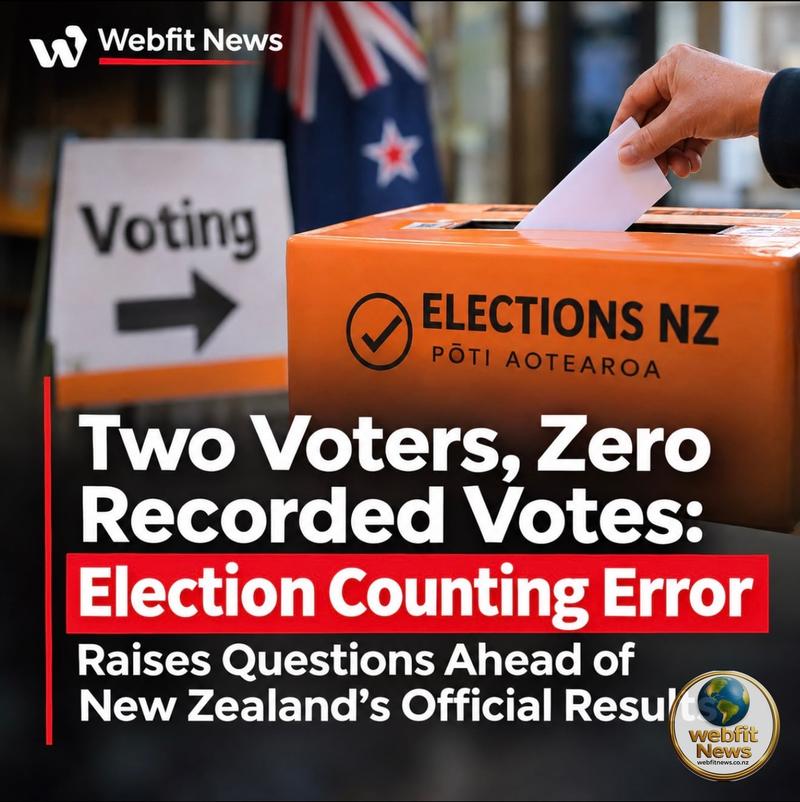
The discrepancy emerged after two voters told Queenstown-based news outlet Crux that they had cast their votes for the Opportunity Party at an Arrowtown polling booth.
According to the preliminary polling-place results, however, the party had received no votes at that location.
The apparent contradiction prompted questions about whether the votes had been counted correctly.
The Electoral Commission subsequently confirmed that the discrepancy resulted from a mistake when figures were entered into the election reporting system after voting closed.
Chief Electoral Officer Karl Le Quesne described the issue as a transposition error during election-night data entry.
The Commission said the correct figures were recorded during the second count of ordinary votes.
This distinction matters.
The identified problem was with the preliminary reporting of votes, not confirmed evidence that ballot papers had disappeared or that votes had deliberately been excluded.
The Commission has not indicated that the Arrowtown discrepancy changed the allocation of parliamentary seats.
Why Election-Night Results Can Contain Mistakes
New Zealand’s election-night results provide an early picture of how the country has voted.
They are not the final verified results.
Votes cast before election day and on election day are counted manually, with figures reported from polling places and entered into the election reporting system.
Although ballot papers are counted by hand, recording and transferring the totals still involves human input.
Errors can occur when numbers are entered incorrectly, transposed or assigned to the wrong field.
That is why the Electoral Commission conducts a second count of ordinary votes as part of the official counting process.
The Commission has explained that preliminary figures are indicative and may contain errors that are identified and corrected during verification.
In the Arrowtown case, the discrepancy was corrected during that process.
The incident illustrates why the election-night count and the official count serve different purposes.
One provides an early indication of the result. The other establishes the verified outcome.
Electoral Commission Confirms Second Count Completed
In an official update issued on 18 November, the Electoral Commission confirmed that all ordinary votes cast before and on election day had been counted for a second time.
It also reported progress on several other verification activities.
These included checking electoral rolls, returning special votes to their home electorates and receiving overseas votes back in New Zealand.
The remaining work involves checking special-vote eligibility, completing the special-vote count and conducting further quality-assurance checks.
Chief Electoral Officer Karl Le Quesne said the Commission remained on schedule to publish the official results on 27 November.
The Commission has also strengthened its quality-assurance procedures compared with previous elections, according to Le Quesne’s comments to RNZ.
These checks are intended to identify discrepancies and unusual figures before the results are formally published.
More Than 400,000 Special Votes Could Change the Final Picture
The Arrowtown error is not the only reason the official results may differ from election-night figures.
A substantial number of special votes were not included in the preliminary count.
According to the Electoral Commission’s 11 November update, the preliminary results included 2,432,403 ordinary votes, while approximately 400,000 special votes remained to be processed.
Special votes can include ballots cast by people voting outside their electorate, voters who enrolled late and New Zealanders voting from overseas.
These ballots require additional eligibility checks before they can be included in the official count.
Where the election count stands
|
Counting stage
|
Status
|
|
General election
|
7 November 2026
|
|
Ordinary votes in preliminary results
|
2,432,403
|
|
Special votes awaiting inclusion in initial results
|
Approximately 400,000
|
|
Second count of ordinary votes
|
Completed
|
|
Overseas votes
|
Returned to New Zealand
|
|
Special-vote verification
|
Underway
|
|
Official results
|
Due 27 November 2026
|
Source: Electoral Commission updates, 11 and 18 November 2026.
The inclusion of eligible special votes can alter party vote percentages, electorate margins and the final distribution of parliamentary seats.
Under New Zealand’s Mixed Member Proportional (MMP) system, even relatively small changes in party vote percentages can matter when parties are close to electoral thresholds or seat-allocation boundaries.
However, changes resulting from the addition of special votes should not be confused with corrections to data-entry mistakes.
They are separate parts of the official counting process.
Does the Arrowtown Error Suggest a Wider Problem?
The confirmed Arrowtown mistake raises a legitimate question about the accuracy of preliminary election reporting.
But one identified data-entry error does not establish that mistakes were widespread.
Nor does it provide evidence of deliberate vote manipulation or electoral fraud.
The Electoral Commission’s response indicates that the discrepancy was corrected through the official counting process.
That is an important distinction when assessing public confidence in the election.
Errors can occur in any process involving large volumes of manually recorded information.
The critical test is whether those errors are detected, investigated and corrected before the final result is declared.
In this case, the Commission says the second count recorded the figures correctly.
There is currently no verified evidence that the Arrowtown discrepancy altered the overall election outcome.
What About People Appearing to Vote Twice?
The Electoral Commission is also checking electoral rolls for cases where voters appear to have been marked as voting more than once.
Le Quesne has explained that many such discrepancies are administrative rather than evidence of individuals casting multiple ballots.
For example, election workers may accidentally mark the wrong person on the electoral roll, particularly when voters have identical or similar names.
These cases require investigation to establish what actually occurred.
The Commission’s checks are designed to identify irregularities before the official results are confirmed.
An administrative discrepancy should not automatically be interpreted as electoral misconduct.
Can Voters Check Their Local Polling Results?
Yes.
Once the official results are published, the Electoral Commission will make detailed polling-place results available.
These figures will show the number of votes recorded for each candidate and political party at individual voting locations.
That means voters, political parties, researchers and members of the public will be able to examine the final totals and compare them with the preliminary results.
The information will not reveal how any individual voted.
New Zealand’s secret ballot remains protected, with only aggregated voting figures published.
The availability of polling-place data provides an important opportunity for public scrutiny.
In the Arrowtown case, the zero-vote figure attracted attention precisely because voters compared the published information with their own experience.
What Happens on 27 November?
The Electoral Commission is scheduled to release the official results of the 2026 general election on Friday, 27 November.
Those results will include the verified ordinary votes, eligible special votes and the final calculations used to determine parliamentary representation.
The figures may differ from the election-night projections because of additional votes being included and any errors corrected during verification.
Close electorate contests and parties near relevant thresholds will be among the areas receiving particular attention.
The official results will provide a much clearer picture of the final parliamentary composition, subject to any subsequent recounts or legal challenges.
Until then, election-night figures remain provisional.
The Bigger Question: Can New Zealanders Trust the Count?
The Arrowtown incident highlights both a weakness and a safeguard within the election reporting process.
The weakness is straightforward: human error can affect preliminary figures.
The safeguard is that those figures are not accepted as final without further counting and verification.
The Commission’s confirmation that the Arrowtown discrepancy was corrected is evidence that the official checking process identified the mistake.
However, public confidence also depends on transparency.
Publishing detailed final results, explaining discrepancies and allowing scrutiny are essential parts of maintaining trust in an electoral system.
For voters, the most useful response is neither to dismiss every error nor to assume that a mistake proves something more serious.
It is to examine the evidence and understand how the counting process works.
The Arrowtown case began with a simple observation: two people said they voted for a party, but the preliminary result showed zero.
The Electoral Commission has explained the discrepancy and confirmed that the mistake was corrected.
The next important test comes on 27 November, when New Zealanders will be able to examine the official results and see the final verified picture of how the country voted.
Sources
Primary sources
Electoral Commission, Progress on official count, 18 November 2026.
https://elections.nz/media-and-news/2026/progress-on-official-count
Electoral Commission, Official count underway, 11 November 2026.
https://elections.nz/media-and-news/2026/official-count-underway
Vote NZ, What happens after the election?
https://vote.nz/2026-general-election/about/overview/what-happens-after-the-election
Additional reporting: The Arrowtown discrepancy was initially reported by Crux. The Electoral Commission’s explanation of the data-entry error and comments from Chief Electoral Officer Karl Le Quesne were subsequently reported by RNZ.
© Webfit News | Independent New Zealand Journalism