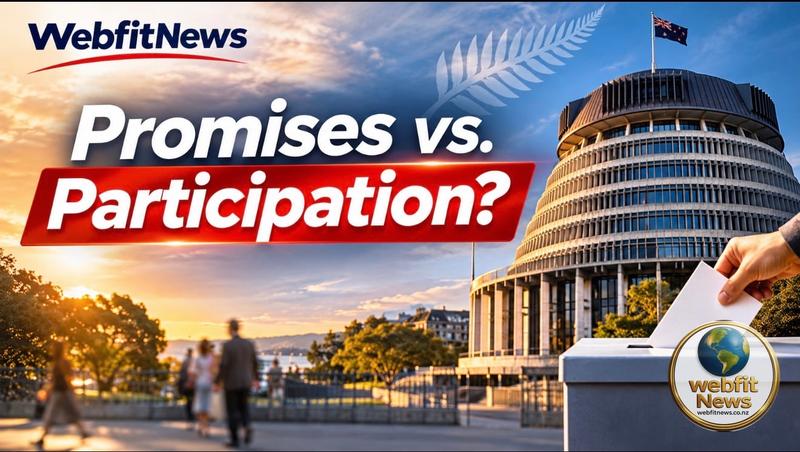
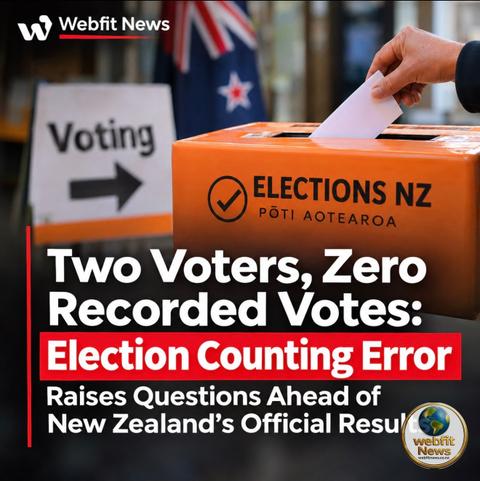
National and Labour, the two parties that have dominated the country’s politics for generations, together received just 58.57% of the preliminary party vote.
More than four in every ten party votes went elsewhere.
And estimated voter turnout fell to 74.6%, compared with 78.2% in 2023.
These figures do not prove that New Zealanders have lost confidence in politicians. But they do reveal two important developments: fewer enrolled voters participated, and those who voted distributed their support across a wider range of parties.
That raises an uncomfortable question for the political establishment.
Are voters losing interest in democracy, or are political parties struggling to connect with what people expect from them?
The numbers behind the election
The preliminary results from the 7 November election show how closely matched the two major parties were.
|
Political party
|
Preliminary party vote
|
|
Labour
|
29.36%
|
|
National
|
29.21%
|
|
Green Party
|
13.30%
|
|
ACT New Zealand
|
10.92%
|
|
New Zealand First
|
9.78%
|
|
Opportunity Party
|
5.96%
|
|
Te Pāti Māori
|
0.57%
|
Source: New Zealand Electoral Commission, preliminary results, 7 November 2026. Figures may change after the official count.
Labour and National were separated by just 3,650 party votes in the preliminary count.
But the bigger picture is the combined support for parties outside the traditional National-Labour contest.
Under New Zealand’s Mixed Member Proportional (MMP) system, smaller parties can play an important role in parliamentary representation and government formation.
Their growing share of the vote does not automatically indicate dissatisfaction. People may support smaller parties because of particular policies, leaders, values or coalition preferences.
Nevertheless, the result challenges the assumption that most voters naturally gravitate towards one of the two major parties.
Two numbers that tell different stories
The 2026 election at a glance
|
Indicator
|
Preliminary result
|
|
Estimated voter turnout
|
74.6%
|
|
Turnout in 2023
|
78.2%
|
|
National and Labour combined
|
58.57%
|
|
All other parties combined
|
41.43%
|
At first glance, these numbers may appear to tell one story about political frustration.
But they actually describe two different behaviours.
One group of people did not participate in the election.
Another group participated but chose parties other than National and Labour.
Not voting and voting differently are not the same thing.
Imagine two neighbours in Auckland.
One decides not to vote because none of the available choices appeals to them.
The other votes for a smaller party because its policies better reflect their priorities.
Both might be dissatisfied with the major parties, but only one has withdrawn from the electoral process.
And some non-voters may have reasons entirely unrelated to politics, including work, accessibility or personal circumstances.
Without detailed voter research, it would be misleading to assume everyone who stayed home was protesting against politicians.
The real test of politics happens after the election
During election campaigns, political parties compete to explain how they would improve the country.
The promises are familiar.
More affordable housing. Better public services. Stronger economic growth. Improved education. Safer communities.
But once the campaign posters disappear, people return to their everyday routines.
The supermarket bill still needs paying.
The mortgage repayment still arrives.
The family still needs a GP appointment.
And businesses still need customers, employees and enough income to remain viable.
That is where political promises meet reality.
Governments cannot solve every problem immediately. Housing, healthcare and economic productivity involve complex challenges that often take years to address.
But voters can reasonably expect clear explanations of what has been promised, what has been delivered, what has changed and why some targets have not been met.
Political commentator Danyl McLauchlan has criticised the growing emphasis on political announcements and short-term communication rather than sustained delivery.
His concern raises a practical question.
Are political parties spending enough time demonstrating results, rather than simply announcing what they intend to do?
When politics becomes a battle of personalities
Another issue highlighted during the election was the increasingly negative tone of political debate.
Criticism and disagreement are essential parts of democracy.
Voters need to understand why parties disagree on taxes, housing, immigration, healthcare and government spending.
But political arguments can become less useful when the focus shifts from policies to personalities.
Former chief science adviser Sir Peter Gluckman has warned that political debates are increasingly reduced to personal attacks and simplified answers to complex problems.
He has also raised concerns about the weakening of the political middle and the growing difficulty of building agreement on long-term national priorities.
The challenge is not to eliminate political disagreement.
It is to make that disagreement more informative.
If one party opposes another party’s housing policy, voters benefit from knowing why, what alternative is proposed, how much it would cost and what outcomes are expected.
That information is more useful than another personal argument between political leaders.
Social media: More political noise, less understanding?
A politician makes a controversial comment.
Someone shares a short video.
A headline appears on Facebook.
Within minutes, hundreds of people are arguing in the comments.
But how many have read the full policy, checked the figures or considered the wider context?
University of Auckland media scholar Neal Curtis has highlighted how the modern attention economy rewards content that attracts engagement.
Outrage, conflict and scandal can generate attention more easily than detailed explanations.
This creates challenges for both politicians and news organisations.
A heated exchange between political leaders may attract thousands of reactions.
A carefully researched explanation of healthcare funding may receive far less attention.
Yet the second story could have a much greater impact on people’s understanding of public policy.
Social media also provides opportunities for political participation, scrutiny and community discussion.
The question is whether the information people encounter helps them make informed decisions or simply encourages them to react.
Are we expecting three-year governments to solve 20-year problems?
New Zealand holds general elections every three years.
That provides regular opportunities for voters to hold governments accountable.
But some of the country’s biggest challenges require much longer planning.
Building hospitals, improving transport networks, increasing housing supply, developing a skilled workforce and strengthening educational outcomes cannot always be completed within one parliamentary term.
Gluckman has argued that New Zealand needs more long-term thinking and greater continuity on important national issues.
His concern is that difficult decisions can become trapped in repeated political cycles.
Consider a family planning for its future.
Parents may be saving for a home, thinking about their children’s education and preparing for retirement.
Those decisions involve years, sometimes decades.
National infrastructure, healthcare and education planning often require the same long-term perspective.
The question is whether political parties can maintain meaningful differences while finding common ground on priorities that extend beyond a single election.
What about communities that feel unheard?
National election results tell us how people voted, but they cannot fully explain how different communities experience politics.
A young person looking for their first job may have different priorities from a retiree.
A migrant family establishing itself in New Zealand may be focused on employment, housing, education and settlement.
A rural business owner may be more concerned about transport, infrastructure and operating costs.
Māori communities also have distinct constitutional, cultural and policy concerns that cannot be reduced to general demographic comparisons.
Massey University associate professor Veronica Tawhai has raised concerns about the lack of long-term political vision on issues affecting Māori, including inequalities in housing and healthcare.
She has also warned that hostile political debate can discourage participation, particularly among younger Māori.
These concerns underline why a national conversation about political trust needs to include different communities rather than assume all voters share the same frustrations.
A question worth asking: Where is the public progress report?
Every election brings new promises.
But how easy is it for an ordinary New Zealander to check what happened to those promises after the election?
Government agencies publish budgets, annual reports and performance information.
Yet finding a simple, understandable connection between a campaign promise, the money allocated and the outcome delivered can be difficult.
Imagine being able to see the following information in one place:
|
Election promise
|
What voters should be able to check
|
|
More affordable housing
|
Homes delivered, costs, locations and progress against targets
|
|
Better healthcare
|
Waiting times, staffing, access and service improvements
|
|
More jobs
|
Employment trends, wages and relevant economic conditions
|
|
Improved education
|
Attendance, achievement and long-term outcomes
|
|
Infrastructure investment
|
Project costs, milestones, delays and completion dates
|
This would not eliminate political disagreement.
Different parties would still disagree about priorities, funding and the best solutions.
But clearer reporting could help voters evaluate performance using evidence rather than relying solely on campaign statements.
The question should not only be what politicians promise before an election, but what the public can independently measure afterwards.
New Zealanders have not stopped participating
There is another side to the story that should not be overlooked.
Despite the decline, estimated turnout was still 74.6% of enrolled voters.
That represents substantial participation in the democratic process.
The election also showed significant support for parties outside National and Labour.
Those voters did not abandon politics. They exercised their democratic choice.
It would therefore be inaccurate to describe the entire result as a rejection of the political system.
A more careful interpretation is that New Zealand’s political landscape is changing, while participation has declined.
Understanding why requires more than election-night commentary.
It requires research into voter motivations, turnout patterns and the issues influencing different communities.
The final results are still coming
The Electoral Commission is scheduled to release the official results on Friday, 27 November 2026.
Approximately 399,000 special votes were estimated to remain outside the preliminary count, including overseas votes.
The official count will determine the final party-vote totals and seat allocations.
Until then, the figures discussed in this article remain preliminary.
But the wider questions about political participation, representation and public confidence will remain relevant regardless of the final seat count.
The election is over. The real questions are not.
The political parties will analyse the results.
Some will celebrate. Others will reconsider their campaigns, leadership and policy priorities.
But outside Parliament, everyday life continues.
Families will still be balancing household budgets.
Workers will still be thinking about wages and job security.
Businesses will still be dealing with operating costs.
Patients will still be waiting for healthcare.
And parents will still be thinking about the future they want for their children.
None of these concerns belongs exclusively to one political party.
They are issues that governments, opposition parties and public institutions must continue to address.
The 2026 election has not established that New Zealanders are tired of democracy.
It has shown lower turnout and a wider distribution of political support.
What those changes mean deserves careful investigation, not easy assumptions.
Perhaps the question New Zealand should be asking is not simply why fewer people voted.
It is whether political parties are giving people enough reasons to believe that the promises made before election day will translate into meaningful results afterwards.
Because for most people, the real measure of politics is not the speech, the slogan or the election-night celebration.
It is what changes in their lives after the votes have been counted.
Sources and editorial note
This article is an independent Webfit News analysis based on preliminary election data released by the New Zealand Electoral Commission and publicly reported commentary from political researchers and analysts, including RNZ’s coverage of the 2026 election.
Election figures are preliminary as at 22 November 2026 and may change following the official count on 27 November.
Webfit News does not endorse any political party or candidate. The article distinguishes confirmed election results from questions and interpretations about voter behaviour.
For corrections, clarifications or editorial feedback, contact webfitnews@gmail.com.