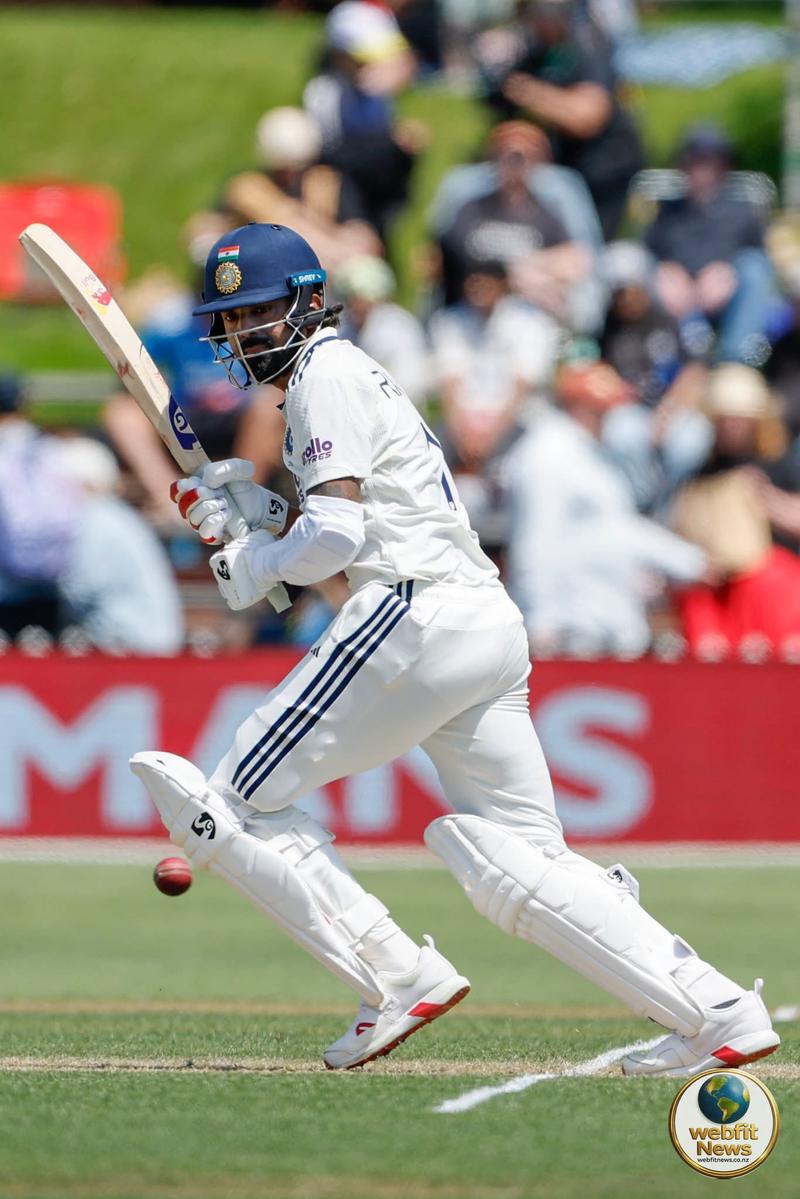
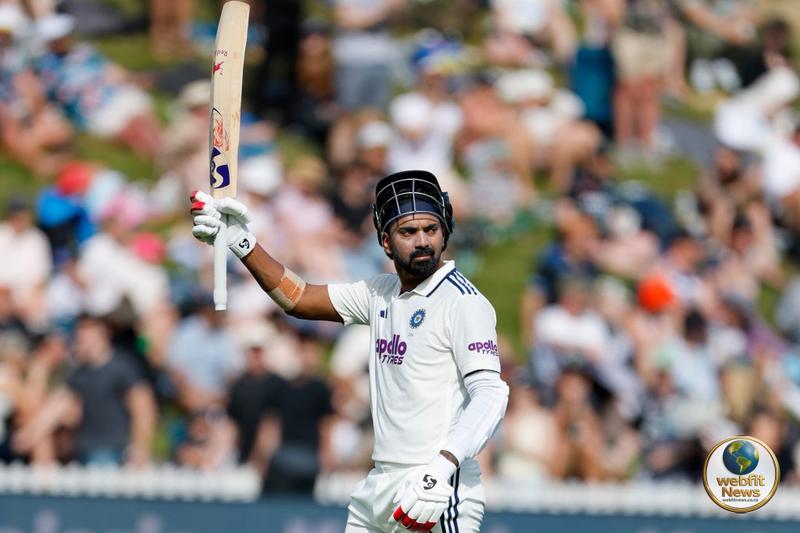
KL Rahul's 136, Shubman Gill's 98 and half-centuries from India's entire top five have put the visitors firmly in charge of the first Test. But with two days remaining and a pitch offering little assistance to the bowlers, New Zealand still have something to fight for.
By Webfit News | Wellington | 21 November 2026
WELLINGTON: New Zealand spent much of Saturday searching for a breakthrough. India spent the day making sure those opportunities were few and far between.
By stumps on Day 3 at the Basin Reserve, India had reached 486/4, taking a first-innings lead of 118 runs with six wickets still in hand.
KL Rahul's commanding 136 was the centrepiece of the innings. Shubman Gill contributed an attacking 98, Devdutt Padikkal made 80, and Rishabh Pant finished unbeaten on 55.
Together with Yashasvi Jaiswal's 85 on Friday, India's top five batters had all passed fifty.
For New Zealand, it was a frustrating day. The bowlers worked hard, but the pitch offered little movement, and every time the home side appeared to be building pressure, India found another way to score.
Yet the biggest question is not whether India have taken control. They clearly have.
It is whether they can turn that control into a victory before time runs out.
Day 3 at a Glance
India vs New Zealand | 1st Test | Basin Reserve, Wellington
Stumps: Saturday, 21 November 2026
Team
First innings
New Zealand
368 all out
India
486/4 (125 overs)
India lead by 118 runs, with six wickets remaining and two days left in the Test.
Key batting performances
Player
Team
Runs
KL Rahul
India
136
Shubman Gill
India
98
Yashasvi Jaiswal
India
85
Devdutt Padikkal
India
80
Rishabh Pant
India
55*
Henry Nicholls
New Zealand
175*
Glenn Phillips
New Zealand
118
An asterisk indicates not out.
The morning New Zealand needed, but never got
India resumed on 159/1, still trailing New Zealand by 209 runs.
For the first hour, there was little indication of the dominance that would follow.
Rahul and Padikkal began cautiously. Five of the first six overs were maidens, and only 20 runs came from the opening ten overs.
New Zealand's bowlers maintained disciplined lines, hoping patience would eventually produce a mistake.
But India refused to provide one.
Rahul was particularly careful outside off stump, while Padikkal looked comfortable defending on the front foot and cutting whenever the bowlers offered width.
Rather than forcing the scoring, the pair waited for the bowlers to tire.
It was traditional Test batting, and it worked.
New Zealand needed early wickets to expose India's middle order. Instead, Rahul and Padikkal settled in and steadily removed the pressure.
By the time the scoring accelerated, the home side had already spent considerable energy without making a breakthrough.
Rahul's 136: A century built on patience
Rahul's innings was not about attacking every delivery.
It was about knowing which deliveries deserved attention and which could be left alone.
The Indian opener reached his 13th Test century, his 12th while opening the batting.
His judgement outside off stump forced New Zealand's bowlers to adjust their lines. Whenever they drifted too straight, Rahul was ready to collect runs through the leg side.
Against Glenn Phillips, he stepped down the pitch and struck the first six of the match.
Jacob Duffy's shorter deliveries also gave him opportunities to pull.
The contrast was clear. Rahul could defend for long periods without looking uncomfortable, then punish the occasional loose delivery.
His partnership with Padikkal was particularly valuable because it allowed India to move towards New Zealand's first-innings total without exposing the middle order.
Rahul eventually fell for 136 when he played Nathan Smith onto his stumps.
By then, India had moved into a position from which they could dictate the pace of the match.
Padikkal's 80 deserves more attention
Rahul's century will naturally attract the headlines, but Padikkal's contribution should not be overlooked.
His 80 was an important part of India's control.
Facing a New Zealand attack still searching for early wickets, Padikkal showed discipline and resisted the temptation to chase deliveries outside off stump.
He survived a chance when Henry Nicholls could not complete a difficult opportunity at gully.
But Padikkal continued to build his innings, helping India move closer to New Zealand's total.
His dismissal eventually came through one of the best deliveries of the day.
Kyle Jamieson used the second new ball to produce a delivery that moved away and struck the top of off stump.
It was a reminder that New Zealand's bowlers still possessed the ability to trouble India.
The problem was producing those deliveries often enough.
Gill's 98: Two runs short, but the damage was done
When Shubman Gill arrived at 295/2, India were already well placed.
The Indian captain chose not to spend too long settling in.
He attacked whenever the bowlers offered an opportunity, using pulls, cuts and lofted shots to keep the scoreboard moving.
Gill reached his half-century from 66 balls.
His approach was significant because India were no longer simply trying to match New Zealand's first-innings score.
They were beginning to think about building a lead large enough to put the home side under serious pressure.
For much of the evening, Gill looked certain to reach a century.
Then came the final over.
With Gill on 98, Jacob Duffy produced a delivery that moved back in and bowled him.
The dismissal gave New Zealand something to celebrate after a difficult day.
For Gill, it was a frustrating end to an excellent innings.
But the captain had already helped India establish control.
Pant changes the tempo
Rishabh Pant's unbeaten 55 added another dimension to India's batting.
Returning from injury, Pant initially took time to find his rhythm.
He scored just 15 runs from his first 38 deliveries before striking his first boundary.
Once he settled, however, his approach changed.
Pant attacked Duffy, struck successive sixes and began scoring freely.
His partnership with Gill passed 100, further stretching New Zealand's bowlers.
By stumps, Pant had reached 55 not out from 62 deliveries.
That could prove important on Sunday.
India already have a useful lead, and Pant's attacking style gives them the opportunity to increase it quickly without spending too much time at the crease.
A remarkable achievement for India's top five
Saturday also produced an unusual batting milestone.
For the first time in an away Test, each of India's top five batters scored at least a half-century.
There was another notable statistic.
India became the first team in a Test match in New Zealand to have each of its top four batters score at least 80 in the same innings.
Remarkably, it was the first Test innings in New Zealand for all four of those players.
Batting position
Player
Score
1
Yashasvi Jaiswal
85
2
KL Rahul
136
3
Devdutt Padikkal
80
4
Shubman Gill
98
5
Rishabh Pant
55*
The significance goes beyond the records.
New Zealand could not find a weak point in India's top order.
Whenever one batter departed, the next continued building the innings.
That consistency made it extremely difficult for the home side to regain momentum.
What went wrong for New Zealand?
It would be unfair to describe New Zealand's performance simply as poor bowling.
The conditions were challenging.
The Basin Reserve surface offered little sustained swing or seam movement, particularly as the ball became older.
Matt Henry and Kyle Jamieson worked hard without receiving much assistance.
Jamieson's dismissal of Padikkal demonstrated what was possible with the right delivery, but such moments were too infrequent.
Duffy struggled with consistency, conceding runs and bowling seven no-balls. His late dismissal of Gill was a welcome breakthrough, but it came after India had already built a substantial advantage.
New Zealand also struggled to create pressure through spin.
Phillips provided another bowling option, but India were prepared to attack him.
The broader problem was that the bowlers rarely looked threatening for extended periods.
India recognised that and made them work even harder.
The detail that could decide this Test
Here is where the match becomes particularly interesting.
New Zealand were 70/5 on the opening day.
At that stage, India appeared capable of dismissing the hosts for a modest total.
Instead, Henry Nicholls and Glenn Phillips produced a remarkable recovery.
Nicholls finished unbeaten on 175, while Phillips made 118, helping New Zealand reach 368.
Their partnership demonstrated how difficult it could become to take wickets once batters settled.
India have now experienced the same conditions.
That creates a fascinating challenge.
The pitch that helped India dominate Day 3 could also help New Zealand survive in their second innings.
India have the advantage, but they still need ten more wickets after completing their first innings.
And taking those wickets may prove more difficult than building the lead.
Why India's batting approach mattered
India's most impressive achievement was not simply scoring 486 runs.
It was how they managed the innings.
They began cautiously when New Zealand's bowlers were fresh.
They increased the scoring once the attack tired.
And they attacked more freely after moving into a position of control.
The change in tempo was particularly noticeable throughout Saturday.
Rahul and Padikkal provided stability. Gill accelerated. Pant then added another attacking option.
It was an effective combination of patience and aggression.
New Zealand, by contrast, struggled to maintain pressure long enough to force mistakes.
The difference was not only in individual performances.
It was in how effectively India managed the changing situation.
What must New Zealand do on Day 4?
New Zealand's first priority is straightforward: take early wickets.
Pant remains dangerous, and India still have six wickets in hand.
If the visitors are allowed to build another substantial partnership, their lead could quickly become difficult to overcome.
The home side must also avoid conceding runs too easily.
Even a relatively short attacking innings from Pant could significantly change the equation.
For India, the decision is more complicated.
They need enough runs to make New Zealand's second innings difficult, but they must also leave their bowlers sufficient time to take ten wickets.
Batting too long could reduce their chances of forcing a result.
Declaring too early could leave New Zealand with a manageable target if conditions remain favourable for batting.
The timing of India's next move may be as important as the runs they score.
Webfit News analysis: India are ahead, but the clock is now part of the contest
After three days, India have clearly been the stronger side.
Their bowlers reduced New Zealand to 70/5 before the hosts recovered, and their batters have now produced an exceptional collective performance.
But Test cricket is rarely decided by one dominant batting day alone.
The condition of the pitch, the amount of time remaining and the ability to take wickets in the fourth innings will all matter.
India's challenge is to turn their lead into a position from which they can attack.
New Zealand's challenge is to prevent that lead from growing too quickly and then bat with the patience Nicholls and Phillips demonstrated earlier in the match.
There is also a psychological element.
India have spent two days building their innings. New Zealand have spent much of that time in the field.
If the hosts can make early breakthroughs on Sunday, they may recover some confidence.
If Pant and the remaining batters add runs quickly, New Zealand could find themselves facing a long battle simply to save the Test.
India won Day 3 convincingly. But winning the day and winning the Test are two different things.
That is what makes Sunday's play so important.
Match summary
1st Test, Wellington | Day 3, Stumps
New Zealand: 368 all out India: 486/4 (125 overs) India lead by 118 runs with six wickets remaining.
New Zealand's leading scorers: Henry Nicholls 175*, Glenn Phillips 118.
Leading Indian bowlers: Jasprit Bumrah 4/92, Akash Deep 3/53, Anshul Kamboj 2/69.
Webfit News | Cricket coverage from Wellington
Match statistics and developments are based on the Day 3 scorecard and reporting published by ESPNcricinfo and Sky Sports. Analysis and editorial presentation by Webfit News.