India have produced one of the most extraordinary batting performances seen on New Zealand soil. But with eight wickets still standing, the Black Caps have one final day to prove that a mountain of runs does not automatically guarantee victory.
By Webfit News Sports Desk | 22 November 2026
WELLINGTON: For 166 overs, New Zealand searched for a way to stop India’s batters. Now the Black Caps have one final day to stop India from winning.
The visitors did not simply score 720 runs at the Basin Reserve. They built partnership after partnership, exhausted the home attack and turned New Zealand’s respectable first-innings total of 368 into a desperate fight for survival.
By Sunday evening, India had declared at an extraordinary 720 for 9, establishing a 352-run lead and leaving the hosts with a daunting task.
New Zealand reached stumps at 119 for 2, still 233 runs behind.
Devon Conway was unbeaten on 59. Rachin Ravindra remained alongside him on 27.
Eight wickets remain. One day remains.
And after four days in which India’s batters have dominated the conversation, the outcome now rests on something far less glamorous than record-breaking strokeplay.
New Zealand must find a way to make time stand still, one delivery at a time.
A scoreboard that tells only half the story
Match situation
Score
New Zealand, first innings
368 all out
India, first innings
720/9 declared
India’s first-innings lead
352 runs
New Zealand, second innings
119/2
New Zealand trail by
233 runs
Wickets remaining
8
Play remaining
Final day, 23 November
The numbers are extraordinary, but the deeper story lies in how India accumulated them.
This was not one batter producing a once-in-a-generation innings while everyone else watched.
It was an entire batting order refusing to let New Zealand regain control.
Seven partnerships. Seven warnings. No escape.
Perhaps the most revealing statistic from India’s innings was not the final total of 720.
It was what happened between the wickets.
For the first time in Test cricket, each of the first seven partnerships in an innings reached at least 50 runs.
Think about what that means for a bowling side.
A wicket falls. The fielding team senses an opening. The bowlers gather around their captain, plans are adjusted and a fresh batter arrives.
Then another partnership develops.
Another wicket eventually falls.
And the process repeats.
Seven times, India ensured New Zealand could not turn a breakthrough into sustained pressure.
That is what made this innings so punishing.
A bowling attack can survive one outstanding century. It can even recover from two.
But when almost every new partnership forces the fielding side to start again, the pressure becomes cumulative.
The bowlers tire. Fielders spend longer in the sun. The captain runs out of easy options.
And the scoreboard keeps moving.
India’s 720 became the highest Test innings total recorded in New Zealand and their highest total in an overseas men’s Test.
It was a collective batting performance that exposed just how difficult Test cricket becomes when a bowling side cannot take wickets in clusters.
Rahul built the platform. Pant turned it into a spectacle.
KL Rahul’s 136 from 290 deliveries provided the foundation.
His innings was not built around constant aggression. It was about occupation, control and making New Zealand work for every opportunity.
Yashasvi Jaiswal contributed 85, Devdutt Padikkal made 80 and captain Shubman Gill scored 98.
Then came Rishabh Pant.
Where Rahul had accumulated, Pant entertained.
The Indian wicketkeeper struck 128 from 153 balls, mixing conventional attacking shots with the improvisation that has made him one of the most unpredictable batters in international cricket.
His century carried its own historical significance.
Pant completed Test hundreds in all four SENA countries: South Africa, England, New Zealand and Australia.
He also moved past former New Zealand captain Brendon McCullum on the all-time Test six-hitting list, reaching 108 sixes and moving into second place behind England’s Ben Stokes.
Dhruv Jurel added a rapid 78 from 79 deliveries as India pushed towards their declaration.
India’s leading run-scorers
Batter
Runs
KL Rahul
136
Rishabh Pant
128
Shubman Gill
98
Yashasvi Jaiswal
85
Devdutt Padikkal
80
Dhruv Jurel
78
The contrast between Rahul and Pant was striking.
One innings was built on restraint. The other thrived on attacking freedom.
Together with the contributions around them, they demonstrated why successful Test batting is not always about playing the same way.
It is about understanding the situation and making the opposition respond.
What India’s 720 says about New Zealand’s bowling
There is no disguising the scale of the challenge New Zealand’s bowlers faced.
Glenn Phillips returned figures of 3 for 154, while Jacob Duffy conceded 201 runs from 33 overs.
The surface offered limited assistance for long periods, but conditions alone cannot explain seven consecutive partnerships of 50 or more.
India’s batters deserve credit for denying the Black Caps the momentum that wickets normally provide.
At the same time, the innings raises questions New Zealand will need to examine before the next Test.
Could the attack have sustained greater pressure between breakthroughs?
Were there opportunities to change the pace of the innings?
And how effectively did the bowling plans respond as India’s partnerships continued to grow?
Those questions cannot be answered simply by pointing to a flat pitch.
A difficult surface for bowlers makes discipline more important, not less.
New Zealand’s bowlers had to keep returning for another spell, another partnership and another attempt to break India’s control.
By the declaration, the hosts had spent 166 overs in the field.
That physical workload matters.
But the mental challenge of watching an opposition batting order repeatedly rebuild may be just as demanding.
The cruelest part of Test cricket: There is no time to recover
After such a long innings in the field, New Zealand still had to face India’s fast bowlers.
And the pressure arrived almost immediately.
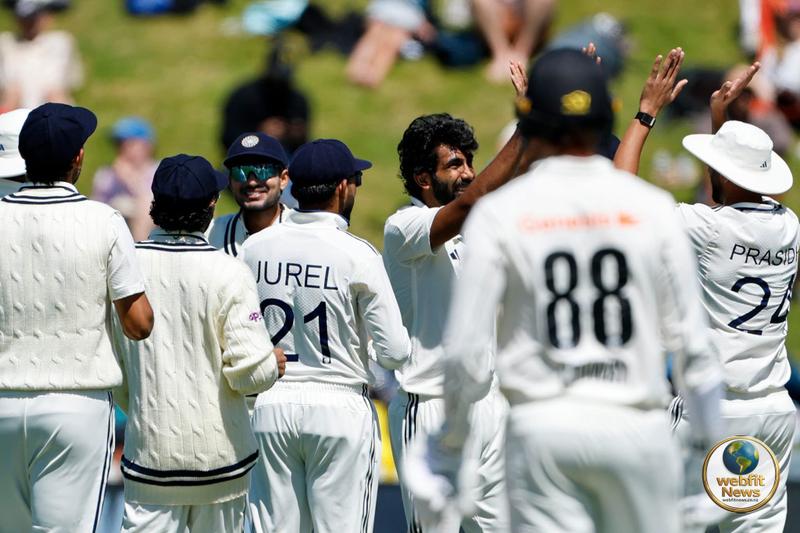
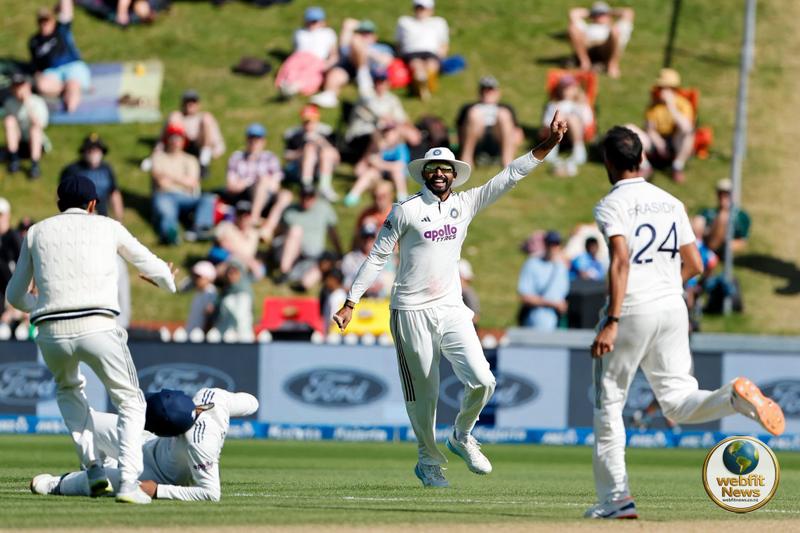
Captain Tom Latham fell for a duck to Jasprit Bumrah.
Henry Nicholls, whose unbeaten 175 had anchored New Zealand’s first innings, joined Conway and attempted to rebuild.
Nicholls made 31 before Prasidh Krishna dismissed him, leaving the hosts at 77 for 2.
For a moment, the danger of a rapid collapse was real.
But Conway and Ravindra refused to surrender the final session.
Conway reached his 14th Test half-century, while Ravindra settled into a supporting role.
Neither needed to produce a spectacular counterattack.
They needed to survive.
By stumps, their partnership had given New Zealand something that looked increasingly distant when India declared.
A realistic route to a draw.
The real contest on Monday is not India versus New Zealand. It is wickets versus time.
The scoreboard says New Zealand trail by 233 runs.
But that deficit is not the most important number heading into the final day.
The most important numbers are eight wickets and the overs remaining.
India must dismiss the remaining batters to secure victory.
New Zealand must deny them those wickets until time runs out.
It is a different kind of contest from the one that produced 720 runs.
There may be long periods without boundaries.
There may be overs where leaving the ball is more valuable than hitting it.
There may be sessions where scoring 40 runs while losing no wickets represents a far greater achievement than an aggressive half-century.
That is the beauty of Test cricket.
It can reward attacking brilliance one day and stubborn resistance the next.
And both can be equally important.
Three battles that could decide the final day
Conway and Ravindra against India’s opening attack
Their partnership is New Zealand’s first line of defence. If they survive the opening session, the hosts will begin to believe a draw is within reach.
But an early wicket could expose the middle order and shift momentum sharply towards India.
India’s fast bowlers against a tiring batting side
Bumrah and Krishna have already taken a wicket each in the second innings.
The question is whether they can maintain enough accuracy and intensity to create repeated chances, particularly when the second new ball becomes available.
New Zealand’s patience against the scoreboard
A 233-run deficit can create psychological pressure even when the immediate objective is survival.
The temptation to force the pace or play an unnecessary attacking shot could prove costly.
The Black Caps must resist the urge to solve the entire problem in one session.
They need to win small battles, one over at a time.
Why the World Test Championship makes this more than an ordinary draw
The outcome in Wellington will also affect the ICC World Test Championship race.
Under the competition’s points system, a victory earns 12 points and a draw earns four, with teams ranked by the percentage of available points earned.
For New Zealand, saving the match would be significantly better than surrendering all the points available for a win.
For India, the difference between victory and a draw is substantial.
A team that has scored 720 and established a first-innings lead of 352 will naturally expect to convert that dominance into victory.
If New Zealand survive, India will be left with extraordinary individual and collective achievements, but without the full reward they were pursuing.
That is why the final day matters.
Not because it can erase what India’s batters accomplished.
It cannot.
But because Test cricket ultimately judges teams by results, not merely records.
What the Black Caps must learn, whatever happens
Even if New Zealand save this match, the bowling performance deserves serious examination.
A draw would represent an impressive act of survival.
It would not automatically mean everything that happened across the previous four days could be forgotten.
India’s innings exposed a troubling inability to interrupt partnerships consistently.
The Black Caps will need to understand whether that was primarily a consequence of the pitch, India’s exceptional batting or shortcomings in their own execution.
Most likely, the answer involves more than one factor.
Equally, defeat would not erase the value of Nicholls’ first-innings resistance or the fight Conway and Ravindra have shown.
The challenge for New Zealand is to separate the result from the performance.
Winning teams do that.
So do teams serious about improving.
India have made history. New Zealand can still make a statement.
There is no question which team has dominated this Test.
India have produced an innings that will remain in the record books long after this match ends.
Rahul’s patience, Pant’s aggression and the remarkable consistency of the batting order deserve recognition.
But Monday offers New Zealand a different opportunity.
Not to outscore India.
Not to rewrite the records.
And not to pretend the previous four days did not happen.
The Black Caps can show that even when a match appears to have slipped beyond reach, discipline and resilience still matter.
Conway and Ravindra will walk out knowing India need eight wickets.
India will return knowing New Zealand must survive the day.
Every delivery will move one side closer to its objective.
And that is why the final chapter remains unwritten.
India have already proved how many runs they can score. Now New Zealand must prove how long they can refuse to be beaten.
Match: New Zealand vs India, First Test Venue: Basin Reserve, Wellington Report: Stumps, Day Four, Sunday 22 November 2026 New Zealand: 368 and 119/2 India: 720/9 declared Next play: Monday 23 November 2026
Sources: Match information and statistics supplied to Webfit News, including the day-four match report and New Zealand Cricket/BCCI match graphics.
Editorial note: This article combines reported match facts with independent editorial analysis. No direct player interviews or eyewitness observations are claimed.