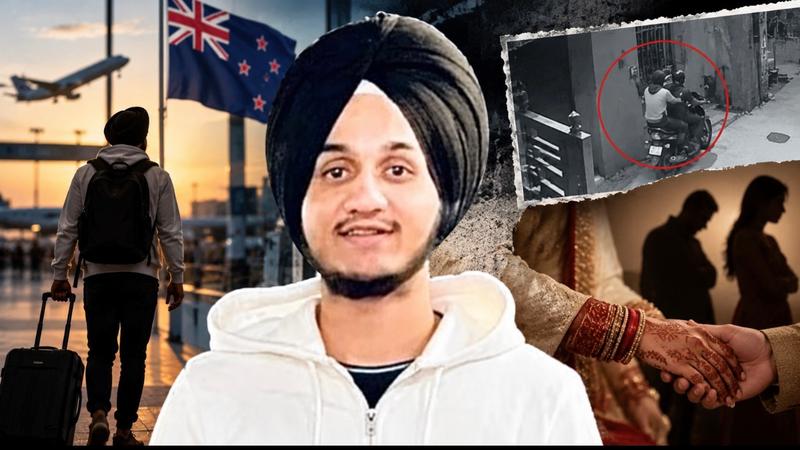
At its centre is a family dispute involving a widowed woman’s decision to remarry.
What Happened in Rampur?
The shooting took place in the Milak Khanam area of Rampur district, Uttar Pradesh.
Navjot Singh operated a vehicle servicing business known as Gill Washing Hub, located in the Kumhariya Kalan area.
According to reports citing police, two men arrived at the premises in a small car at approximately 5pm.
The attackers allegedly opened fire on Navjot before fleeing.
He suffered fatal gunshot injuries.
CCTV footage reportedly captured the incident and subsequently circulated on social media.
Indian media reports describe the attackers arriving in a grey or silver Maruti Alto.
Police later identified Avdeep Singh and Rajandeep Singh as suspects.
While the footage may form part of the investigation, the existence of a video does not by itself establish the guilt of any individual.
Why Police Believe the Marriage Was Behind the Killing
Investigators have linked the alleged motive to the marriage between Navjot Singh and Kamal Kaur, Avdeep’s mother.
Kamal, who had been widowed following the death of her first husband, had married Navjot after developing a relationship with him.
Indian reports describe a substantial age difference between the couple.
According to police accounts, Avdeep opposed his mother’s decision to remarry, particularly her marriage to a younger man.
Investigators allege that this opposition developed into a plan to kill Navjot.
However, the precise motive remains an allegation to be tested through the legal process.
A family disagreement may explain the background of a police investigation, but it does not establish that the accused committed the crime.
The New Zealand Connection
One of the most significant details is that Avdeep had reportedly been living and working in New Zealand.
According to Indian media reports, he was employed in dairy farming.
Police allege that he travelled from New Zealand to India approximately five days before the shooting.
Investigators are examining the circumstances of his return and his alleged involvement in planning the attack.
The available reporting does not establish his New Zealand immigration status, the precise location of his employment or whether any New Zealand authorities are involved in the investigation.
The alleged crime occurred in India and is being investigated by Indian police.
Living or working in New Zealand does not establish New Zealand citizenship, and the accused’s nationality should not be assumed.
How the Investigation Developed
The early reporting of the case contained some conflicting information, particularly about whether the suspects were still being sought.
The sequence established by later police reporting is clearer.
|
Date
|
Reported development
|
|
Approximately 5 October
|
Avdeep reportedly returned to India from New Zealand
|
|
10 October
|
Navjot Singh was fatally shot at his car service centre in Rampur
|
|
11 October
|
Early reports described suspects being sought by police
|
|
12 October
|
Police reportedly arrested Avdeep Singh and Rajandeep Singh
|
|
13 October
|
Indian news organisations published further details from police about the alleged motive and arrests
|
Additional Superintendent of Police Anurag Singh confirmed the arrests in statements reported by Indian news agencies.
The victim’s father, Nishan Singh, also reportedly made allegations against several relatives in his complaint to police.
Those wider allegations should not be confused with established findings against every person named.
The available reports confirm the arrests of Avdeep and Rajandeep but do not establish a conviction or final judicial determination.
Why Are There Different Ages in the Headlines?
One reason the story requires careful reporting is that Indian publications have given different ages for the victim.
Some early accounts described Navjot as 25, while others reported 30 or 35.
A later police-attributed report published on 13 October identified him as 30 years old, while identifying Kamal Kaur as 49.
Webfit News has relied on that later reporting but has not independently verified Navjot’s age through official identity records.
The difference does not alter the central allegation, but it demonstrates why details from rapidly developing criminal investigations should be checked before being repeated as fact.
Beyond the Crime: A Woman’s Decision to Remarry
The most troubling aspect of the alleged motive is the suggestion that a woman’s decision to remarry became the source of such serious family conflict.
Kamal Kaur had lost her first husband.
She subsequently entered another marriage.
Her adult children reportedly objected.
What followed, according to police, was a deadly attack against her new husband.
The case raises a question that goes beyond one family or one country.
When an adult woman decides to rebuild her life after losing a partner, how much control should her family expect to have over that decision?
Family members may have concerns about a relationship, including differences in age, financial arrangements or compatibility.
But disagreement does not give anyone the right to threaten or harm another person.
It is also important not to turn an individual criminal allegation into a generalisation about Indian families, migrant communities or cultural traditions.
Millions of families navigate remarriage and disagreements without violence.
The allegations in this case concern specific individuals and must be assessed on their evidence.
What Happens Next?
The arrests are an important development, but they are not the end of the legal process.
Investigators must establish the sequence of events, examine forensic and CCTV evidence, and determine the alleged roles of those involved.
The prosecution must then prove its case under the applicable Indian criminal law.
The suspects are entitled to legal representation and the presumption of innocence.
No conviction has been established in the reporting reviewed by Webfit News.
Further court proceedings may clarify whether the police allegations are supported by the evidence.
Webfit News Analysis: The Most Important Story Is Not the Flight From New Zealand
The international connection makes this case unusual.
A young man reportedly working in New Zealand returns to India, and within days his stepfather is killed.
That sequence understandably attracts attention.
But reducing the story to the journey from New Zealand risks missing the more serious human questions.
A man has lost his life.
A woman has lost her husband.
A family dispute has become the subject of a murder investigation.
And two young men now face serious allegations with potentially life-changing consequences.
The alleged opposition to Kamal Kaur’s remarriage deserves scrutiny, not because the police’s account should be accepted without question, but because it raises a broader issue about autonomy and family relationships.
Parents and adult children can disagree profoundly about personal decisions.
That disagreement must never become a justification for violence.
The distance between New Zealand and India is thousands of kilometres. But the most important boundary in this case is much closer: the line between disagreeing with someone’s personal choice and believing you have the right to control it.
For now, that is the question left hanging over a family’s tragedy as the Indian justice system examines what happened.
Sources and Acknowledgements
Primary reporting:
- Press Trust of India (PTI), 13 October 2026, reporting police confirmation of the arrests and circumstances of the killing.
- The Indian Express, coverage of the Rampur shooting and alleged family dispute.
- Hindustan Times, 12–13 October 2026, reporting on the suspects, New Zealand connection and investigation.
- India Today, 13 October 2026, reporting police statements about the alleged motive and arrests.
- The Times of India, 11–13 October 2026, reporting the CCTV footage, family complaint and initial investigation.
- ABP Live, 12 October 2026, Hindi-language reporting on the case.