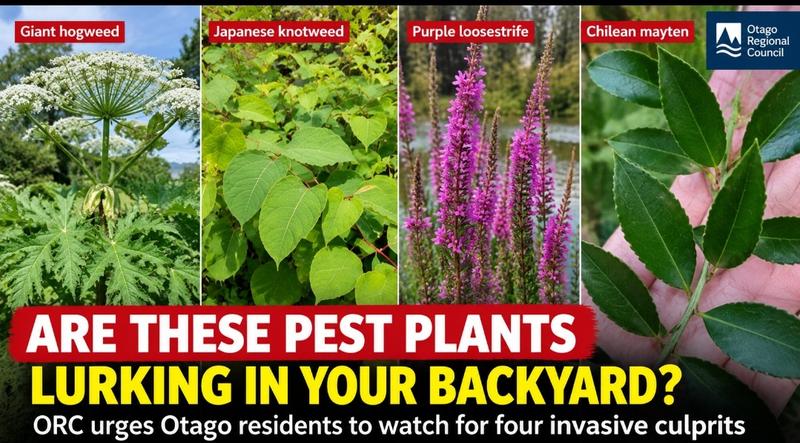
From a giant weed whose sap can burn human skin to a flowering plant capable of producing 2.5 million seeds a year, Otago Regional Council is urging residents to look more closely at what is growing in their gardens, along roadsides and beside waterways.
By Webfit News | Otago | 22 October 2026
A plant growing quietly in your backyard might look harmless. It could have attractive flowers, unusual leaves or simply resemble another shrub you have seen hundreds of times.
But some plants can cause serious environmental damage, and one of the four species Otago Regional Council (ORC) is asking residents to watch for can also cause severe skin injuries.
As warmer weather brings more people into gardens, parks and outdoor spaces, the council's Biosecurity team has issued a warning about four invasive pest plants that may be hiding in plain sight across the region.
The plants are giant hogweed, Japanese knotweed, purple loosestrife and Chilean mayten.
All four are listed as Unwanted Organisms under New Zealand's National Pest Plant Accord.
The concern is not simply that these plants grow quickly. Some can overwhelm native vegetation, spread through waterways, damage wetland habitats or establish dense colonies that are extremely difficult to control.
And because certain species resemble ordinary garden plants, people may not realise what they are looking at.
Council Wants Residents to Become Its Eyes and Ears
ORC portfolio lead Councillor Andrew Noone says residents have an important role in helping authorities identify these invasive species.
"These four plants: giant hogweed, Japanese knotweed, purple loosestrife and Chilean mayten are declared Unwanted Organisms in the National Pest Plant Accord," Noone said.
The classification places restrictions on selling, propagating and spreading the plants.
"If you see one or more of them, get in touch with ORC's Biosecurity team," he said.
The council's message is straightforward: you do not have to be a botanist to help protect Otago's environment.
Recognising something unusual and reporting a possible sighting could help biosecurity specialists identify an infestation before it spreads further.
1. Giant Hogweed: The Plant That Can Burn Your Skin
Scientific name: Heracleum mantegazzianum
The biggest immediate human-health concern among the four plants.
Giant hogweed is not an ordinary oversized garden weed.
Originating from the Caucasus region, including areas around Armenia and Azerbaijan, this invasive plant can grow up to five metres tall.
It has enormous, deeply jagged leaves and large umbrella-shaped clusters of white flowers.
Its appearance can be striking, but the real danger lies in its sap.
Why Is It Dangerous?
Giant hogweed sap contains substances that make skin highly sensitive to sunlight.
When the sap comes into contact with skin and the affected area is exposed to sunlight, it can cause a phototoxic reaction, resulting in severe burns and blistering.
This means someone could be injured simply by coming into contact with the plant and subsequently exposing their skin to sunlight.
Do not touch giant hogweed or attempt to remove it with bare hands.
How to Recognise It
Look for:
- A very large plant, potentially reaching five metres.
- Huge, deeply divided and jagged green leaves.
- Large, umbrella-shaped clusters of small white flowers.
- Growth in damp or disturbed places, particularly riverbanks, roadsides and woodland edges.
Why It Threatens the Environment
According to ORC, a single giant hogweed plant can produce up to 50,000 viable seeds.
These seeds can spread along waterways, allowing the plant to establish colonies over considerable distances.
Dense infestations suppress native plants and grasses.
When giant hogweed dies back in winter, previously covered riverbanks may be left exposed, increasing their vulnerability to erosion and further weed invasion.
The combination of human-health risks and environmental damage makes this species particularly concerning.
2. Japanese Knotweed: A Persistent Invader That Can Choke Waterways
Scientific name: Reynoutria japonica
Japanese knotweed may not look as intimidating as giant hogweed, but its ability to spread makes it a serious biosecurity concern.
Originally from Japan, the plant has become an invasive species in many parts of New Zealand.
It grows rapidly through an extensive underground system of thick, fleshy roots and underground stems.
Once established, it can form dense thickets that crowd out other vegetation.
How to Recognise It
Japanese knotweed typically has:
- Broad green leaves.
- Upright stems and dense growth.
- Small white flowers, generally appearing between December and April.
- Extensive underground growth that allows it to spread beyond the visible plant.
It may be found in urban areas, shrublands, waterways, landfills and places where garden waste has been dumped.
Why Is It a Problem?
The plant's dense growth can replace existing vegetation and obstruct waterways.
Its underground system also makes established infestations difficult to control.
Removing the visible growth does not necessarily eliminate the plant beneath the ground.
This is why residents should avoid digging up or moving suspected knotweed without appropriate biosecurity guidance. Disturbing and transporting plant material can increase the risk of spreading an infestation.
The council is particularly concerned about the species becoming established in areas where it can expand rapidly and displace surrounding plants.
3. Purple Loosestrife: Beautiful Flowers, Serious Consequences
Scientific name: Lythrum salicaria
With its striking purple flowers, purple loosestrife could easily be mistaken for a desirable ornamental plant.
But behind its attractive appearance is a highly invasive perennial herb capable of transforming wetland environments.
The plant can outcompete native vegetation, interfere with water movement and degrade habitats used by wildlife, particularly wetland birds.
The Extraordinary Number of Seeds
One of the most alarming figures in ORC's warning concerns its reproductive capacity.
A single purple loosestrife plant can produce up to 2.5 million seeds annually.
Those seeds can be dispersed by wind, water and contaminated machinery.
Once the plant becomes established, controlling its spread can be extremely challenging.
Where Is It Found in Otago?
ORC reports that purple loosestrife is locally established in Ōamaru, with scattered populations in Tapanui and Dunedin.
It is currently found at relatively few locations across the region, primarily around wetlands and riverbanks.
Why Does It Matter?
Wetlands are important habitats for native plants and animals.
When an invasive plant begins dominating these environments, it can alter the balance of the ecosystem.
Purple loosestrife can also obstruct access to waterways, affect irrigation systems and reduce the quality of hay and pasture.
Its presence is therefore a concern for both conservation and land management.
The key message is that an attractive flowering plant is not necessarily an environmentally harmless one.
4. Chilean Mayten: The Tree That Can Look Like a Native Plant
Scientific name: Maytenus boaria
Of the four plants highlighted by ORC, Chilean mayten may be one of the easiest to overlook.
Unlike giant hogweed, it does not have dramatically oversized leaves. Unlike purple loosestrife, it does not necessarily attract attention with colourful flowers.
Instead, it can resemble an ordinary evergreen shrub or small tree.
That makes identifying it particularly challenging.
Why Is the Council Concerned?
Chilean mayten is considered an emerging pest in Otago.
ORC wants to build a clearer picture of where the species is growing and how widely it has spread.
The tree is relatively resistant to cold and drought and can grow in a range of environments.
After several decades, it may reach approximately six to eight metres in height.
Its most concerning feature is the way it reproduces and spreads.
The plant produces aggressive root suckers that can form dense thickets more than 10 metres from the parent tree.
It also spreads through seeds.
Why Is It Difficult to Identify?
When young, Chilean mayten can resemble native New Zealand plants such as māhoe and some lacebarks.
As a mature tree, it may be confused with exotic species including weeping willow and pepper tree.
Its small evergreen leaves offer few immediately obvious distinguishing features.
ORC says the species flowers in New Zealand from late August through October, making the current period a particularly useful time to look for it.
The council is seeking public assistance to better understand its distribution.
Residents should avoid assuming a plant is Chilean mayten based on leaf shape alone, particularly because it can resemble other species.
Four Plants, Four Different Risks
Although the species have different characteristics, they share one important feature: each can cause problems if allowed to establish and spread.
Pest plant| Main concern| Identification clue
Giant hogweed| Severe skin burns and displacement of native vegetation| Huge jagged leaves and white umbrella-shaped flower clusters
Japanese knotweed| Dense growth that can overwhelm vegetation and choke waterways| Broad leaves, dense thickets and small white flowers
Purple loosestrife| Wetland damage and extremely high seed production| Showy purple flower spikes
Chilean mayten| Spreading root suckers and competition with surrounding plants| Small evergreen leaves; resembles some native shrubs
Why This Matters Beyond Your Backyard
Invasive plants do not respect property boundaries.
A weed beginning in one garden can eventually spread into a neighbouring property, roadside reserve or waterway.
Seeds may travel through flowing water, while plant material can be moved unintentionally through gardening, earthworks or contaminated machinery.
Once invasive species become established in natural habitats, they can be costly and difficult to manage.
For Otago, the risks extend beyond untidy gardens.
They include the loss of native vegetation, degradation of wetland habitats, disruption to waterways and increased erosion in vulnerable areas.
This is why early identification matters.
A small infestation discovered before it spreads may be much easier for biosecurity specialists to assess and manage than an established colony covering a large area.
What Should You Do if You Spot One?
The most important advice is do not rush to pull out or destroy a plant you cannot confidently identify.
In particular, avoid touching suspected giant hogweed because of the risk of serious skin injury.
If you encounter a plant that resembles one of the four species:
1. Keep a safe distance, especially from suspected giant hogweed.
2. Take a clear photograph from a safe position if possible.
3. Record the location so biosecurity staff can investigate.
4. Avoid moving, cutting, transporting or disposing of suspected invasive plant material without advice.
5. Contact the Otago Regional Council Biosecurity team.
Report a Suspected Pest Plant
Otago Regional Council – Biosecurity Team
Phone: 0800 474 082
Email: biosecurity@orc.govt.nz
Residents do not need to make a definitive identification before reporting a possible sighting.
If a plant appears suspicious, the council's specialists can advise on the appropriate next steps.
If skin comes into contact with suspected giant hogweed sap, wash the affected area, protect it from sunlight and seek medical advice promptly.
The Bigger Question: Are We Paying Enough Attention to What Grows Around Us?
New Zealand's natural environment faces pressures from a wide range of introduced species.
Some are obvious. Others are so familiar in gardens and public spaces that they may go unnoticed.
The four plants identified by ORC demonstrate why appearance alone can be misleading.
A towering plant with white flowers can pose a direct health risk.
A dense green shrub can gradually overwhelm a waterway.
A beautiful purple flower can produce millions of seeds.
And an ordinary-looking evergreen tree can spread through underground suckers far beyond its original planting site.
The challenge for councils is not simply identifying these species, but finding them early enough to limit their spread.
That is where public awareness becomes important.
The next time you are gardening, walking beside a river or exploring a local reserve, it may be worth taking a closer look at the plants around you.
You may not find anything unusual.
But recognising and reporting a suspected invasive species could help protect Otago's waterways, native vegetation and natural habitats before a small problem becomes a much larger one.
Sources and Photo Credits
Primary source: Otago Regional Council (ORC), media release, Are These Pest Plants Lurking in Your Backyard?, 22 October 2026.
Information and identification photographs: Otago Regional Council Biosecurity Team.
Purple loosestrife photograph: Kirk Robertson.
Chilean mayten photographs: Murray Dawson / iNaturalistNZ.
Additional photographs: As supplied by Otago Regional Council with its media release.