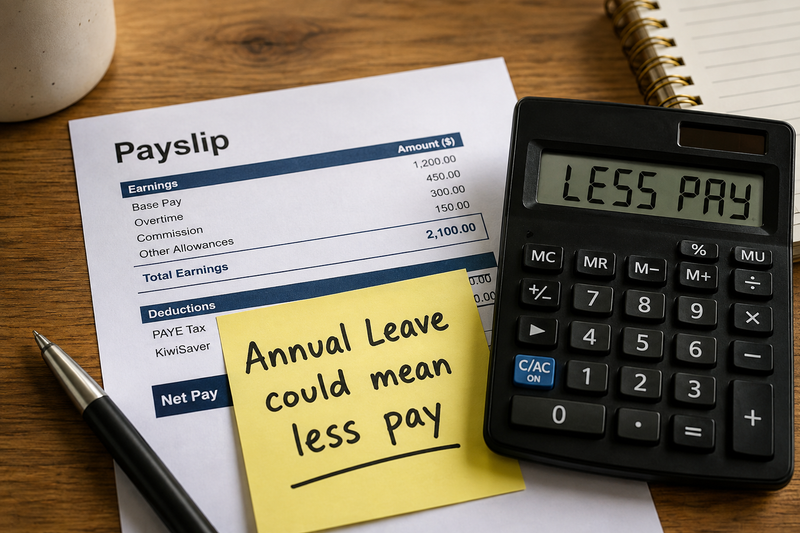
"For employees who are paid partly or wholly by way of commission, there is an ability to negotiate a 'leave payment rate'. If they are unable to reach agreement with their employer on a leave payment rate, they can be paid their leave at minimum wage."
Workers First Union national organiser Callum Francis said he shared that concern. "Those that earn commission are going to find out quite shortly, if they haven't clicked, that they're going to be having less pay when they're on leave. It's potentially going to make it harder for them to take leave or want to take leave. This seems, at least from our point of view, like it isn't going to make life easier."
He said many people would be in a pattern where they relied in working overtime to have enough money coming into the household. "People are going to take annual leave and suddenly realise that they're losing potentially hundreds of dollars in a week. They will suddenly find that taking annual leave is more difficult… our colleagues and the people we deal with in supermarket retail stores are regularly put on their minimum hour contracts and regularly work at least, if not another day, then a number of hours extra in a week to try to help ends meet…we are genuinely worried that people aren't going to be able to take leave, or they're going to cash it up because they're low on money, and they're not going to get that time out from work."
University of Otago associate professor Paula O'Kane said many people would not understand what had happened. "What I think needs to be considered from an employer's point of view is really what contracts and what hours they're putting their people on as their base rate.
"So they might need to think more carefully about having more accurate contracts and more consistent contracts so that gets paid properly." She said it would rely more on people being good employers and treating staff fairly.
"I'm not sure there was ever any easy solution to getting this right, at the moment it's quite complex [but] there's worrying things in [the bill] and I think a lot of it will come down to how an employer interprets and works with it.
"Sick pay not accruing for casual employees is a little bit problematic too because we could all say save that 4 percent you get extra into your pay packet for when you're sick [as a casual worker] but few people will be disciplined enough."
Employees would also need to think about which staff were truly casual and which were really permanent part-time. She said it would have been better to consider an option where employees could accrue sick leave across jobs and take it from one to the next.
"For casual employees you'll get your sick leave for every hour you work but if we had done that for all employees and put it into a centralized pot like a bit like ACC then you could let that accrue to infinity, because it's sitting in a government pot that you could pull it down under any employment, so instead of your employer paying you sick leave, that 4 percent would go into a pot every week or month when you get paid and then the employer pulls it down to pay you your sick leave… that would have been wonderful that would have solved a whole lot of problems. But it probably was too complex."
Sign up for Money with Susan Edmunds, a weekly newsletter covering all the things that affect how we make and spend money