Party wants a plan for sick and dead wild birds
AJP co-leader Danette Wereta said the funding was welcome, particularly for organisations already caring for wildlife.
“This funding is a good start, and the people caring for wildlife desperately need it,” Wereta said.
But she argued that support for six facilities did not resolve the practical challenges of responding to sick or dead birds across the country.
The party wants the Government to clarify who would collect and safely dispose of dead wild birds, who would care for birds that could be rehabilitated, and how that work would be funded.
It has also called for support for volunteer wildlife rescuers.
Earlier in September, AJP wrote to Biosecurity Minister Andrew Hoggard requesting a funded wildlife response alongside measures aimed at the poultry industry.
Its proposals included temporarily suspending bird hunting while H5N1 circulates and establishing independent oversight of the welfare of birds culled on farms.
These are proposals from the party, rather than measures announced by the Government.
How does New Zealand's funding compare with Australia?
AJP pointed to Australia's announced A$113 million federal commitment to its bird flu response, which the party said included A$47.1 million for threatened species and priority biodiversity.
Using a population-based comparison, AJP estimated that an equivalent commitment in New Zealand would be approximately NZ$24 million.
That figure is the party's estimate, not an independently established funding requirement for New Zealand. Differences between the two countries' wildlife populations, industries and response arrangements mean the figures are not directly comparable.
Wereta said AJP was not proposing that New Zealand replicate every element of Australia's approach.
Instead, she argued that the funding announced for six facilities should form part of a broader plan.
What is the Government's approach?
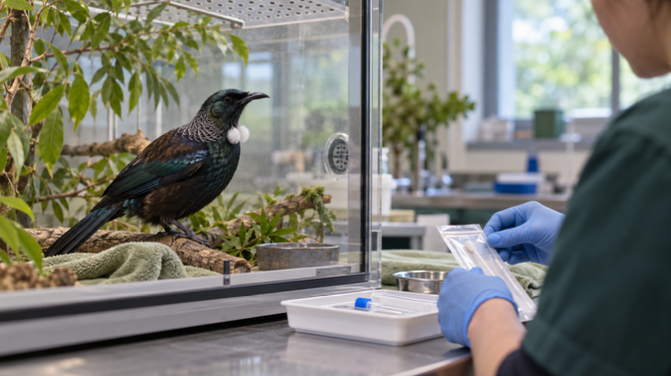
The Government has described wildlife care facilities as important partners in detecting bird flu early and protecting vulnerable native species.
Hoggard said early detection would be critical to limiting the effects on wildlife, industries and communities if the disease spread beyond individual wild birds.
The September funding follows other bird flu measures, including a $1.5 million grant announced in August to help poultry operators prepare for the possible arrival of H5 highly pathogenic avian influenza.
The difference between the Government's announcement and AJP's position is principally one of scope.
The announced $150,000 is targeted support for six facilities involved in surveillance and wildlife care. AJP is seeking a wider, explicitly funded system for responding to affected wild birds throughout New Zealand.
The Government's funding announcement did not set out a comprehensive new national wildlife rehabilitation or carcass-collection programme. That does not, by itself, establish that no other response arrangements exist.
Why is bird flu a concern for New Zealand?
Bird flu is already a live biosecurity concern.
In July, the Government confirmed H5 bird flu in a brown skua found at Petone Beach in Wellington. A second case was subsequently confirmed in a kāhu, or swamp harrier, found in the Wairarapa.
The detections underline the importance of surveillance, although they do not establish that a widespread outbreak is occurring across New Zealand's wild bird populations.
For AJP, the concern is whether wildlife carers and public agencies would have sufficient resources and clearly assigned responsibilities if more birds were affected.
The party says that question needs to be addressed before a larger response is required.
What should the public do if they find sick or dead birds?
MPI advises people not to touch sick or dead birds.
Groups of three or more sick or dead birds should be reported to MPI's exotic pest and disease hotline on 0800 80 99 66.
For one or two sick or injured native birds or other wildlife, people should contact the Department of Conservation's emergency hotline on 0800 DOC HOT (0800 362 468).
The Government advises against handling wildlife or taking affected animals home or to DOC offices.
Sources: Animal Justice Party Aotearoa New Zealand media release, 26 September 2026; New Zealand Government announcement, 24 September 2026.