India, meanwhile, demonstrated the attacking approach and batting depth that have become central to their T20 game.
For the Christchurch crowd, it was an evening of high-quality cricket, dramatic momentum shifts and a finish worthy of the occasion.
Match at a Glance
|
|
|
|
New Zealand
|
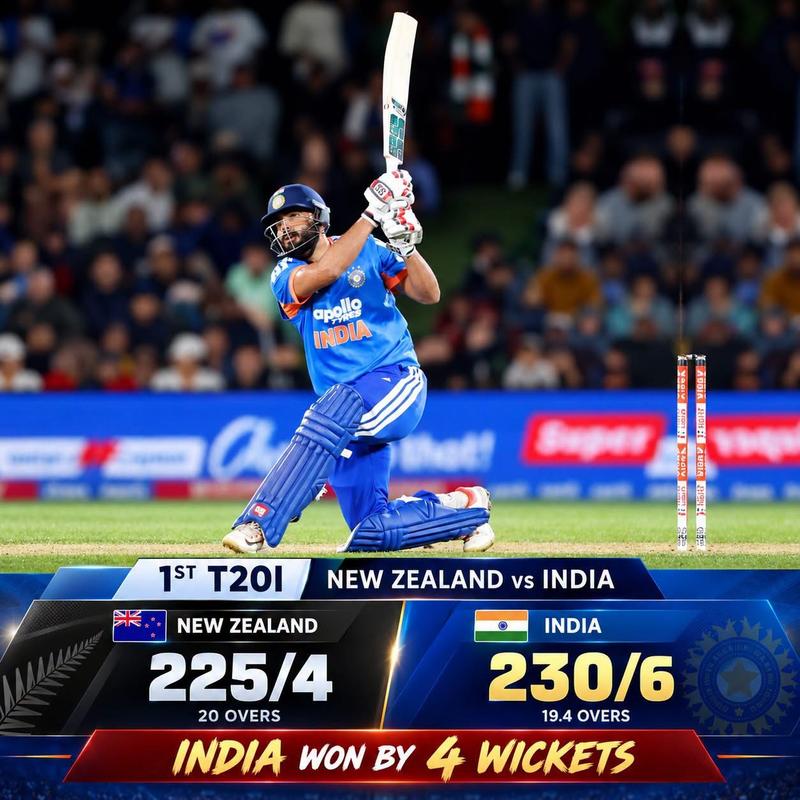
225/4 (20 overs)
|
|
India
|
230/6 (19.4 overs)
|
|
Result
|
India won by four wickets
|
|
Venue
|
Hagley Oval, Christchurch
|
|
Player of the Match
|
Sanju Samson
|
|
Series
|
India lead 1–0
|
Glenn Phillips Leads New Zealand’s Batting Charge
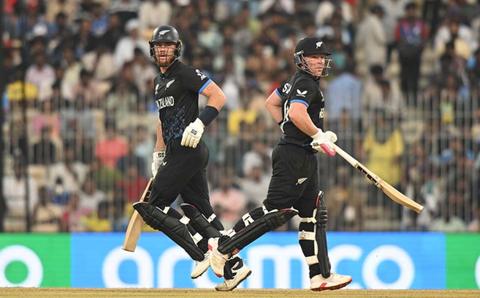
After India won the toss and chose to bowl, New Zealand’s opening pair of Finn Allen and Tim Seifert made a positive start.
The two added 49 runs in five overs, setting the tone for an aggressive innings.
Seifert scored 24 from 17 balls, while Allen struck 45 from 24 deliveries, including five fours and two sixes.
Daryl Mitchell contributed 28 from 19 balls before Glenn Phillips took centre stage.
Phillips delivered an exceptional innings, remaining unbeaten on 82 from just 40 balls, including eight fours and three sixes.
His ability to find boundaries while maintaining the scoring rate ensured New Zealand remained on course for a substantial total.
Young batter Bevon Jacobs provided valuable support, scoring 31 from 16 deliveries.
Their 73-run partnership helped the BLACKCAPS accelerate during the latter stages of the innings.
By the end of the 20 overs, New Zealand had reached 225 for four.
It was a commanding batting performance and a total that would have challenged any international side.
India Respond with an Extraordinary Powerplay
India’s chase began at remarkable speed.
Sanju Samson and Abhishek Sharma attacked New Zealand’s pace bowlers from the outset, adding 93 runs for the opening wicket in just 5.5 overs.
Samson struck 67 from 33 deliveries, including eight fours and four sixes.
Abhishek contributed 29 from only 12 balls.
India reached 94 for one after six overs, significantly reducing the pressure created by New Zealand’s imposing total.
The opening partnership proved decisive, but the match was far from over.
BLACKCAPS Show Character with Middle-Over Comeback
New Zealand responded impressively after the Powerplay.
Captain Mitchell Santner and Michael Bracewell brought greater control to the bowling effort, taking wickets and disrupting India’s momentum.
India slipped from 93 without loss to 122 for four.
Bracewell finished with two wickets for 37 runs, while Santner claimed two for 39.
Their combined efforts brought New Zealand firmly back into contention.
Speaking after the match, a BLACKCAPS player acknowledged the difficulty of recovering from India’s explosive start but praised the team’s determination.
He pointed out that the bowlers had conceded almost 100 runs during the Powerplay yet still managed to take the contest into the final over.
Against an Indian batting line-up with considerable depth, he considered that recovery an important demonstration of the team’s character.
It was a significant moment in the match.
New Zealand had absorbed India’s initial assault and created an opportunity to turn the result in their favour.
However, India still had experienced batters at the crease and considerable batting strength to follow.
Shreyas Iyer and Naman Dhir Complete India’s Recovery
Captain Shreyas Iyer played an important role in stabilising India’s innings.
He scored 42 from 28 deliveries and combined with Axar Patel, who contributed 24 from 14 balls, to rebuild after the loss of four wickets.
Their partnership of 45 runs helped India regain momentum.
Iyer later added another valuable partnership with Naman Dhir, who played a decisive role in the closing stages.
Dhir remained unbeaten on 42 from just 15 deliveries, striking five fours and two sixes.
India entered the final over needing eight runs.
Dhir struck a boundary from Matt Henry’s first delivery and eventually finished the match with a six from the fourth ball.
India reached their target with two deliveries remaining.
It was a composed finish from a player still establishing himself at international level.
Samson: India’s Aggressive Approach Is No Accident
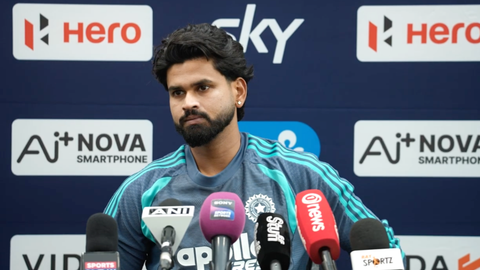
Speaking to the media after the match, Sanju Samson explained that India’s attacking start was part of a deliberate team strategy rather than simply a response to the target of 226.
He said India’s batters approach the Powerplay, middle overs and final overs differently, with an emphasis on taking advantage of scoring opportunities early in the innings.
“So we make sure that we kill the game in the Powerplay itself,” Samson said.
According to Samson, the philosophy has been central to India’s T20 cricket since the team’s victory at the 2024 World Cup.
He explained that even when chasing a smaller total, India’s intention is to capitalise on a strong start rather than automatically become more cautious.
The approach carries risks, but Samson said the team believes in continuing with a style that has worked for it.
He also stressed the importance of keeping the team’s interests ahead of individual achievements.
Playing Under Pressure and Managing Expectations
Samson spoke openly about the pressure associated with representing India.
With cricket attracting intense public attention, he said players must avoid allowing social media criticism or outside expectations to influence their approach.
“Playing for Indian cricket is not easy. There is a lot of noise happening,” he said.
Rather than trying to prove critics wrong, Samson said he focuses on preparation, practice and performing his role for the team.
He also praised India’s fitness preparation ahead of a demanding international schedule.
The players, he said, had placed considerable emphasis on their physical conditioning following the England series.
Samson reserved particular praise for Naman Dhir, highlighting the young batter’s composure in a difficult situation.
For India, the victory reflected not only aggressive batting but also the confidence of less experienced players to contribute under pressure.
New Zealand Reflect on Dew and Difficult Bowling Conditions
The BLACKCAPS’ post-match assessment offered another perspective on the contest.
A New Zealand player explained that the fast bowlers had struggled with their footing during the evening, with dew making conditions slippery.
Maintaining bowling rhythm was particularly challenging against Samson and Abhishek, who punished deliveries that missed their intended areas.
The player noted that dew and cold evening conditions are familiar challenges in New Zealand at this time of year.
A wet ball can be difficult to grip, potentially affecting the execution of yorkers, slower deliveries and other variations.
However, he made clear that the conditions were not an excuse.
New Zealand’s responsibility, he said, was to adapt.
He also acknowledged that batting second could offer some advantage when dew develops, although he did not believe the toss alone determined the result.
Fielding Opportunities and Fine Margins
New Zealand’s fielding also came under discussion during the post-match press conference.
When questioned about missed catching opportunities, the BLACKCAPS player challenged the suggestion that four catches had been dropped.
He distinguished between genuine dropped catches and opportunities where fielders had not managed to get their hands to the ball.
While acknowledging that chances had been missed, he stressed the importance of assessing them accurately.
In a match decided with just two balls remaining, small moments inevitably attract attention.
An additional wicket, a successful catch or a few more dot balls during India’s recovery could have changed the pressure on the chasing side.
Yet New Zealand’s ability to recover from the opening assault was also an important part of the story.
The BLACKCAPS did not allow India’s 94-run Powerplay to end the contest prematurely.
They continued competing, took wickets and remained in contention until the closing deliveries.
‘You Have to Have Every Plan Under the Sun’
Asked about the challenge of bowling to India’s aggressive batters, the New Zealand player said teams needed multiple plans and the ability to adapt quickly.
He acknowledged the quality of Samson and Abhishek, noting that bowlers have very little margin for error against players capable of scoring at such a high rate.
New Zealand had prepared different bowling options, but the challenge was executing them under pressure.
The player also credited India’s batters for adjusting to Christchurch conditions, including the bounce and relatively large boundaries.
His assessment was measured.
New Zealand had opportunities to win, but India performed better in the decisive moments.
That acknowledgement reflected the competitive respect between the two sides after a demanding contest.
A Positive Night for New Zealand’s Young Batters
Despite the defeat, New Zealand’s batting performance provided encouraging signs.
Allen and Seifert established an attacking platform, Phillips played a superb unbeaten innings and Jacobs contributed important runs during the closing stages.
The BLACKCAPS player also spoke positively about the confidence shown by younger members of the squad.
He suggested that New Zealand’s team environment allows emerging players to express themselves rather than feel constrained by their relative lack of international experience.
That confidence was evident in the way Jacobs attacked India’s bowling.
The performance also highlighted New Zealand’s batting depth and its ability to build partnerships throughout an innings.
Those are positives the team can carry into the remainder of the series.
What the Numbers Tell Us
The scorecard illustrates just how closely contested the match became after India’s rapid opening.
|
Key performance
|
Figures
|
|
Glenn Phillips
|
82 not out (40 balls)
|
|
Finn Allen
|
45 (24 balls)
|
|
Bevon Jacobs
|
31 (16 balls)
|
|
Sanju Samson
|
67 (33 balls)
|
|
Shreyas Iyer
|
42 (28 balls)
|
|
Naman Dhir
|
42 not out (15 balls)
|
|
Michael Bracewell
|
2/37
|
|
Mitchell Santner
|
2/39
|
|
India’s Powerplay
|
94/1
|
|
India’s highest successful T20I chase
|
Target of 226
|
New Zealand’s innings demonstrated its ability to score heavily against a strong international opponent.
India’s response showed how quickly a large total can be challenged when a batting side establishes early momentum.
The middle-over comeback, meanwhile, demonstrated that New Zealand’s bowling attack remains capable of creating opportunities even after a difficult start.
Attention Turns to Saturday’s Second T20
The teams will meet again at Hagley Oval on Saturday, 24 October, with New Zealand looking to level the five-match series.
For the BLACKCAPS, the priority will be translating their strong batting performance and middle-over bowling recovery into a complete 20-over display.
The team will also have to consider how best to manage its pace attack during a busy series.
The post-match discussion indicated that New Zealand has several frontline bowling options available, allowing selectors to consider fitness, workload and conditions when choosing the side.
India, meanwhile, will aim to maintain its aggressive batting approach while adapting to whatever conditions the next match presents.
Samson acknowledged that the circumstances could be different if India bats first, but indicated that the team’s broader attacking mentality would remain.
A Match That Showed the Strength of Both Teams
Thursday’s contest was more than a record chase or a disappointing defeat.
It was an example of how quickly modern T20 cricket can shift.
New Zealand’s 225 for four reflected the quality of its batting line-up, particularly Phillips’ outstanding innings and the contributions of Allen and Jacobs.
India’s successful pursuit demonstrated its ability to attack from the outset, recover from setbacks and finish under pressure.
Both teams had periods of control.
Both produced performances worthy of recognition.
Ultimately, India executed better in the closing stages and deserved the victory.
But the BLACKCAPS’ determination to fight back after a difficult Powerplay offered an important reminder that the result was not settled until the final over.
India leave Christchurch with the series lead and a place in their T20 record books. New Zealand leave with a defeat, but also with clear evidence that they can challenge the visitors.
For cricket supporters on both sides, the opening match has set up an intriguing series.
And with four T20 internationals still to play, there is plenty more cricket ahead.
Sources: Match scorecard and independent match reporting, 22 October 2026; post-match media interviews with Sanju Samson and a New Zealand player, credit : NZC
Reporting: Webfit News Sports Desk.