However, there is an important distinction between what Tamaki alleges, what Australian immigration law permits and what has actually been established.
At the centre of this story are three separate questions: Why did Australia cancel his visa? Were New Zealand authorities involved? And where does legitimate religious expression end and unlawful incitement begin?
Those questions deserve examination independently of whether people agree or disagree with Tamaki.
What Happened at Brisbane Airport?
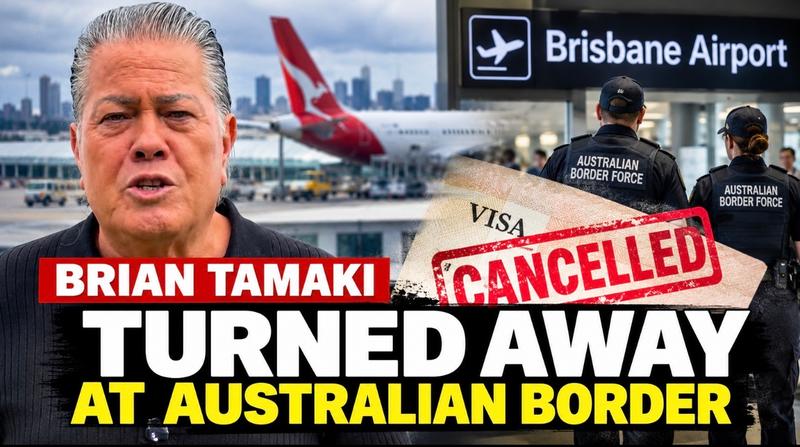
According to his Facebook statement, Tamaki travelled to Brisbane with his family on Tuesday, 20 October, intending to speak at a Christian church conference.
He says Australian Border Force officers stopped him at the airport and subjected him to more than 12 hours of questioning.
Tamaki claims he was subsequently held under guard until arrangements were made for his return to New Zealand.
He said he arrived back in Auckland on Wednesday, 21 October.
In his Facebook post, Tamaki shared excerpts that he attributed to Australian Border Force documents.
One excerpt described his social media statements as “inflammatory and concerning”.
Another suggested his presence in Australia could risk the good order of the Australian community, particularly Sikh and Muslim communities.
These extracts are significant because they suggest the reported decision was connected to concerns about the possible impact of his public statements, rather than an allegation that he intended to commit a specific criminal offence while visiting Australia.
However, Webfit News has not independently examined the complete visa cancellation notice or obtained confirmation from Australian Border Force about the exact grounds for the decision.
That distinction matters.
A person’s account of an immigration decision can be an important starting point for reporting, but the full official reasons are necessary before concluding whether the decision was legally justified, disproportionate or improperly motivated.
The Timeline: From June Statements to an Australian Border Decision
The Australian incident did not occur in isolation.
A series of events over the preceding four months provides important context.
June 2026: Controversial Religious Statements
During public commentary concerning Indian Prime Minister Narendra Modi and allegations of persecution of Christians in India, Tamaki made statements about Hindus, Sikhs and Muslims in New Zealand.
His remarks included a call to remove members of those religious communities from the country and a reference to burning mosques and temples in retaliation for alleged attacks on churches overseas.
Those comments attracted criticism and prompted police scrutiny.
Tamaki subsequently denied advocating violence and maintained that his comments were directed at religious beliefs and political leaders rather than people because of their race.
15 October 2026: Police Charges Confirmed
New Zealand Police confirmed that Tamaki faced three charges of inciting racial disharmony under Section 131 of the Human Rights Act 1993.
The charges relate to comments and Facebook publications made in June.
19 October 2026: Court Appearance
Tamaki appeared in the Manukau District Court and pleaded not guilty to all three charges.
He was granted bail, with his next court appearance scheduled for 25 January 2027.
20 October 2026: Brisbane Airport Incident
Tamaki says he travelled to Australia for a Christian conference but was questioned at Brisbane Airport and had his visa cancelled.
21 October 2026: Return to Auckland
According to Tamaki, he arrived back in New Zealand after being refused entry.
22 October 2026: Public Allegations
Tamaki’s Facebook statement has brought the Australian decision into public discussion and raised questions about possible communication between authorities in both countries.
The sequence is clear. What remains unclear is whether the New Zealand prosecution had any direct bearing on Australia’s immigration decision.
What Australian Law Actually Says
Section 116 of Australia’s Migration Act 1958 provides grounds on which authorities may cancel a visa.
Among those grounds are concerns that a visa holder’s presence in Australia may pose a risk to the health, safety or good order of the Australian community, or a segment of that community.
This is an important distinction from criminal law.
Australian immigration authorities do not necessarily need to establish that a visitor has committed a criminal offence before exercising certain visa cancellation powers.
A decision may instead involve an assessment of prospective risk.
But the existence of that power does not mean every cancellation is automatically justified.
The relevant legal grounds, the evidence supporting the decision, the assessment of risk and any applicable procedural fairness requirements remain important.
In Tamaki’s case, several facts have not yet been independently established.
Was the decision based entirely on his previous social media statements? Did officials consider the nature of the Christian conference he planned to attend? Was there specific evidence of a potential public-order risk? What explanation was provided to him, and what opportunity did he have to respond?
Without the complete cancellation documents, it is not possible to determine whether Australian authorities applied the legislation correctly.
There is also no basis at present to conclude that travelling to preach at a Christian conference was itself treated as a criminal offence.
The distinction between refusing someone entry on immigration grounds and criminalising religious worship is substantial.
The Question of New Zealand’s Involvement
One of the most consequential allegations in Tamaki’s statement concerns possible cooperation between New Zealand and Australian authorities.
Tamaki has called for Police Minister Mark Mitchell and New Zealand Police to be questioned about whether information was shared with Australian officials.
The possibility of information sharing is not inherently unusual.
Countries maintain immigration, border-security and law-enforcement relationships, and information can be exchanged for legitimate purposes subject to applicable laws and safeguards.
However, three very different possibilities must not be confused.
First, Australian officials may have independently reviewed Tamaki’s publicly available statements.
Second, they may have received information through ordinary government or law-enforcement channels.
Third, authorities may have coordinated specifically to prevent him from speaking at the conference.
Only the third possibility would support the more serious suggestion of deliberate cross-border suppression.
Tamaki’s Facebook statement does not establish which, if any, of these scenarios occurred.
Even evidence of routine information sharing would not, by itself, prove improper political interference.
Equally, government agencies should be able to explain the lawful basis for consequential decisions, subject to legitimate privacy, security and operational restrictions.
The public-interest question is therefore not simply whether information was shared, but what information was shared, under what authority and how it influenced the decision.
Why the New Zealand Criminal Case Matters
Tamaki’s legal difficulties in New Zealand provide context, but they must not be confused with the Australian immigration decision.
In the Manukau District Court on 19 October, he pleaded not guilty to three charges of inciting racial disharmony.
The prosecution relates to Facebook posts and statements made in June.
Section 131 of the Human Rights Act concerns certain threatening, abusive or insulting communications made with the intention of exciting hostility or ill will against groups identified by protected characteristics, including race, colour and ethnic or national origins.
The legal threshold involves more than simply expressing an unpopular opinion.
The wording, context, intention and statutory requirements are central to determining whether an offence has occurred.
The prosecution must establish the elements of the alleged offences, and Tamaki is entitled to challenge the evidence against him.
He remains presumed innocent unless proven guilty.
Tamaki has repeatedly maintained that he was challenging religious beliefs and political leadership rather than targeting individuals because of their racial background.
That defence will need to be considered alongside the actual language used and the prosecution’s evidence.
The distinction is especially important because religion and ethnicity can overlap in public discourse without being legally identical.
A criticism of a religious doctrine is not necessarily an attack on an ethnic group.
However, describing statements as religious criticism does not automatically remove them from legal scrutiny if their content and context engage protections against racial or ethnic hostility.
That is a question for the court, not a conclusion that should be reached through political slogans or social media reactions.
Free Speech Is Protected, but It Is Not Unlimited
New Zealand’s Bill of Rights Act 1990 protects freedom of expression, freedom of thought and religion, and the right to manifest religious beliefs.
These protections extend to opinions that others may find offensive, controversial or deeply objectionable.
Section 14 protects the freedom to communicate information and opinions, while Section 5 permits reasonable legal limits that can be demonstrably justified in a free and democratic society.
That means the law must balance competing interests.
People should be free to criticise governments, religious doctrines and public figures without automatically facing punishment.
At the same time, members of religious and ethnic communities are entitled to protection under laws addressing unlawful hostility, threats and incitement.
The challenge is not to decide which group deserves greater protection. It is to apply consistent legal principles regardless of the speaker’s popularity, religious affiliation or political position.
There is another distinction in Tamaki’s situation.
New Zealand’s Bill of Rights Act governs the actions of New Zealand public authorities. It does not directly determine whether an Australian immigration decision is lawful.
Australia’s decision must be assessed under its own legislation and applicable legal protections.
A person can therefore have a protected right to express views in New Zealand without possessing an automatic right to enter another country to express those views.
Whether the Australian decision was justified remains a separate question.
A Concern Beyond Brian Tamaki: How Should Governments Assess Speech?
The wider issue is how governments assess the potential consequences of controversial speech before any harm has occurred.
Immigration authorities may legitimately consider public-order risks when deciding whether a visitor should be admitted.
But such assessments raise questions about evidence and proportionality.
Should a person’s previous statements alone be sufficient to refuse entry?
How should authorities distinguish deliberately provocative rhetoric from a credible risk of hostility or violence?
Should the purpose of a visit, the intended audience and the circumstances of the proposed event influence that assessment?
And how much information should authorities disclose so that an affected person can understand and, where legally available, challenge the decision?
These questions matter beyond Tamaki.
They could arise when religious leaders, political activists, academics, campaigners or other controversial speakers seek to travel internationally.
The relevant principle should be consistency.
A decision should not depend simply on whether authorities or the public approve of the speaker’s views. It should be based on the applicable law and evidence.
Equally, a claim of religious or political expression should not automatically prevent authorities from examining a genuine public-safety concern.
What About the Sikh and Muslim Communities Named in the Documents?
Tamaki’s account specifically identifies Sikh and Muslim communities as groups Australian authorities considered potentially affected by his presence.
That detail deserves attention.
The debate has largely centred on Tamaki’s ability to speak, but freedom of religion also protects the rights of people whose beliefs are being criticised.
Members of Sikh, Muslim, Hindu and Christian communities are equally entitled to practise their faith, participate in public life and express their beliefs.
Disagreement between religious communities is not inherently unlawful.
However, there is a meaningful distinction between challenging a belief and encouraging hostility towards people who hold that belief.
That distinction becomes particularly important when public statements refer not only to religious ideas but also to removing communities from a country or damaging their places of worship.
Tamaki denies advocating violence, and the legal significance of his New Zealand statements remains before the court.
His explanation deserves to be reported accurately, just as the original language and concerns arising from it must not be omitted.
At present, Webfit News has not obtained a direct response from representatives of the Sikh or Muslim communities specifically concerning the reported Australian border decision.
Their perspectives would be relevant to understanding whether the concerns identified by Australian officials reflected documented risks, community representations or an independent government assessment.
What the Free Speech Union Has Said
The Free Speech Union has publicly raised concerns about Tamaki’s prosecution in New Zealand.
In a statement issued on 15 October, the organisation questioned the use of racial disharmony provisions in a case involving religious commentary.
Its argument centres on the risk of using criminal law to restrict speech that challenges religious beliefs, even when that speech is offensive.
The organisation has distinguished between objectionable expression and conduct that warrants criminal punishment.
That position contributes an important perspective to the debate, although it does not establish that Tamaki’s particular statements were lawful or that the Australian immigration decision was improper.
Those questions require separate legal assessments.
The 31 October Protest and Auckland’s Diwali Celebrations
Tamaki has announced a public gathering for Saturday, 31 October, at 12pm in Britomart Square, Auckland.
The demonstration, promoted under the slogan “Get Them Out”, is connected to his wider campaign concerning immigration, freedom of speech and government accountability.
The date has attracted additional attention because Auckland’s Diwali Festival is also scheduled for that weekend.
Tamaki has denied deliberately choosing the protest date to coincide with the festival.
The coincidence nevertheless raises practical questions about public messaging, community confidence and the management of simultaneous gatherings in central Auckland.
The right to peaceful protest is an important democratic freedom.
So too is the right of communities to celebrate their religious and cultural traditions without intimidation.
Neither right should automatically be treated as cancelling out the other.
The responsibility of authorities is to protect lawful participation, maintain public safety and respond to actual conduct rather than assumptions about the people involved.
What Still Needs to Be Established?
For a case attracting such strong claims about government conduct and individual freedoms, several essential pieces of information remain missing from the public account examined by Webfit News.
1. The complete Australian visa cancellation decision
Tamaki has shared excerpts attributed to official documents, but the full notice would clarify the precise legal grounds and reasons relied upon.
2. The evidence used in the risk assessment
It remains unclear which statements Australian officials considered, how they assessed their potential impact and whether other information influenced the decision.
3. Any communication between New Zealand and Australian authorities
No independently verified evidence currently establishes that New Zealand officials requested, encouraged or coordinated the cancellation.
4. The opportunity Tamaki had to respond
The circumstances of his questioning, the process followed and any available review rights require clarification.
5. The nature of the planned Christian conference
The conference’s programme, organisers, intended audience and any relevant security arrangements could help establish the context of his proposed visit.
6. The views of affected communities
Direct responses from community representatives would help establish how the statements and reported immigration decision are viewed by those specifically named in Tamaki’s account.
7. Official responses from both countries
Statements from Australian Border Force, the Australian Department of Home Affairs and relevant New Zealand authorities would help distinguish confirmed administrative actions from allegations of political interference.
These are not minor details. They are the information needed to reach an evidence-based understanding of what happened.
The Bigger Question: Accountability Must Work Both Ways
The case illustrates why public debate about free speech cannot be reduced to supporting or opposing one individual.
Tamaki has the right to dispute the allegations against him, defend his religious beliefs and question government decisions.
Australian authorities have responsibilities under immigration law, including assessing relevant risks to the community.
New Zealand authorities have responsibilities to enforce the law fairly and independently.
And the communities affected by controversial statements have rights and interests that deserve consideration.
None of these principles is automatically more credible because of the political identity of the person invoking it.
If authorities exercise powers that restrict an individual’s activities, there should be an identifiable lawful basis and appropriate accountability.
If a public figure claims government persecution or international coordination, that allegation should also be supported by evidence.
The standard of scrutiny should apply in both directions.
Conclusion: A Border Decision That Needs More Than Political Arguments
Brian Tamaki’s reported refusal of entry into Australia has brought together two separate legal systems and several fundamental questions about democratic rights.
His New Zealand criminal case concerns whether specific statements breached the Human Rights Act.
The Australian matter concerns whether immigration officials had sufficient grounds to cancel his visa.
His allegation of coordination between the two countries raises a third issue, one that remains unproven.
It would be premature to conclude that the Australian decision demonstrates a campaign to silence Christianity.
It would be equally premature to conclude that the cancellation was unquestionably justified without examining the full reasons and evidence.
The strongest test of a democratic system is not whether it protects only popular speech, or whether it acts firmly against unpopular speakers. It is whether the same laws, standards of evidence and procedural safeguards apply fairly to everyone.
For now, Tamaki has presented his account. The New Zealand court proceedings are ongoing. The full basis of the Australian decision has not been independently established.
The next meaningful development should come from documents, official explanations and evidence, rather than competing political claims.
That is where the public-interest story now lies.
Source and Editorial Disclosure
This article was developed from a public statement and accompanying video published on Brian Tamaki’s Facebook page and supplied to Webfit News.
Background information was checked against reporting by RNZ, 1News and the New Zealand Herald, the Free Speech Union’s published statement, New Zealand’s Human Rights Act 1993 and Bill of Rights Act 1990, and Australia’s Migration Act 1958.
Webfit News has distinguished Tamaki’s allegations from independently reported court proceedings and established legal provisions. The full Australian visa cancellation documents have not been independently reviewed, and the allegation of coordinated action by Australian and New Zealand authorities remains unverified.
This report does not endorse or oppose Tamaki, his statements, the prosecution or the Australian immigration decision. It examines the evidence currently available and the questions that remain unanswered.