National’s nationwide party vote has fallen sharply from its 2023 result, while the party has retained a substantial number of electorate seats.
That combination could leave no room for some of its most senior list MPs.
Nicola Willis: A finance minister facing Parliament exit
For Nicola Willis, the result carries particular significance.
As National’s deputy leader and Minister of Finance, Willis has been one of the most prominent figures in Christopher Luxon’s government.
She also holds the Economic Growth and Social Investment portfolios.
Yet despite being ranked second on National’s party list, immediately behind Luxon, Willis faces the prospect of not returning to Parliament.
Unlike the 2023 election, when she contested Ōhāriu against Labour’s Greg O’Connor, Willis did not stand for an electorate in 2026.
Her return therefore depends entirely on National securing enough list seats.
Speaking to reporters on election night, Willis acknowledged the seriousness of her position.
According to the New Zealand Herald’s election-night reporting, she said she had likely lost her job and accepted that she was very unlikely to return to Parliament.
For a sitting finance minister and deputy party leader, it is a remarkable political development.
Chris Bishop: Hutt South defeat adds to National’s difficulties
Chris Bishop, another senior National figure, is also facing an uncertain future.
Bishop previously represented Hutt South and held major government responsibilities, including housing and infrastructure-related portfolios.
In the 2026 election, he faced Labour’s Ginny Andersen in Hutt South.
As counting progressed, Andersen maintained a lead over Bishop, putting the electorate beyond his immediate reach in the preliminary projections.
Bishop’s position is especially difficult because an electorate defeat would leave him dependent on National’s party list.
With the party’s list allocation under pressure, that route back to Parliament may not be available.
The potential loss of Bishop would remove another experienced government minister from National’s parliamentary team.
Paul Goldsmith: Another senior minister at risk
Paul Goldsmith is also among the senior National MPs facing the possibility of leaving Parliament.
Goldsmith, who has held the Justice portfolio, was another list-only candidate in 2026.
He did not contest an electorate seat.
That means his parliamentary future depends on the number of list places National receives after its electorate victories are taken into account.
Despite his seniority and prominent position within the government, Goldsmith could be excluded from the next Parliament if National’s electorate MPs fill its entire proportional entitlement.
Gerry Brownlee: A veteran politician faces uncertainty
Gerry Brownlee, one of National’s longest-serving political figures, is also affected by the party’s difficult list-seat calculations.
Brownlee has served in numerous senior roles during his parliamentary career, including Speaker of the House.
Like Willis and Goldsmith, he contested the 2026 election as a list-only candidate.
His return depends on National having sufficient list seats available.
Brownlee has pointed to the impact of split-ticket voting, where voters support National electorate candidates but give their party vote to another political party.
That pattern can produce strong electorate results without providing the party-vote share needed to accommodate additional list MPs.
Banks Peninsula and other electorate contests
National has also faced setbacks in individual electorates.
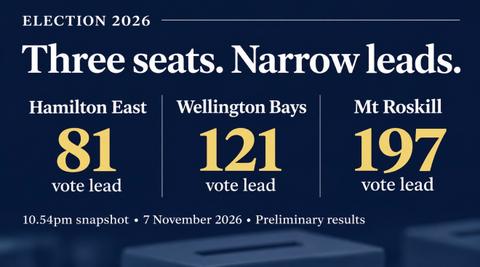
In Banks Peninsula, Labour’s Tracey McLellan was leading National’s Vanessa Weenink during the preliminary count.
In Hutt South, Labour’s Ginny Andersen was ahead of Chris Bishop.
Wairarapa also became an exceptionally close contest between Labour’s Kieran McAnulty and National’s Mike Butterick.
These contests have contributed to the changing parliamentary calculations throughout election night.
However, not every National electorate contest has gone against the party.
National candidates have maintained substantial leads in several other constituencies, including Botany, Napier and Tukituki.
The party’s problem is therefore more complicated than a straightforward loss of electorate representation.
It is the relationship between its electorate victories and its nationwide party vote.
How can National win electorates but lose senior ministers?
Under New Zealand’s MMP system, the party vote generally determines how many seats each political party receives in Parliament.
Electorate victories are counted towards that total.
If National is entitled to approximately 40 seats based on its party vote and wins more than 40 electorates, those electorate MPs retain their seats.
The additional seats can create an overhang, increasing the size of Parliament.
But the party does not automatically receive extra list seats for senior politicians who failed to win electorates or did not contest them.
That is the problem facing Willis, Bishop, Goldsmith and Brownlee.
National’s electorate success could effectively use up its entire parliamentary entitlement, leaving no list positions available.
It is a striking consequence of an electoral system designed to balance local representation with proportional party support.
National’s party vote has fallen sharply
The scale of National’s decline in the nationwide party vote helps explain the situation.
At the 2023 general election, National received approximately 38% of the party vote.
Late preliminary figures from Saturday’s election showed its support falling below 30%.
That represents a substantial reduction in its national vote share.
At the same time, National has remained competitive across numerous electorate contests.
This difference between the two votes is central to the party’s parliamentary difficulties.
It also demonstrates why electorate victories alone cannot be used to judge a party’s overall electoral performance under MMP.
Could National still form the government?
Despite the potential loss of senior ministers, National and its existing coalition partners remained in contention to govern.
Late election-night projections placed National, ACT and New Zealand First on approximately 66 seats in a 129-seat Parliament.
That would provide a narrow majority, with 65 seats required to govern.
However, the result remains preliminary.
Special votes, including overseas ballots, have not yet been included in the official allocation.
Changes to close electorate results could also affect the size of Parliament and the majority threshold.
The final outcome may therefore alter both the governing arithmetic and the number of National MPs who return.
A difficult result for National’s leadership
The possible departure of Willis, Bishop, Goldsmith and Brownlee presents a significant challenge for National.
These are not obscure candidates at the bottom of a party list.
They include the deputy leader, the finance minister, other senior ministers and one of the party’s most experienced parliamentary figures.
If they fail to return, National would face substantial changes to its parliamentary leadership and ministerial team.
That would create complications even if Luxon ultimately secured another term as prime minister.
But it would be premature to describe their departures as confirmed.
The official results could still change the distribution of parliamentary seats.
The election-night paradox
The 2026 election has produced an unusual possibility for National.
The party could retain enough support, alongside ACT and New Zealand First, to continue governing.
Yet some of the politicians who helped lead its previous government could find themselves outside Parliament.
For Nicola Willis, the situation is particularly significant.
A sitting finance minister and deputy leader, ranked second on her party’s list, may be unable to return because of the way National’s electorate victories interact with its reduced party vote.
National could keep the government benches while losing some of the ministers who occupied them.
That is one of the most consequential stories emerging from election night.
The Electoral Commission expects to declare the official result on 27 November 2026.
Until then, the fate of National’s senior list MPs remains provisional.
This article reflects preliminary election-night results and reporting from 7 November 2026. Parliamentary allocations may change after special votes are counted.
Sources: New Zealand Electoral Commission, RNZ, 1News and New Zealand Herald election-night reporting.
Why this is the stronger news angle
The headline puts Nicola Willis first, because she is National’s deputy leader and finance minister. The supporting story explains the wider risk to Bishop, Goldsmith and Brownlee rather than falsely claiming all four have already lost their seats. RNZ’s reporting identifies the four as list-seat casualties at risk, while the NZ Herald reports Willis’ own acknowledgement of her likely departure. 1news.co.nz +1
I would not headline this “National loses several senior ministers” yet. That turns a preliminary projection into a confirmed outcome. “Faces Parliament exit” is both stronger editorially and defensible.