
An analysis of ACC’s Christmas party data shows Auckland accounts for almost four in every 10 recorded claims, while younger workers are disproportionately represented among those injured.
By Webfit News | 24 November 2026
Friday 25 December
Countdown to ChristmasAn analysis of ACC’s Christmas party data shows Auckland accounts for almost four in every 10 recorded claims, while younger workers are disproportionately represented among those...
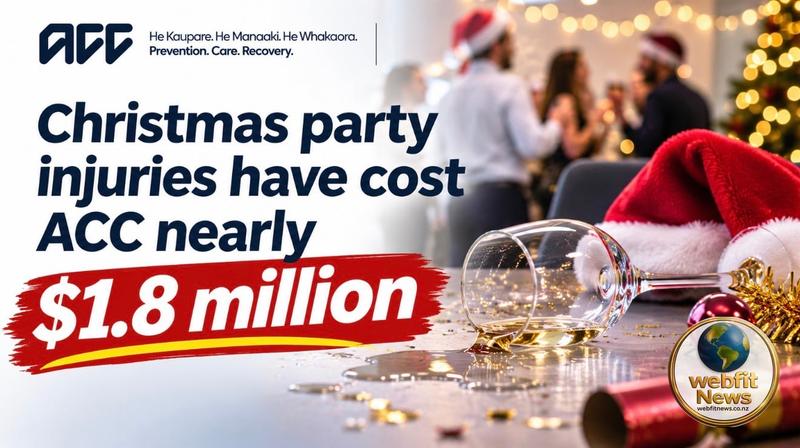
An analysis of ACC’s Christmas party data shows Auckland accounts for almost four in every 10 recorded claims, while younger workers are disproportionately represented among those injured.
By Webfit News | 24 November 2026
The end-of-year party season has generated a surprisingly expensive hangover for New Zealand.
More than 420 Christmas party-related injuries were recorded by ACC between 2021 and 2025, costing almost $1.8 million.
But a closer look at the data shows something more interesting.
Auckland alone accounted for 163 of the 421 claims, or almost 39% of the national total.
And people aged between 25 and 34 accounted for 104 claims, meaning almost one in every four recorded Christmas party injuries came from that relatively narrow age group.
Across the five-year period, the average cost works out at roughly $4,300 for every recorded claim.
These are not necessarily spectacular accidents involving drunken dance floors or office-party stunts.
Most are much more ordinary.
Losing balance.
Lifting something awkwardly.
Twisting the wrong way.
Missing a step.
In other words, the biggest Christmas-party risk may simply be people doing normal things while tired, distracted or operating in unfamiliar surroundings.
Auckland dominates the raw numbers
ACC recorded:
|
Region |
Christmas party claims |
Share of 421 claims |
|
Auckland |
163 |
38.7% |
|
Wellington |
64 |
15.2% |
|
Canterbury |
43 |
10.2% |
Together, those three regions account for about 64% of all recorded Christmas party claims in the dataset.
Auckland’s dominance should be viewed with some caution.
It is also New Zealand’s largest population centre, so a higher raw claim count is not unexpected.
That means the data does not prove Auckland has the country’s most dangerous Christmas parties.
What it does show is where the largest absolute burden is falling.
And for employers and event organisers in Auckland, 163 claims is still a number worth noticing.
Younger workers stand out
Age is another interesting part of the dataset.
People aged 25 to 29 recorded 53 claims, the highest of any age group.
Those aged 30 to 34 recorded 51.
Combined, that is 104 claims.
Put another way, roughly 24.7% of all recorded Christmas party injuries involved people aged 25 to 34.
The next notable group was those aged 50 to 54, with 41 claims.
ACC has not provided enough information to calculate injury rates by age group because we do not know how many people from each age group actually attended Christmas functions.
So it would be wrong to conclude that younger employees are inherently more reckless.
But they are clearly prominent in the claims data.
The average claim costs about $4,300
The headline figure of $1.8 million sounds large.
Spread across 421 claims, it equates to an average of roughly $4,300 per claim.
That average should not be mistaken for the cost of a typical injury.
Some claims may have involved relatively minor treatment.
Others may have required surgery, rehabilitation, weekly compensation or long-term support.
ACC says some people continued to require assistance well after the celebrations ended.
That is why a relatively small number of injuries can generate a sizeable total bill.
2022 had the most injuries. 2023 cost the most.
The years also tell two different stories.
The highest number of claims occurred in 2022, when 101 were lodged.
But the most expensive year was 2023, when Christmas party-related claims cost ACC $489,302.
That difference matters.
More claims do not automatically mean higher costs.
A smaller number of serious injuries can cost far more than a larger number of minor ones.
In 2025, ACC recorded 86 claims.
That is lower than the 2022 peak, but still a significant number across the November-December party season.
The injuries are surprisingly ordinary
ACC injury prevention leader James Whitaker says the most common risks are often hiding in plain sight.
“The biggest risks aren’t necessarily the ones people expect,” he said.
“Many injuries happen during ordinary activities like walking or carrying items.”
Loss of balance was the leading cause.
Lifting and carrying injuries were also common, along with twisting and contact with other people.
Sprains, strains, fractures, concussions and cuts all featured in the claims.
The lower back, spine, knees and ankles were among the most commonly affected parts of the body.
“It doesn’t take much,” Whitaker said.
“A missed step, awkward lift or loss of balance can be enough to turn a celebration into a summer spent recovering.”
The real risk may begin before the party even starts
One point in ACC’s data is easy to overlook.
Not every injury necessarily happens while people are celebrating.
Christmas functions involve setting up tables and decorations, carrying boxes, moving equipment, standing for long periods and then packing everything away afterwards.
Those jobs often fall to employees or volunteers who may not normally perform physical work.
Add unfamiliar venues, end-of-year fatigue and activities outside people’s usual routines, and the risk starts to make more sense.
Whitaker said those factors often combine.
“People are often in unfamiliar venues, helping set up or pack down events, taking part in activities they wouldn’t normally do, or simply spending long periods on their feet after a busy year when they’re already tired.”
That makes this as much a workplace-planning story as a party story.
What the numbers cannot tell us
There is one important limitation.
ACC does not maintain a neat database labelled “Christmas party injuries”.
The 421 claims were identified by searching free-text accident descriptions for combinations of words such as “Christmas”, “Xmas”, “work”, “social”, “party”, “parties” and “function”.
That field is optional.
Not everyone completes it.
And people describe accidents differently.
ACC itself warns that the figures should therefore not be treated as a definitive count.
The real number of Christmas party-related injuries could be higher or lower.
The data also cannot tell us how many Christmas parties took place, how many people attended, or what proportion of attendees were injured.
That means it can describe the claims ACC found.
It cannot establish the actual risk of attending a Christmas party.
That distinction is important.
Christmas party injuries are a small part of ACC’s wider burden
The nearly $1.8 million cost is significant in the context of preventable end-of-year injuries.
But it is still a small part of ACC’s overall injury burden across New Zealand.
That wider context matters because it shows this is not about portraying Christmas parties as unusually dangerous.
It is about recognising that relatively ordinary, avoidable incidents can still create real costs for individuals, employers and the public injury system.
The takeaway is not “don’t have a Christmas party”
Christmas functions matter.
They give colleagues, friends and whānau a chance to finish the year together.
The data is not an argument for cancelling them.
It is an argument for thinking about the boring details that nobody notices until something goes wrong.
Who is moving the tables?
Is the floor slippery?
Are cables crossing walkways?
Is an activity suitable for everyone?
How are people getting home?
Whitaker’s advice is simple:
“A little planning goes a long way.”
That may sound obvious.
But five years, 421 claims and almost $1.8 million later, the numbers suggest obvious things are exactly where many injuries begin.
The most expensive part of the Christmas party may not be the food, the venue or the drinks. It may be the missed step nobody saw coming.
Was this article useful?