Discover the Ramayana on the Big Screen: A New Generation’s Invitation to an Ancient Epic
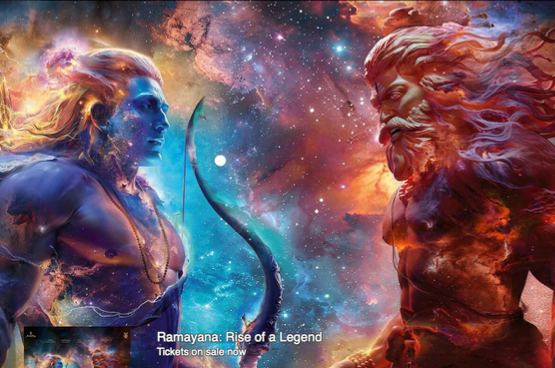
Ranbir Kapoor, Yash and Sai Pallavi lead Ramayana: Rise of a Legend, opening in New Zealand on 5 November, with visual effects from DNEG and ReDefine and music by Hans Zimmer and...
Ranbir Kapoor, Yash and Sai Pallavi lead Ramayana: Rise of a Legend, opening in New Zealand on 5 November, with visual effects from DNEG and ReDefine and music by Hans Zimmer and A.R. Rahman.
By Webfit News | 3 November 2026 Promotional feature prepared at the request of the film’s New Zealand distributor.
For some families, the Ramayana brings back memories of grandparents telling stories, television episodes watched together and childhood questions about courage, loyalty and doing the right thing.
For others, particularly younger New Zealanders, the names Rama, Sita and Ravana may be familiar without the story behind them.
This week offers an opportunity for both audiences to meet in a cinema.
Ramayana: Rise of a Legend opens in New Zealand on Thursday, 5 November 2026. Event Cinemas has confirmed tickets are on sale, with selected V-Max and IMAX with Laser 3D screenings among its advertised options.
The attraction is straightforward: an ancient epic, a contemporary live-action production and the chance to discover its characters through performance, music and a world created for the big screen.
New to the Ramayana? Start here
The Ramayana is one of India’s great Sanskrit epics, traditionally attributed to the sage Valmiki. Its central figure is Rama, prince of Ayodhya, whose life is transformed by a 14-year exile. His wife Sita and brother Lakshmana accompany him, and the wider epic includes Sita’s abduction by Ravana, the ruler of Lanka.
It is also a sacred narrative for many Hindus. That religious significance deserves respect, even as a cinema adaptation invites people from different backgrounds to encounter the story.
You do not need to memorise a family tree before taking your seat. A useful starting point is to recognise the questions beneath the adventure.
What do you do when keeping a promise costs you the life you expected? What does loyalty demand when circumstances become difficult? And what happens when power is guided by pride?
Those questions give newcomers something immediate to connect with. The setting may be unfamiliar; the tensions between love, responsibility, ambition and sacrifice are easier to recognise.
The film’s official synopsis places Rama and Ravana at its centre, describing a prince shaped by sacrifice and an immortal king driven by vengeance, with a prophecy connecting their destinies.
The faces behind the characters
The production’s announced principal cast brings together:
Actor
Character
Ranbir Kapoor
Rama
Sai Pallavi
Sita
Yash
Ravana
Ravie Dubey
Lakshmana
Sunny Deol
Hanuman
For first-time viewers, the relationships provide an entry point: Rama and Sita as husband and wife, and Lakshmana as Rama’s brother. For viewers returning to a familiar story, the interest lies in how these performers interpret characters they may have imagined since childhood.
The film is directed by Nitesh Tiwari, whose credits include Dangal. Sony’s official credits name Shridhar Raghavanas screenwriter and Namit Malhotra as producer.
A production built around visual storytelling
One of the clearest reasons to consider a cinema visit is the production’s visual ambition.
DNEG confirms that Ramayana was filmed for IMAX, with visual effects supplied by DNEG and ReDefine. Sony identifies DNEG’s previous work on films including Dune, Interstellar and Inception. Those credits establish the studio’s experience with large-scale screen worlds, while audiences will judge this film’s finished results for themselves.
For someone encountering the Ramayana for the first time, visual storytelling can offer a useful bridge. A face, a landscape or a moment of danger can make an unfamiliar setting easier to follow than a list of names and explanations.
The promise of this approach is that viewers can enter the story through what they see and feel. Technology gives filmmakers tools to suggest scale, distance and extraordinary events; the characters give those images meaning.
Prime Focus also identifies Brahma AI’s support through real-time virtual workflows and AI research. That is a specific production claim, rather than a reason to describe the entire film as “AI-generated”.
A screen adaptation remains an artistic interpretation of the epic. Its images can inspire curiosity about the Ramayana, without replacing the text or the many ways people understand it.
The craftspeople shaping the world
The announced creative team extends beyond the cast and visual effects studios.
Prime Focus names Terry Notary and Guy Norris as the action choreography leads, with production design by Ravi Bansal and Ramsey Avery.
That combination matters because spectacle involves more than digital imagery. Movement, physical spaces, costumes, framing and performance all contribute to whether a screen world feels convincing.
For audiences, there is no homework required in knowing the departments behind a film. But their presence helps explain the ambition of this production: it brings together specialists across several crafts to interpret a story on a substantial cinematic scale.
Hans Zimmer and A.R. Rahman join forces
The music is another significant part of the film’s appeal.
The production brings together Academy Award-winning composers Hans Zimmer and A.R. Rahman, in what DNEG describes as their first collaboration.
For a story involving sacrifice, separation and confrontation, the score has an important job. It can give quiet moments space to breathe and lend weight to larger sequences.
Hearing that collaboration through a cinema sound system is a distinct reason for music lovers to consider the theatrical release. The names alone cannot tell audiences how they will respond to the finished score, but they make it a collaboration worth listening for.
An invitation for Gen Z and first-time viewers
A younger viewer should not have to pretend to know a story simply because older relatives grew up with it.
There is room to begin with curiosity.
Who are these characters? Why do their choices matter? Why has this story remained important to people across generations?
For New Zealanders raised between cultures, a cinema outing could become an easy starting point for those conversations. A parent might recognise a moment from childhood. A teenager might question a character’s decision. A friend unfamiliar with the tradition might want to know more about what happens next.
That exchange can be part of the pleasure of going together.
Nor does every younger viewer need the same reason to attend. Some may come for the actors, others for the music, the visuals or an interest in epic storytelling. Any of those can be a starting point.
The beginning of a two-part journey
Viewers should know that this release begins a larger project.
DNEG and Prime Focus announced Ramayana as a two-part production, with the first instalment in 2026 and the second planned for 2027.
Treat this cinema visit as the opening chapter of that adaptation. Familiarity with the wider epic does not establish exactly which events appear in this instalment.
The production has already held a Los Angeles premiere at the Academy Museum of Motion Pictures’ David Geffen Theatre on 27 October, attended by its lead cast and filmmaking team.
DNEG’s subsequent announcement lists Hindi, Tamil, Telugu, Kannada, Malayalam and English among its worldwide release languages. Availability in New Zealand depends on the cinema and session.
What New Zealand audiences should check before booking
Both Event Cinemas and HOYTS list a 5 November New Zealand release. HOYTS specifically lists a Hindi version with English subtitles.
The current Hindi listings give a running time of 205 minutes, or three hours and 25 minutes. Allow extra time for the cinema visit and check the booking page for session arrangements.
Event’s Hindi listing still displays the classification as TBC at the time of checking, so parents should confirm the final rating and content advice before booking for children.
When choosing tickets, check:
The spoken language and subtitle information.
Whether the session is standard, 3D, V-Max or IMAX.
The final classification and content advice.
The start time, location and ticket price.
Premium formats vary by venue and session. Choose the experience that suits your group.
Make a night of discovering the story
For people who know the Ramayana, this release offers another interpretation to explore. For those who have never followed it, it offers a chance to begin with a live-action film made for contemporary cinema audiences.
Go with someone who knows the story. Take a friend who does not. Leave time afterwards to talk about the characters, the choices and the questions the film raises.
Ramayana: Rise of a Legend opens in New Zealand cinemas on Thursday, 5 November. Tickets are available through Event Cinemas and HOYTS. Choose your cinema, check your preferred language and format, and book your seats.