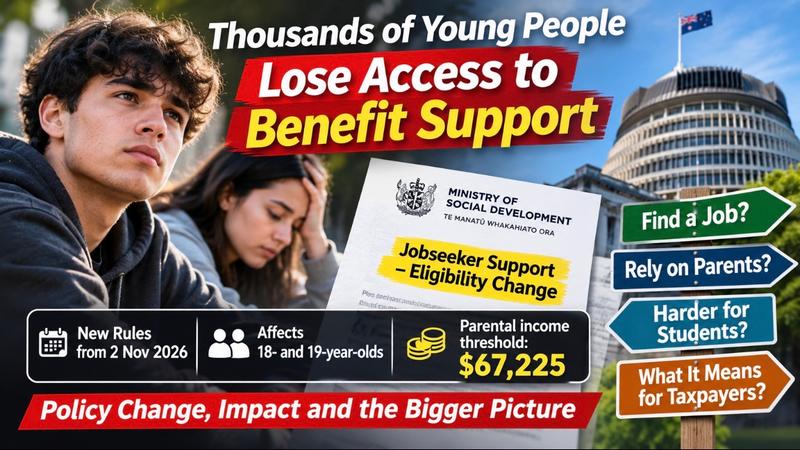
Supporters of the reform see it as a question of responsibility: why should taxpayers fund an unemployed young adult if their parents can reasonably provide financial assistance?
Critics argue that the income threshold does not necessarily reflect what families can afford, particularly when they have rent, mortgages, younger children and other commitments.
Both arguments deserve examination.
The bigger question is whether the reform will help more young New Zealanders move into employment, or whether some will simply disappear from benefit statistics while remaining unemployed.
The Key Numbers
|
Measure
|
Figure
|
Why it matters
|
|
New parental income threshold
|
$67,225 annually
|
Determines one route to eligibility for affected young people
|
|
Young people estimated to lose eligibility
|
Approximately 4,300
|
Government estimate, not a confirmed count of payments stopped
|
|
NZ unemployment rate
|
5.6%
|
Highest since 2015, based on June 2026 data
|
|
Unemployed New Zealanders
|
171,000
|
Seasonally adjusted June 2026 estimate
|
|
Unemployment among 15–19-year-olds
|
25.3%
|
Youth figure reported by RNZ
|
|
Student Allowance parental income cut-off, living at home
|
$131,670
|
More than $64,000 above the new Jobseeker threshold
|
|
Student Allowance parental income cut-off, living away
|
$141,451
|
Highlights differences between student and unemployment assistance
|
Sources: Ministry of Social Development, Work and Income, StudyLink, Stats NZ and RNZ Checkpoint. Figures refer to different programmes and populations and should not be treated as directly interchangeable.
1. What Exactly Changed on 2 November?
Until this reform, an eligible unemployed 18- or 19-year-old could apply for Jobseeker Support without being subject to this new parental income requirement.
They still had to satisfy the ordinary eligibility conditions, including relevant work-related and financial requirements.
Now, affected applicants must also complete a Parental Assistance Test.
There are two principal ways to meet that test:
- Parental income: The applicable parents’ combined gross income is no more than $67,225 annually.
- Parental support gap: The young person cannot reasonably be expected to rely on parental assistance because of their circumstances.
The support-gap provision is important. It recognises that not every young adult has a safe or functioning relationship with their parents.
Examples may include family breakdown, unsafe contact, a parent in prison or prolonged hospital care.
Young people with dependent children are exempt from the new parental test.
Does everyone immediately lose their benefit?
No.
This is an important distinction.
Existing recipients generally continue receiving Jobseeker Support until their next reapplication or a relevant change in circumstances triggers reassessment.
For many Jobseeker recipients, that occurs during the 26-week reapplication process.
The new policy therefore does not mean that 4,300 payments were automatically cancelled on Monday morning.
The figure represents an estimate of reduced eligibility, not a verified count of people who have already lost payments.
2. What Was the Rule Under the Previous Labour Government?
This is one of the most important parts of the debate.
The previous Labour-led government, which held office until November 2023, operated a system in which eligible 18- and 19-year-olds could access Jobseeker Support without the parental income test now being introduced.
However, that did not mean benefits were unconditional.
Applicants still had to meet the relevant Jobseeker eligibility criteria and obligations.
Labour’s previous settings compared with the new policy
|
Policy area
|
Previous Labour-era settings
|
New rules from 2 November 2026
|
|
Jobseeker access for eligible 18–19-year-olds
|
Available subject to ordinary eligibility rules
|
Additional Parental Assistance Test required
|
|
Parents’ income
|
No equivalent new parental income threshold for this group
|
$67,225 combined gross annual income limit
|
|
Work-related obligations
|
Applied where relevant
|
Continue to apply
|
|
Family breakdown or unsafe parental relationship
|
Considered through existing support and eligibility arrangements
|
Explicit parental support-gap route
|
|
Young people with dependent children
|
Existing benefit provisions applied
|
Exempt from the new parental test
|
|
Summer student hardship assistance
|
Subject to its existing eligibility rules
|
Additional parental test for affected 18–19-year-olds
|
The underlying difference is about where financial responsibility sits.
Under the previous settings, the welfare system could provide direct support to an eligible unemployed young adult regardless of parental income.
Under the new settings, the government expects parents who meet the relevant income criteria to take greater responsibility, unless an exception applies.
Was Labour’s approach necessarily better?
That cannot be established simply by comparing eligibility rules.
Broader access provides a stronger immediate income safety net, but it also increases the potential number of people receiving taxpayer-funded assistance.
Tighter eligibility can reduce direct expenditure, but the long-term result depends on whether affected young people obtain work, continue studying or experience hardship.
Both approaches involve trade-offs.
3. Why Is the Government Introducing This Now?
The reform did not emerge suddenly.
It was announced as part of Budget 2025, developed through legislation during 2026 and brought into force on 2 November.
The government initially indicated implementation in July 2027 before bringing the start date forward.
The Social Security (Jobseeker Support and Accommodation Supplement) Amendment Act 2026 received Royal assent on 3 September.
Social Development and Employment Minister Louise Upston has argued that the welfare system should focus resources on those most in need while encouraging young people into work, education or training.
The government’s position is that taxpayers should not automatically be responsible for financially supporting an unemployed 18- or 19-year-old when their parents have the means to do so.
This reflects a broader approach to welfare policy that places greater emphasis on employment participation, individual obligations and controlling government expenditure.
The timing creates an important question
The reform is beginning when unemployment is elevated.
Stats NZ reported that New Zealand’s unemployment rate reached 5.6% in the June 2026 quarter, the highest since 2015.
That represented approximately 171,000 unemployed people.
RNZ also reported unemployment of 25.3% among 15- to 19-year-olds.
A policy designed to encourage work therefore begins at a time when finding work may already be difficult, particularly for younger applicants with limited experience.
That does not prove the policy will fail.
But it means employment outcomes, rather than benefit reductions alone, will be an important measure of its effectiveness.
4. The Taxpayer Question: Why Should Working New Zealanders Pay?
This is a legitimate concern.
Jobseeker Support is funded through public revenue. That money ultimately comes from taxpayers and other government revenue sources.
Every dollar spent on income assistance is a dollar that cannot simultaneously be spent on another public priority without additional revenue or borrowing.
A welfare system must therefore make decisions about eligibility, need and the appropriate duration of assistance.
The government’s argument is that public funding should be concentrated on people who genuinely cannot support themselves or obtain reasonable family assistance.
There is a clear financial rationale behind that position.
If an 18-year-old can reasonably live with parents who are willing and financially able to support them while they look for work, taxpayers may not need to provide the same level of direct income assistance.
However, that reasoning depends on a critical assumption: that parental income translates into parental capacity and willingness to provide support.
That assumption will not hold in every household.
Reducing spending is not the same as reducing unemployment
There are at least three possible outcomes for someone who becomes ineligible:
- They obtain employment and begin earning their own income.
- Their parents provide support while they continue looking for work or training.
- They remain unemployed but must rely on savings, informal help, hardship assistance or other arrangements.
The first outcome could improve both the young person’s prospects and the government’s finances.
The second shifts the immediate cost from the state to the family.
The third may reduce recorded benefit expenditure without resolving the underlying unemployment problem.
These outcomes are materially different.
A credible evaluation should distinguish between them.
5. Is $67,225 Enough for Parents to Support Another Adult?
This may be the most contested part of the reform.
The threshold is based on combined gross parental income, not the amount remaining after tax, housing costs and other household expenses.
A combined income of $67,225 works out to approximately:
- $5,602 per month before tax.
- $1,293 per week before tax.
- $646 per person per week before tax if earned equally by two parents.
These are simple arithmetic illustrations, not estimates of disposable income.
A household earning just above the threshold may still face significant financial commitments.
Consider two hypothetical families.
Family A: Parents earning $68,000 combined
The parents rent a home, support two younger children and have little money left after essential bills.
Their 19-year-old child is looking for work but has not secured a job.
Because the parents’ combined income exceeds the threshold, the young adult may not qualify through the income test.
Whether they can qualify through another route depends on their circumstances.
Family B: Parents earning $150,000 combined
The parents own their home, have manageable expenses and are willing to support their 18-year-old while they complete training or find employment.
In this situation, the government’s argument for expecting family support may be more straightforward.
But the new test does not simply compare the two families’ disposable incomes or actual financial capacity.
It uses a defined income threshold alongside the separate support-gap provisions.
The central issue is whether a fixed income cut-off can adequately distinguish between families who can afford to help and those who cannot.
6. Why Is the Student Allowance Threshold So Different?
The comparison with Student Allowance raises another important question.
Under the 2026 settings, the parental income cut-off for Student Allowance is approximately:
|
Financial assistance
|
Combined parental income cut-off
|
|
Jobseeker Support for affected 18–19-year-olds
|
$67,225
|
|
Student Allowance, living with parents
|
$131,670
|
|
Student Allowance, living away from parents
|
$141,451
|
The difference between the Jobseeker threshold and the Student Allowance cut-off for someone living at home is approximately $64,445.
However, the two systems are not identical.
Student Allowance is a separate programme with its own income-abatement rules. The listed Student Allowance figures are upper cut-offs, not thresholds below which every applicant automatically receives the full allowance.
The comparison nevertheless highlights a practical inconsistency.
A young person may qualify for some Student Allowance while studying, yet face a much lower parental income threshold when applying for Jobseeker Support Student Hardship during a study break.
That could affect students who have ongoing rental obligations but cannot secure summer employment.
Why the summer timing matters
Many university and tertiary students finish their academic year around this period.
Some will find summer jobs quickly. Others may struggle, especially where seasonal vacancies are limited or competition is high.
A student renting in Auckland, Hamilton, Wellington or Dunedin may still owe rent even when classes are not running.
If they are ineligible for Jobseeker Support Student Hardship, they may need to seek other assistance, use savings, rely on family or reconsider their living arrangements.
This is not proof that large numbers will abandon their studies.
But it is a foreseeable risk that deserves monitoring.
7. The Issue RNZ’s Report Raises: Legal Adults, Financial Dependants
At 18, New Zealanders can vote and take on substantial legal and financial responsibilities.
They may live independently, sign rental agreements, enter employment contracts and manage their own finances.
Yet the new benefit rules treat many 18- and 19-year-olds as financially dependent on their parents for the purposes of Jobseeker eligibility.
That creates a distinction between legal adulthood and welfare eligibility.
It is not entirely new in public policy. Student Allowance has long used parental income assessments for many younger students.
The question is whether that approach should also determine access to unemployment support.
What if parents refuse to help?
A young adult may have parents who earn above the threshold but refuse financial assistance.
The parental support-gap provisions are intended to address circumstances where reliance on parents is unreasonable.
However, a refusal to provide money does not automatically establish eligibility.
The young person may need to provide information or evidence about their family circumstances.
This creates a practical challenge: the people most affected by family conflict may also find it difficult to obtain parental documents or explain sensitive circumstances to an agency.
The way Work and Income applies these exceptions will be as important as the wording of the law.
8. A Less Discussed Risk: Young People Who Disappear From Benefit Statistics
One of the most important questions is what happens after someone becomes ineligible.
If a young person stops receiving Jobseeker Support, the number of beneficiaries may fall.
But that does not necessarily mean the person has found work.
They could still be unemployed, financially dependent on family or facing hardship.
This is why a reduction in benefit numbers should not automatically be presented as an employment success.
A more complete assessment would examine:
- How many affected young people move into paid employment?
- How many enter education or training?
- How many continue searching for work without receiving Jobseeker Support?
- How many receive other forms of assistance?
- How many experience housing instability or interrupt their studies?
The government has a legitimate interest in reducing long-term benefit dependence.
But the strongest evidence of success would be sustained improvements in employment, qualifications and financial independence, rather than a reduction in benefit eligibility alone.
9. Could the Reform Actually Improve Employment Outcomes?
There are potential benefits.
A stronger expectation of parental support could encourage some young people to pursue work, education or training sooner.
It could also reduce public expenditure where families are genuinely capable of providing temporary support.
However, the relationship between benefit eligibility and employment is not automatic.
Young people still need actual vacancies, suitable skills, transport and access to training.
For someone living in an area with limited entry-level opportunities, removing income assistance does not create a job.
For someone with a health condition or difficult family circumstances, the barriers may be more complex.
The policy’s effectiveness will therefore depend partly on the support available alongside the new eligibility rules.
10. What About Genuine Cases of Hardship?
It would be inaccurate to suggest that every unemployed 18- or 19-year-old is unwilling to work.
Some may have recently finished school, lost a job, experienced illness or struggled to find entry-level employment.
Others may be estranged from their families or unable to live safely at home.
The new rules include provisions for parental support gaps and exemptions for young people with dependent children.
Work and Income also says people who do not qualify for a main benefit may still be eligible for certain supplementary or hardship assistance, depending on their circumstances.
However, those forms of support are not necessarily equivalent to an ongoing Jobseeker payment.
The distinction matters for anyone budgeting for rent, food and transport.
Young people affected by the reform should seek an individual eligibility assessment rather than assuming they are automatically excluded.
11. What Would Make This Policy Successful for New Zealand?
The government has identified reducing benefit dependence and encouraging work or study as central objectives.
Those outcomes can be assessed.
A useful public evaluation would track five areas:
|
Measure
|
What should be examined
|
|
Employment
|
Whether affected young people obtain sustained paid work
|
|
Education and training
|
Whether participation and completion improve
|
|
Government expenditure
|
Actual savings after administration and other assistance costs
|
|
Family finances
|
Whether households experience additional financial pressure
|
|
Hardship
|
Whether affected young people experience increased housing or food insecurity
|
The financial assessment should include more than gross Jobseeker savings.
For example, if someone loses a main benefit but later receives emergency assistance, part of the expenditure may have shifted between programmes.
Similarly, if a young person obtains stable employment, the benefits could extend beyond immediate welfare savings through future earnings and tax contributions.
At present, the reform has only just taken effect.
It is too early to establish whether these longer-term outcomes will materialise.
12. The Questions That Still Need Answers
Several questions deserve continued scrutiny as the policy is implemented.
How many people actually lose support?
The estimate of approximately 4,300 is not the same as an observed count. Actual numbers should be reported over time.
How consistently will family hardship exceptions be applied?
Applicants in similar circumstances should receive consistent assessments, with accessible review processes.
Will young people move into work or simply become ineligible?
Employment outcomes should be reported separately from benefit numbers.
Will the parental income threshold keep pace with living costs?
The threshold is adjusted annually, but that does not by itself establish whether it reflects the financial pressures experienced by households.
What happens to students over summer?
Applications for Jobseeker Support Student Hardship, declines and subsequent study participation would help establish the impact.
How much money will taxpayers actually save?
The public should be able to distinguish forecast savings from realised savings, including the cost of administration and other assistance.
The Bigger Picture: Who Should Pay, and for How Long?
The debate ultimately concerns the balance between three responsibilities.
The individual has a responsibility to make reasonable efforts towards employment, education or training.
Families may have a role in supporting young adults through temporary periods of unemployment, particularly where they have the means and willingness to help.
The state has a responsibility to administer public money carefully while maintaining assistance for people who cannot reasonably support themselves.
The difficulty is determining where one responsibility ends and another begins.
A young person who refuses reasonable opportunities to work is not in the same position as someone applying repeatedly for jobs without success.
A family with substantial disposable income is not necessarily in the same position as one whose gross income sits just above the threshold but whose essential expenses are high.
A well-functioning system needs to recognise those differences.
Conclusion: The Real Test Starts Now
New Zealand’s new parental assistance rules represent a significant shift in how unemployment support is assessed for younger adults.
The government believes the reform will better target public spending and reinforce expectations around work, education and family responsibility.
Critics question whether the income threshold is realistic and whether the change could leave some young people without adequate support during a difficult employment market.
Both the fiscal objective and the hardship concerns can be examined through evidence.
For taxpayers, the important question is whether the reform produces meaningful, sustainable savings.
For young people, it is whether the system provides a practical route towards employment and independence.
And for families, it is whether the financial responsibility being transferred to them is one they can reasonably meet.
The success of the policy should ultimately be measured not by how many young people stop receiving benefits, but by how many become genuinely financially independent, without avoidable hardship along the way.
Original Reporting and Sources
Original reporting credit: RNZ Checkpoint, Thousands of young people lose access to unemployment benefits, 2 November 2026.
Additional research: Ministry of Social Development, Work and Income, StudyLink, Stats NZ, New Zealand Parliament, and the Social Security (Jobseeker Support and Accommodation Supplement) Amendment Act 2026.
Webfit News has independently expanded on RNZ’s original reporting through policy comparisons, public financial data, legislative research and analysis of potential impacts on young people, families and taxpayers. Hypothetical household examples are illustrative and do not represent actual benefit applicants.