Could a strategy designed to strengthen the coalition leave National without some of its most senior MPs?
The Campaign Turning Coalition Partners Into Competitors
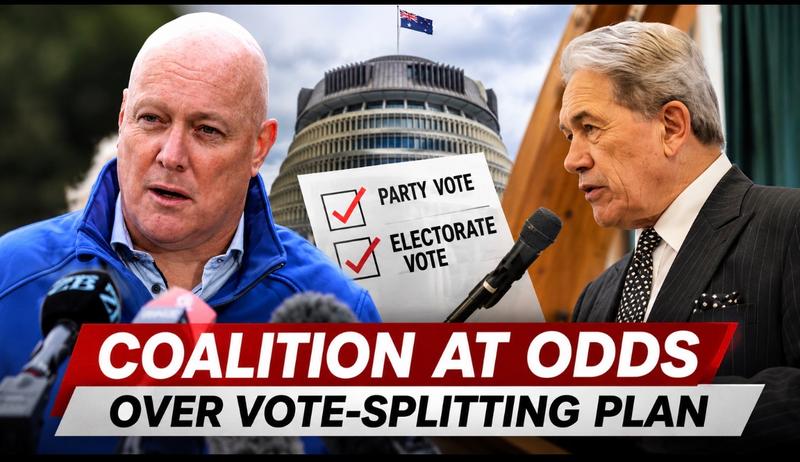
The controversy centres on newspaper advertising organised by Reality Check Radio and written by former National and ACT leader Don Brash.
The campaign encourages voters who support a right-leaning government to consider giving their electorate vote to National candidates while directing their party vote to ACT or New Zealand First.
Both smaller coalition parties approved the advertising.
Luxon has rejected the approach, saying National does not endorse the campaign and expressing disappointment that its partners supported it.
Seymour argues that a party vote for ACT can contribute to a coalition government just as effectively as one for National.
Peters has gone further, telling supporters that giving National their party vote would be a waste.
Labour leader Chris Hipkins has characterised the disagreement as evidence of divisions among the governing parties.
The competing statements highlight a tension that has become increasingly visible during the campaign: the parties may cooperate in government, but they are competing directly for the same pool of voters.
The Overhang Strategy: What Voters Need to Understand
New Zealand’s Mixed Member Proportional system gives every voter two votes.
The electorate vote determines who represents a local constituency. The party vote largely determines how many seats each qualifying party receives in Parliament.
Normally, the two work together.
A party that wins 30 percent of the party vote would generally receive around 36 seats in a 120-seat Parliament. Its successful electorate candidates take those seats first, with the remainder filled from its party list.
An overhang occurs when a party wins more electorate seats than its party vote would otherwise entitle it to receive.
Consider a simplified example.
A party receives enough party votes for 25 seats but wins 30 electorates. It keeps all 30 electorate MPs, creating five overhang seats.
Parliament expands to accommodate them.
The Electoral Commission confirms that overhang seats do not reduce the number of seats allocated to other parties.
That detail is central to the strategy being promoted.
However, there is an important qualification: an overhang is not automatically created simply because voters split their votes.
It depends on the final party vote, the number of electorates won and the allocation of parliamentary seats.
Nor does transferring party votes between coalition partners necessarily increase their combined representation in a straightforward way. The final outcome depends on the distribution of votes and seats across all qualifying parties.
The proposed strategy is therefore a political calculation, not a guaranteed electoral advantage.
Nicola Willis and the Risk Hidden in National’s Party List
Perhaps the most significant issue is what the strategy could mean for National’s own candidates.
Finance Minister Nicola Willis is standing as a list-only candidate.
Unlike an electorate MP, she cannot secure a parliamentary seat by winning a local constituency.
Her return depends on National receiving enough party votes to qualify for list seats and on her position in the party’s ranking.
If National wins enough electorates to exhaust its entire entitlement under the party vote, it would receive no list seats.
That could leave Willis outside Parliament.
Luxon has already described her continuation as Finance Minister as non-negotiable in any second-term government.
Yet a strategy promoted by his coalition partners could complicate that objective.
This exposes a distinction often lost in campaign discussions: winning enough seats to form a government does not guarantee that every senior minister will return to Parliament.
A coalition’s overall numbers and the composition of each party’s parliamentary team are two different things.
The Other Question: Who Controls the Finance Portfolio?
The dispute also has implications for future coalition negotiations.
Seymour has acknowledged that seeking the finance portfolio would be a possibility, although he has subsequently played down speculation about ministerial positions.
That does not establish that ACT intends to demand the role.
But it demonstrates why the potential loss of National list MPs matters.
If Willis were absent from Parliament, Luxon’s stated preference for her to remain Finance Minister would become significantly more complicated.
And even if she returned, a changed balance of seats between National, ACT and New Zealand First could influence negotiations over portfolios and government policy.
The vote-splitting debate is therefore about more than electoral mathematics. It also concerns the distribution of influence within any future coalition.
Why Epsom and Tāmaki Are Different
There is another revealing detail in the campaign.
Seymour has said ACT initially declined to approve the advertising but later agreed on the condition that it support ACT candidates in Epsom and Tāmaki.
Seymour is contesting Epsom, while James Christmas is standing for ACT in Tāmaki following Brooke van Velden’s retirement.
The exception illustrates the limits of the broader strategy.
Although ACT supports encouraging some voters to separate their electorate and party choices, it also wants to protect its own electorate contests.
That is not inconsistent with MMP, which allows voters to make separate choices. But it shows how the strategy changes depending on which party stands to benefit locally.
What About Voters Who Support a Coalition but Not One Particular Party?
The dispute also raises a practical question for New Zealanders who broadly favour one side of politics but have different preferences among its parties.
A voter may prefer a particular local candidate while supporting a different party’s national policies.
That is a normal feature of MMP.
But voters should distinguish between choosing the party they want represented in Parliament and following a campaign designed to engineer a particular seat allocation.
The Electoral Commission’s explanation is straightforward: the party vote largely determines parliamentary representation, while the electorate vote selects the local MP.
A party generally needs at least five percent of the nationwide party vote or one electorate victory to qualify for seats.
Those rules matter more than claims that one particular voting combination will necessarily produce a preferred coalition outcome.
For New Zealand’s growing migrant communities, including Indian New Zealanders, the debate is also an opportunity to understand how the two votes operate independently.
Voters do not have to give both votes to the same party. Equally, there is no requirement to split them.
The choice belongs to each voter.
Six Days Out, the Coalition Faces a Different Kind of Test
Advance voting is already underway ahead of the general election on Saturday, 7 November.
The dispute has brought an unusual feature of coalition politics into public view.
National wants to maximise its own party vote and preserve its parliamentary team.
ACT and New Zealand First want to increase their representation and influence, while maintaining the possibility of governing with National.
Those objectives can overlap, but they are not identical.
The proposed overhang strategy has made that difference visible.
What remains unknown is whether voters will follow the advertising, whether an overhang will result, and how the final allocation of seats will affect the parties.
Those outcomes cannot be established before votes are counted.
For now, the more immediate significance is clear: a campaign intended to influence the balance of power has exposed competing priorities within the coalition itself.
And it has brought a question usually left to election-night calculations into the final days of the campaign.
It is possible for a party to win electorates, remain central to a coalition, and still lose senior figures from its parliamentary team.
That is the risk National is now publicly confronting.
Sources and references
- RNZ, Giles Dexter, 31 October 2026: National, ACT and NZ First at odds over vote-splitting campaign. Original reporting on the advertising campaign and statements from Christopher Luxon, David Seymour, Winston Peters and Chris Hipkins.
- Electoral Commission: What is MMP? and How are MPs elected? Official explanations of party votes, electorate seats and overhangs.
- Electoral Commission: Key dates for the 2026 General Election, confirming election day as 7 November and the advance voting timetable.
Webfit News analysis of the electoral implications is based on the published reporting and the Electoral Commission’s rules. The illustrative overhang calculation is hypothetical, not a forecast of the election result.