Her starting point was income tax. The Greens say their proposed changes would cut income tax for 96 percent of people.
The published policy includes a tax-free threshold for the first $10,000 of income, alongside higher taxation of substantial wealth and the largest corporations. It also proposes a higher income tax rate on earnings above $160,000. These are election proposals, rather than changes already available to households.
Craig presented that redistribution as the answer to a familiar objection: how can a government spend more on services without taking more from households already under pressure?
Her argument was that the additional contribution should come from those with the greatest resources.
Yet the interview did not establish a dollar figure for the example family. No income was specified, and Craig did not calculate its likely weekly gain.
That leaves a practical question for voters: how much would their own household receive, and when would the benefit arrive?
A Public Supermarket, but How Quickly Would Prices Fall?
On groceries, Craig described the experience of watching people return items they could no longer afford.
“I’m tired of going to the supermarket and seeing people around me putting back groceries because they just can’t afford them.”
Her proposed response was to challenge the supermarket duopoly and establish KiwiMart, a publicly owned competitor.
The published Green policy would require at least 120 stores and distribution-centre capacity to be sold into public ownership. The party puts acquisition and capitalisation costs at a combined $2.8 billion. Its broader food programme also proposes stronger action against excessive pricing.
For shoppers, however, ownership is only part of the story. The outcome that matters is whether the same basket becomes cheaper.
Asked about her priorities for the first 100 days, Craig pointed to legislation against supermarket price gouging as something she wanted progressed quickly.
She distinguished that from infrastructure projects that would take longer.
“I don’t think I can promise rail within 100 days.”
That distinction matters. Passing legislation, establishing a supermarket competitor and delivering lower checkout prices are separate milestones. The interview did not establish a timetable or a guaranteed saving for shoppers.
The Renter’s Problem With Rooftop Solar
Craig also promoted interest-free solar finance as a way to reduce household energy costs.
But the family in Webfit News’ question was renting.
That makes access crucial. A household cannot simply make the same decisions about a rental property’s roof as an owner can.
The Greens’ published energy programme addresses those groups separately. It proposes government-backed zero-interest clean-energy loans for up to 90 percent of homeowners, alongside a renters’ right to solar and changes to allow plug-in solar.
For a tenant facing another winter power bill, the important detail is how those renter provisions would work in practice.
Craig’s answer outlined the direction. It did not establish what the example renting family would save or how soon it could access the proposed support.
Why Trust Politicians With More Money?
Webfit News put another concern directly to Craig: many New Zealanders feel they are paying more while receiving worse public services. Why trust politicians promising to spend more?
Craig blamed government cuts and argued for rebuilding public-service capacity. She also pointed to her own experience working in economic policy.
But her answer became personal when she discussed why she was standing.
Craig spoke about coming out as a transgender woman and encountering both support and hostility. She described the exposure involved in seeking public office, saying her motivation came from conviction.
“The truth is, as a trans person, standing and putting myself in the spotlight is not great for me.”
She also recalled her involvement in Students for Climate Solutions and the experience of using legal action to pursue change.
Those experiences explained her motivation. Whether voters trust the proposed spending programme, however, also depends on delivery, oversight and results.
Immigration: Build for Growth, Craig Argues
Asked about Labour’s 2021 Resident Visa and concerns over pressure on housing, healthcare and infrastructure, Craig accepted that population growth must be matched by investment.
She rejected the idea that reducing immigration was the answer she wanted to pursue.
“The solution isn’t to look at immigration. The solution is to look at our infrastructure.”
Craig argued for longer planning horizons and greater continuity across changes of government, criticising the cycle of major projects being proposed and then abandoned.
Her response placed the responsibility on infrastructure planning. It did not provide an unqualified verdict on every aspect of the 2021 visa decision.
For communities experiencing crowded services, the unresolved issue remains delivery: how quickly capacity can catch up with demand.
Palestine: Pressed on the Price of Compromise
On foreign affairs, Craig called for recognition of Palestinian statehood and sanctions against Israel.
Webfit News followed with a harder question: would the Greens make their position on Palestine a condition of joining a government, or would they compromise?
Craig said coalition negotiations were not hers to determine.
She argued that recognition was an area of agreement among parties she identified as potential governing partners, and therefore did not expect it to become a negotiating obstacle.
Her answer did not establish a binding coalition condition. It also left open what would happen if prospective partners differed over sanctions or other measures.
That is the distinction between supporting a position during a campaign and securing it in a governing agreement.
What Do the Greens Get Wrong?
One of Craig’s more revealing answers came during the rapid-fire questions.
Asked what her own party sometimes gets wrong, she acknowledged stubbornness.
“Sometimes we’re a little bit stubborn in our beliefs.”
She said that had historically made compromise and cooperation harder, although she believed the party had improved.
It was a useful admission in an interview dominated by ambitious proposals. Any programme depends on the ability to negotiate, legislate and implement it.
Her Challenge to Both Chrises
Given the chance to address Luxon and Hipkins directly, Craig challenged both leaders over the scale and urgency of their response to living costs and climate change.
“I’d ask what on earth you were focussing on and why you aren’t looking at the bigger picture.”
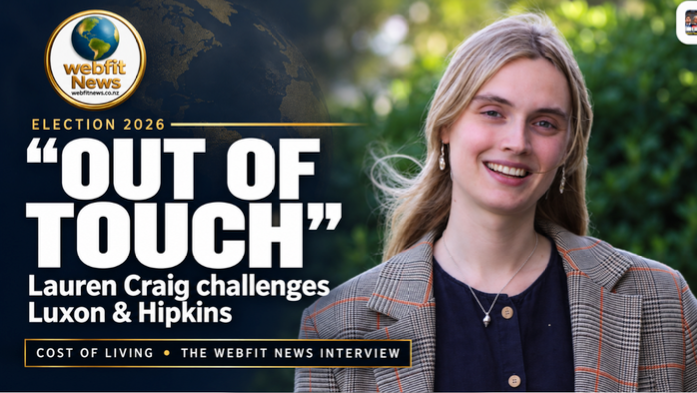
Asked earlier to describe Luxon, her answer was blunt: “Out of touch.”
But the most consequential question in the interview was the one about the family paying rent and raising two children.
Craig offered a clear direction: shift more of the tax burden towards wealth, intervene in essential markets and invest in public infrastructure.
The test for the Greens is turning that direction into a household result that voters can measure.
When the rent, groceries and power bill are paid, how much is left?