The Greens’ apprenticeship policy puts the spotlight on wages. But the bigger test is whether workers and small employers can both afford the journey to qualification.
By Webfit News | 18 October 2026
Analysis
The Greens’ apprenticeship policy puts the spotlight on wages.
Part of our coverageNZ Election 2026Polls, policies, candidates and how to vote, all in one place. →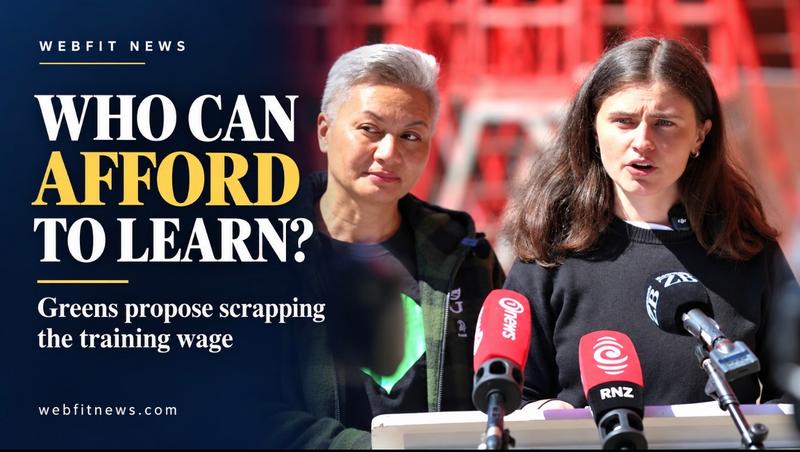
The Greens’ apprenticeship policy puts the spotlight on wages. But the bigger test is whether workers and small employers can both afford the journey to qualification.
By Webfit News | 18 October 2026
Analysis
An apprentice needs enough money to keep turning up. An employer needs enough money to keep training them.
New Zealand’s latest election argument over apprentice pay turns on whether those two needs can be met together.
The Green Party wants to abolish the training wage, introduce a $2,000 equipment grant and offer employers a $2,000 completion bonus. It also proposes an additional $30 million annually for Māori and Pasifika-led training and support.
Supporters see a way to make learning a trade financially possible. Opponents warn that higher wage costs could discourage businesses from offering places.
But beneath that familiar disagreement sits a more revealing question: how much of the cost of building New Zealand’s future workforce should apprentices carry through lower earnings?
The “young apprentice” debate misses a legal distinction
Political responses have repeatedly focused on businesses taking a chance on young people.
Yet the training minimum wage is specifically a category for eligible workers aged 20 and over. Their employment agreement must require at least 60 credits of relevant industry training annually.
Apprentices aged 16 to 19 can qualify for a different category, the starting-out minimum wage, where their agreement requires at least 40 credits annually.
Both minimum rates are currently $19.16 an hour, compared with the adult minimum of $23.95. They are equal rates, but separate legal categories.
That distinction matters when judging what the Greens’ promise would actually change.
The party’s announcement promises to abolish the training wage and describes benefits for apprentices generally. However, the announcement does not explicitly explain how it would amend the separate starting-out provisions for apprentices under 20.
That detail needs clarification before assuming every apprentice would receive the same new wage entitlement.
A career change can become a household funding decision
Green Party co-leader Chlöe Swarbrick told RNZ the average person entering an apprenticeship was 27.
That does not establish every apprentice’s circumstances. But it challenges the picture of apprenticeship as something undertaken only by teenagers supported by parents.
For an adult changing careers, the question may involve rent, children, transport and an existing household budget.
The potential barrier is not simply willingness to learn. It is whether the household can absorb the earnings available while learning.
That creates a risk worth examining: access to a trade could depend partly on access to family financial support.
This does not mean the Greens’ policy would eliminate that barrier. Higher wages cannot, on their own, guarantee an available apprenticeship.
The $2,000 bonus and the weekly wage bill run on different clocks
Using current statutory rates, moving a worker from $19.16 to $23.95 would add $4.79 an hour.
For someone paid for 40 hours a week, Webfit News calculates that as:
|
Illustrative wage difference |
Amount |
|
Each week |
$191.60 |
|
Over 52 paid weeks |
$9,963.20 |
|
Proposed $2,000 bonus expressed as weeks of that difference |
About 10.4 weeks |
These are illustrative gross wage calculations, not a forecast of every employer’s costs. They exclude additional wage-linked costs and assume unchanged hours and rates throughout the year.
An employer already paying the adult minimum or more would not face that particular increase.
Nor should the bonus be presented as though the Greens promised it would reimburse the full difference. It is a completion incentive.
Nevertheless, the timing matters. Wages must be funded throughout training. A completion reward recognises an outcome later.
For a small business, the ability to finance the months before that outcome may influence the initial hiring decision.
New Zealand already has a different support mechanism
Apprenticeship Boost currently pays eligible employers $500 a month for up to 12 months, subject to qualification and other eligibility requirements.
Work and Income says payments are made monthly in advance and can help employers meet costs such as wages.
That illustrates an important policy distinction.
Regular support helps finance training while it happens. A completion bonus rewards getting through it. Equipment assistance addresses another expense altogether.
These mechanisms can complement one another, but they solve different problems.
The question is therefore not just whether $2,000 is generous. It is how the proposed package would interact with existing support, and whether assistance arrives when workers and employers most need it.
Neither side has proved the employment outcome
Higher pay could make an apprenticeship easier to sustain. Higher costs could also affect an employer’s willingness to recruit.
Neither possibility establishes the size of the eventual effect.
MBIE’s 2025 minimum-wage review said a lower training rate may incentivise employers to take on and support trainees. That is a reason to examine hiring risks, not proof that removing the rate would necessarily reduce apprenticeships.
Equally, a promise of better wages is not evidence that more people will complete qualifications.
A serious assessment needs to track both sides: places offered and qualifications completed, alongside earnings, withdrawals and employer participation.
The real test is who gets through the door
The strongest case for reform is that people should not need financially comfortable parents or a partner’s income to enter a skilled occupation.
The strongest implementation challenge is ensuring employers can still offer those opportunities.
A cheaper apprentice who cannot afford to stay is not a successful training outcome. Neither is a better-paid apprenticeship that never becomes available.
The election debate needs to move beyond choosing which side carries the bill.
The more useful question is how to share that cost so New Zealand gains qualified workers, without making either household hardship or small-business cash flow the price of training them.
Sources: Green Party policy announcement, 17 October 2026; RNZ reporting by Giles Dexter; Employment New Zealand minimum-wage guidance; Work and Income Apprenticeship Boost guidance; MBIE Minimum Wage Review 2025. Illustrative calculations by Webfit News.