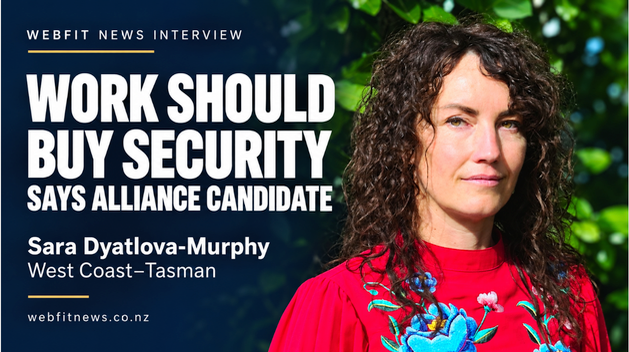
She initially trained as a chef and worked in horticulture before later moving into software development.
Living in Europe, including several years in Denmark, gave her a different experience of public services and family support.
She said being able to seek healthcare without first worrying about the balance in her bank account left a lasting impression.
After her marriage ended, she returned to New Zealand with two children and studied in Christchurch.
Despite having access to some support, she described that period as living in poverty.
The contrast between the two countries helped shape her belief that financial security should not depend entirely on a household’s ability to absorb a crisis.
Her experience is the basis of her political argument, rather than proof that another country’s system can simply be transferred to New Zealand. The policies she supports would still require funding, administration and a workable transition.
Software work brought flexibility, but also uncertainty
Dyatlova-Murphy said software development appealed partly because it offered the possibility of good pay and flexibility around parenting.
However, she described a sector where cancelled contracts and restructuring can quickly unsettle employment.
That experience informs her view that insecurity extends beyond traditionally low-paid work.
Artificial intelligence is also changing software roles, she said. She wanted technology used to support people’s work and improve productivity, rather than treating replacement of workers as its primary purpose.
That distinction runs through her campaign: economic progress should be judged partly by whether it gives people greater control over their lives.
Cost of living connects a diverse electorate
Based in Riwaka, Dyatlova-Murphy described campaigning across an electorate whose communities face markedly different local pressures.
In Motueka and surrounding areas, she highlighted difficulty finding affordable rentals.
Across the West Coast, she identified employment security, household costs and access to healthcare as recurring concerns.
Her argument was that these issues reinforce one another. A job opportunity is less useful if a family cannot find somewhere affordable to live, while affordable housing alone does not resolve the loss of a major employer.
She also acknowledged differences within the electorate over mining.
Dyatlova-Murphy said she opposed the proposed Sams Creek development, while recognising anxiety among West Coast residents whose livelihoods depend on established mining operations.
That presents a practical challenge for any regional employment policy: opposing one development does not answer what happens to workers who rely on another industry.
Her proposed response centres on diversifying employment and using government investment to create additional opportunities.
Tax relief funded by a broader change in who pays
Alliance proposes making the first $20,000 of personal income tax-free.
Dyatlova-Murphy presented that as immediate relief for households whose earnings are already subject to income tax and whose spending attracts GST.
The party’s published package goes further than the tax-free threshold. It combines a revised income tax scale with proposed taxes on wealth, realised capital gains and financial transactions, alongside a 30 per cent corporate tax rate.
Its proposed annual wealth tax would apply at 2.5 per cent to individual net wealth above $2 million.
Alliance estimates a worker earning $65,000 would retain an additional $2,408 annually under its proposed income tax scale. That is the party’s calculation, not an independently verified household outcome.
Asked about the risk of wealth leaving New Zealand, Dyatlova-Murphy acknowledged the concern but argued that assets tied to a location cannot necessarily be moved easily.
The wider policy question remains how investors and asset owners would respond, and how reliably the proposed taxes would fund the promised changes.
Public electricity ownership, with a cost still to explain
Dyatlova-Murphy supported returning electricity to public ownership, arguing that power should operate as an essential service.
She said electricity costs affected households, farms and businesses, making energy affordability a regional economic issue as well as a household concern.
However, she did not provide a purchase price, detailed acquisition mechanism or timetable during the interview.
“It is going to cost a lot, but I think it will cost us a lot not to,” she said.
The proposal therefore raises two separate questions for voters: whether public ownership is desirable, and whether the cost and operating model would deliver the promised benefits.
Ownership alone does not establish what a household’s future bill would be.
Family support without an unexpected repayment bill
As the party’s social security spokesperson, Dyatlova-Murphy argued for replacing complex, conditional assistance with more predictable support.
She highlighted Working for Families reconciliations as a source of stress when households receive payments based on estimated income and later discover they have been overpaid.
Alliance’s published policy proposes a Universal Child Benefit paid to the principal caregiver and indexed to average weekly earnings.
Dyatlova-Murphy also supported extending paid parental leave to 52 weeks.
Her argument was that parents should have more time and financial room to care for young children, rather than being forced back to work before they are ready.
Asked how success should be measured, she identified reducing child poverty as the central outcome.
The interview did not establish a specific payment amount or a complete implementation plan for the family benefit.
Ending sanctions: support first, with implementation questions remaining
Alliance also proposes ending benefit sanctions and introducing a Universal Benefit as part of a wider social security redesign.
Dyatlova-Murphy rejected the assumption that people generally want to remain dependent on a benefit.
She argued that inadequate support can make it harder for people to recover from illness, manage disability, care for children or prepare for employment.
Parenting itself required substantial work, she said, particularly for sole parents with young children.
Asked how accountability would operate without sanctions, she emphasised support and the party’s commitment to full employment.
She did not set out a detailed alternative compliance process during the interview.
That leaves an important distinction between the principle she supports, protecting people from hardship, and the administrative system needed to put it into practice.
The 35-hour week meets the small-business question
Alliance’s proposed 35-hour working week, without a reduction in pay, produced one of the interview’s clearest implementation challenges.
Dyatlova-Murphy pointed to shorter-week trials and the potential for technology to improve productivity.
However, she acknowledged that the transition would be more difficult for businesses such as cafés and hairdressers, where service often depends directly on staff being present.
She said she was not the party’s employment spokesperson and did not offer a detailed answer about how those employers would manage staffing and costs.
A reduction from 40 to 35 hours at unchanged weekly pay would increase the effective hourly pay rate by about 14.3 per cent. Whether a business could absorb that through productivity gains would depend on how its work is organised.
For regional employers, the transition arrangements would be as important as the headline promise.
Healthcare concerns need to be read alongside current plans
Dyatlova-Murphy called for stronger primary care and adequate hospital staffing, arguing that distance and workforce shortages create difficulties for rural patients.
She also criticised the approach to Nelson Hospital’s redevelopment and argued the region needed a comprehensive rebuild.
Current government information confirms that redevelopment is proceeding.
On 2 September, the Government announced the start of work for a new 128-bed inpatient building, alongside other improvements on the hospital campus.
Her criticism is therefore about the adequacy and scope of the approach, rather than the absence of a redevelopment project.
Resilience through more than roads
On transport, Dyatlova-Murphy advocated stronger coastal shipping and rail connections, supported by a hub-and-spoke approach to ports.
She argued that alternative freight routes could reduce dependence on roads vulnerable to earthquakes and severe weather.
She also supported restoring public infrastructure-building capability through a Ministry of Works model and exploring a renewed public forestry service.
Her underlying position was that resilience requires planning across transport, land use and public investment, rather than responding to each disruption separately.
A campaign built around everyday security
Away from policy, Dyatlova-Murphy named gardening as an alternative to politics, admitted an interest in modified cars and recalled her grandmother describing life as a series of chapters.
Her appeal to voters who feel disillusioned was that Alliance offers a distinct choice on ownership, taxation, work and social support.
“We are a party of workers for workers,” she said.
The interview showed a candidate whose political views are closely connected to her own experience of raising children, studying and working through uncertainty.
For West Coast–Tasman voters, the next question is how those principles would translate into affordable policies, dependable services and jobs in the communities where people already live.
Source: Webfit News interview with Sara Dyatlova-Murphy, with policy details checked against Alliance’s published material and hospital context checked against government announcements.