Dipke’s involvement in political communications predates the formation of the Cockroach Janta Party.
According to Reuters reporting, he joined the Aam Aadmi Party’s social media operations in 2020, where he gained experience in political messaging, online campaigns, satire and digital engagement.
These techniques would later become central to CJP’s public identity.
Dipke subsequently travelled to the United States to pursue a master’s degree in public relations at Boston University.
His American education later became a subject of political debate, particularly after questions emerged about how his studies were financed and whether he had developed relationships with foreign political donors.
Dipke has maintained that his education was supported through a university scholarship and an education loan.
There is no established evidence that his education was financed through an unlawful political funding arrangement.
May 2026: The Birth of the Cockroach Janta Party
The Cockroach Janta Party emerged in May 2026 from a satirical social media campaign.
What began as political commentary soon developed into a youth-focused movement raising concerns about unemployment, examination irregularities, education standards and government accountability.
Its unconventional name, provocative messaging and social media campaigns helped attract attention among younger audiences.
The movement increasingly positioned itself as an independent platform for citizens frustrated with established political parties.
By June and July, CJP had become associated with demonstrations in Delhi and campaigns concerning recruitment examinations and education-related controversies.
Its activism contributed to wider political pressure during a period of growing public dissatisfaction over examination irregularities.
However, the movement’s rapid rise also prompted questions about its leadership, organisational structure and financial resources.
The AAP Connection: What Investigations Revealed
One of the most significant findings concerning CJP came from an investigation published by ThePrint in August 2026.
The report identified previous AAP associations or public support for the party among six of the 12 members of CJP’s core committee.
That meant half of the movement’s reported core leadership had some history of association with, or support for, AAP.
This finding raised questions about the movement’s claims of political independence.
Dipke himself had previously worked in AAP’s social media operations.
ThePrint also reported comments from AAP spokesperson Sanjeev Jha acknowledging past associations involving individuals who had subsequently moved away from the party.
AAP has denied operating CJP behind the scenes.
The distinction is important.
Former membership of a political party does not automatically establish continuing political control. Individuals are free to leave parties and establish independent organisations.
Nevertheless, when several leaders of a movement share connections with the same political party, questions about current organisational relationships, funding arrangements and decision-making structures become legitimate matters of public interest.
October 8: Punjab Chief Minister Acknowledges Dipke’s AAP Background
The debate intensified when Punjab Chief Minister Bhagwant Mann publicly acknowledged Dipke’s earlier association with AAP.
Speaking at an India Today event on 8 October, Mann confirmed that Dipke had worked with the party’s social media team before travelling to the United States.
However, Mann rejected suggestions that AAP was secretly directing CJP.
Dipke has also maintained that his movement operates independently and is not controlled by AAP or Congress.
These statements establish that Dipke’s previous political association is not merely an opposition allegation.
It is part of his acknowledged professional history.
What remains disputed is whether any formal relationship continues between AAP and CJP.
No verified evidence has established that AAP currently controls or finances the movement.
Why Has CJP Faced Questions Over Its Activities in Punjab?
Another controversy concerns the movement’s different approaches to state governments.
CJP has frequently organised confrontational demonstrations and public campaigns targeting authorities in BJP-governed states.
These activities have included demands for resignations, public deadlines and protests over government performance.
However, India Today reporting in September examined differences between CJP’s activities in BJP-led states and its interventions in AAP-governed Punjab.
In Punjab, some prominent CJP activities involved school inspections, social audits and engagement with education officials.
CJP co-convenor Saurav Das visited government schools in Ludhiana, including a School of Eminence established under the AAP government’s education programme.
The visits identified both positive developments and infrastructure shortcomings.
AAP leader Arvind Kejriwal publicly thanked Das for identifying problems.
This interaction attracted criticism from political opponents, who questioned whether CJP was applying equal pressure to all governments.
It would be incorrect to suggest that CJP has never criticised or investigated conditions in Punjab.
Its representatives have raised concerns about education and recruitment-related issues in the state.
The more important question is whether the movement applies consistent standards of scrutiny and political pressure regardless of which party holds power.
If CJP claims to represent independent public accountability, its campaigning priorities should be explainable through transparent and consistent criteria.
The Funding Question: Who Pays for CJP’s Activities?
The financial arrangements behind CJP have become a central issue following Millben’s allegations.
A movement organising public demonstrations, maintaining digital campaigns and coordinating activities across different locations requires resources.
That does not automatically mean those resources come from political parties or foreign donors.
However, financial transparency becomes increasingly important as a movement expands its influence.
During an August interview with journalist Barkha Dutt, Dipke addressed questions about his education and funding.
He stated that his studies at Boston University had been financed through a scholarship and an education loan.
He also discussed crowdfunding as a means of supporting CJP’s activities.
These explanations address some questions but do not replace independently verifiable organisational financial disclosures.
The public-interest questions include how much money CJP has raised, where contributions originate, how funds are spent and whether financial statements are independently audited.
It is also important to distinguish personal education financing from political donations.
Receiving a scholarship or obtaining an education loan does not constitute evidence of improper political funding.
Likewise, allegations of foreign financial support require documentary evidence before they can be treated as established facts.
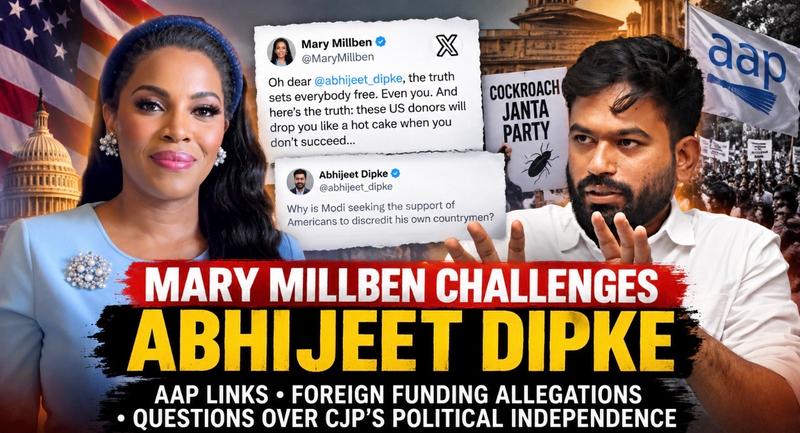
October 14: Mary Millben Enters the Controversy
The debate took an international turn when American singer Mary Millben responded to Dipke on social media.
Dipke had questioned why Prime Minister Narendra Modi was allegedly seeking support from Americans to discredit Indian critics.
He also challenged the involvement of foreign nationals in India’s internal political affairs.
Millben responded sharply, suggesting that American donors opposed to Modi would abandon Dipke if his political activities failed.
She urged him to use his American education and talents constructively and suggested that he should engage positively with India’s prime minister.
Millben also defended Modi’s domestic political support, arguing that he did not require American backing to maintain his position.
Her remarks attracted attention because they directly challenged Dipke’s political credibility and raised the issue of foreign influence.
However, Millben’s statements remain allegations and political commentary.
They do not establish that Dipke has received undisclosed foreign funding or participated in an unlawful financial arrangement.
No authenticated donor records, banking transactions or independently verified financial documents substantiating her allegation have been identified in the reporting reviewed for this article.
Has Mary Millben Exposed Dipke?
Millben’s intervention has undoubtedly intensified public scrutiny of Dipke.
But there is a difference between publicly challenging a political activist and proving allegations against that individual.
Her comments have drawn attention to questions about foreign financial support, while earlier journalism has established Dipke’s previous AAP association and identified former AAP associates within CJP’s leadership.
Those are separate issues.
The documented political connections are relevant to understanding the movement’s background.
They do not establish that CJP is a covert operation run by AAP.
Similarly, Dipke’s education in the United States does not prove that American donors are financing his activism.
A credible assessment must distinguish verified relationships from unproven allegations.
CJP’s Role in Public Accountability
The controversy should not obscure the public issues that helped CJP attract support.
The movement has raised concerns about examination irregularities, unemployment, recruitment practices and government school infrastructure.
Its campaigns have drawn attention to problems affecting students and young people.
Some interventions have also prompted responses from public authorities.
These activities are relevant when assessing the movement’s public role.
A political activist’s previous party association does not automatically invalidate the concerns raised by supporters.
At the same time, campaigning on public accountability creates an expectation that the movement itself will operate transparently.
Both principles can apply simultaneously.
Seven Questions That Deserve Answers
As CJP continues to attract national attention, several questions remain relevant to its public credibility.
1. Who funds CJP?
Will the organisation disclose its total donations, major funding sources and expenditure since its formation?
2. Does CJP receive financial support from outside India?
If foreign contributions exist, what are their sources, purposes and applicable legal arrangements?
3. What is CJP’s present relationship with AAP?
Given the acknowledged history of several leaders, will CJP clarify whether any organisational, financial or strategic relationships continue?
4. Why do campaigning approaches differ between states?
Will CJP explain how it selects issues and determines the intensity of its protests in BJP-governed and opposition-governed states?
5. Will CJP publish independently audited financial statements?
Publicly accessible accounts could help resolve speculation about the movement’s funding.
6. How are CJP’s leadership and political decisions determined?
Does the organisation have a formal constitution, transparent appointment procedures and clearly defined decision-making responsibilities?
7. Will CJP apply the same accountability standards to every government?
A movement claiming political independence should be prepared to scrutinise all administrations consistently, including those led by parties with which its leaders have previously been associated.
The Bigger Political Question
The controversy surrounding Dipke reflects a wider challenge in modern politics.
Social media movements can grow rapidly, mobilise thousands of supporters and influence public debate without initially developing the formal structures associated with established political organisations.
That flexibility can make them effective.
It can also create uncertainty about leadership, financial accountability and political relationships.
Dipke’s earlier work with AAP is documented. The presence of former AAP associates within CJP’s leadership has also been reported.
Questions about the movement’s campaigning priorities deserve examination.
However, allegations that it is secretly financed by foreign donors or directed by AAP remain unproven.
Mary Millben’s public criticism has brought these issues back into the spotlight, but the final assessment must depend on evidence rather than political rhetoric.
For Dipke and CJP, the most effective response would be transparent financial disclosures, clarity about current political relationships and consistent accountability standards across all states.
For critics, the responsibility is equally clear: serious allegations require serious evidence.
The central question is no longer simply whether CJP can hold India’s political establishment accountable. It is whether the movement is equally willing to subject itself to public scrutiny.
That is a question its supporters, critics and the wider Indian public are entitled to ask.