The Commission confirmed on Friday that 3,790,946 people are enrolled, representing 93.6% of the estimated eligible voting population.
Chief Electoral Officer Karl Le Quesne described the provisional result as evidence of public awareness of the new deadline.
The figure is close to the final enrolment rate of 94.7% recorded in 2023.
But the real question is not only how many people registered.
It is also how many eligible people remain outside the electoral system, and whether the earlier deadline has made participation more difficult for some of them.
A Strong Enrolment Rate, But Not the Complete Picture
New Zealand has maintained relatively high electoral enrolment rates over the past decade.
The rate was 92.6% in 2014, 92.4% in 2017, 94.1% in 2020 and 94.7% in 2023.
For 2026, the provisional figure stands at 93.6%.
The Electoral Commission says the final rate will not be confirmed until after the election.
Nevertheless, the numbers suggest that most eligible voters have completed the registration process.
What they do not tell us is whether everyone who wanted to vote managed to enrol before the deadline.
That distinction is particularly important this year.
Under the changed rules, enrolment closed on Sunday 25 October, before advance voting began.
At the previous two general elections, people could enrol and vote during the voting period, including on election day.
That option is no longer available.
The change provides election administrators with a clearer deadline for processing enrolments. But it also removes an opportunity previously available to people who registered late.
The important question is whether the administrative benefits outweigh the loss of that opportunity.
The Commission’s latest release does not provide figures showing how many eligible people have attempted to enrol after the deadline.
Without that information, it is not possible to measure the change’s full effect on participation.
Young Voters: The Most Important Number May Be the Missing 25.8%
One of the most significant results in the Commission’s update concerns younger voters.
Among 18- to 24-year-olds, the provisional enrolment rate has reached 74.2%.
That is a substantial improvement from 53.9% on 31 July, an increase of 20.3 percentage points.
It is also close to the 76.7% recorded at the 2023 election.
That progress deserves recognition.
But viewed another way, the same figures show that approximately 25.8% of eligible young people are still not enrolled.
In other words, roughly one in four eligible voters in this age group remains outside the electoral roll.
And because the enrolment deadline has passed, those who did not register in time cannot simply turn up at a polling station and enrol.
This raises a wider question about the relationship between young people and the electoral system.
Is lower youth enrolment primarily about political interest? Or do practical barriers, uncertainty about eligibility, changes of address and limited familiarity with the process also play a part?
The Commission’s figures do not answer those questions.
What they demonstrate is that a successful late enrolment drive has substantially narrowed the gap without eliminating it.
That distinction matters when assessing whether the new rules have worked fairly across different age groups.
Māori Enrolment Has Increased, But a Gap Remains
The Commission also reports that 603,968 voters of Māori descent are enrolled, compared with 567,012 in 2023.
The provisional Māori enrolment rate is 85.9%.
Of those enrolled, 331,455, or 54.9%, are on the Māori roll, while 272,513, or 45.1%, are on the general roll.
The Māori enrolment rate is 7.7 percentage points below the overall provisional rate of 93.6%.
That difference deserves attention, although the figures rely on estimates of eligible populations and should not be treated as a precise measure of individual participation.
The increase in the total number of Māori voters enrolled is encouraging, but it does not establish that all barriers to enrolment have been addressed.
Nor does the choice between the Māori and general rolls indicate which political party someone intends to support.
At a time when Māori representation, Treaty obligations and public funding are prominent election issues, the figures reinforce an important distinction.
Political debate about a community is not the same as ensuring every eligible member of that community has a practical opportunity to participate.
Advance Voting Is Up 31.6%. Does That Mean Higher Turnout?
The Electoral Commission says approximately 309,876 votes were cast during the first three days of advance voting.
At the equivalent point in 2023, the figure was 235,515.
That is an increase of 74,361 votes, or approximately 31.6%.
The increase is significant.
It suggests that more people are making use of the opportunity to vote before election day.
But there is a risk in reading too much into early voting figures.
Higher advance voting does not necessarily mean higher overall turnout.
Some people who would previously have voted on election day may simply be voting earlier.
The final turnout will reveal whether more eligible New Zealanders participated overall.
Until then, the figures show a change in the timing of voting, not necessarily a change in the total number of people who will vote.
The Deadline Creates a Question That Enrolment Rates Cannot Answer
This is where the debate becomes more significant than the headline numbers.
A 93.6% enrolment rate is strong by historical standards.
But it does not establish whether the new deadline has improved or reduced access to voting.
To evaluate that, New Zealand needs answers to several practical questions.
How many eligible people attempted to enrol after 25 October?
How many were unaware that enrolment had closed before voting began?
Were some age groups or communities more affected than others?
And how does the number of people unable to enrol during the voting period compare with previous elections?
Those questions are not accusations against the Electoral Commission, which administers the rules set by Parliament.
They are questions about the effects of the rules themselves.
A high enrolment rate and an accessibility problem can exist at the same time.
The former does not automatically disprove the latter.
Equally, the fact that some eligible people remain unenrolled does not establish that the new deadline caused their non-participation.
That is why evidence about late enrolment attempts and final turnout will be important when the election is reviewed.
Convenience Matters, Especially for People Balancing Work and Family
The Commission has also outlined the practical arrangements for voting.
There are 515 voting places open on Friday, 563 on Saturday and 373 on Sunday.
More than 2,300 voting places will be open on election day, Saturday 7 November, from 9am to 7pm.
Around 3.5 million EasyVote cards had been delivered by 24 October, with another 108,000 EasyVote emails being sent to people who enrolled or updated their details by 6pm on 22 October.
Voters can bring their EasyVote card on paper or show it on their phone.
Importantly, they can still vote without one.
These arrangements matter because voting is not equally convenient for everyone.
People working shifts, caring for children, studying or managing transport difficulties may have fewer opportunities to visit a polling place at a particular time.
Advance voting can help reduce those barriers.
But it only helps people who have already satisfied the enrolment requirements.
That is why access to enrolment and access to voting should be considered together rather than as separate administrative exercises.
What Should Be Measured After the Election?
The Electoral Commission’s latest figures provide a useful snapshot of the election’s opening days.
They show strong overall enrolment, substantial progress among young voters, an increase in Māori enrolments and faster early voting.
Those are meaningful developments.
But the most important assessment will come after 7 November.
New Zealand should examine not only the final turnout but also the effect of the changed enrolment deadline.
That includes whether eligible people were prevented from voting because they missed the cut-off, whether awareness campaigns reached those most at risk of missing it, and whether the administrative benefits of the change were realised.
The answers could inform how future elections are organised.
For now, the Commission’s figures offer both encouragement and a reason for closer scrutiny.
Nearly 3.8 million people are enrolled to vote. That is an achievement.
But a healthy democracy must also ask who remains outside the process, why they are missing and whether the rules make it easier or harder for every eligible person to have a say.
The number of registered voters matters. So does the number of people who never get the chance to become one.
Voting Information
Advance voting is underway across New Zealand.
Election day is Saturday 7 November 2026, with polling places open from 9am to 7pm.
People enrolled by the 25 October deadline can vote without an EasyVote card. Those who enrolled after the printed roll was prepared may need to cast a special vote.
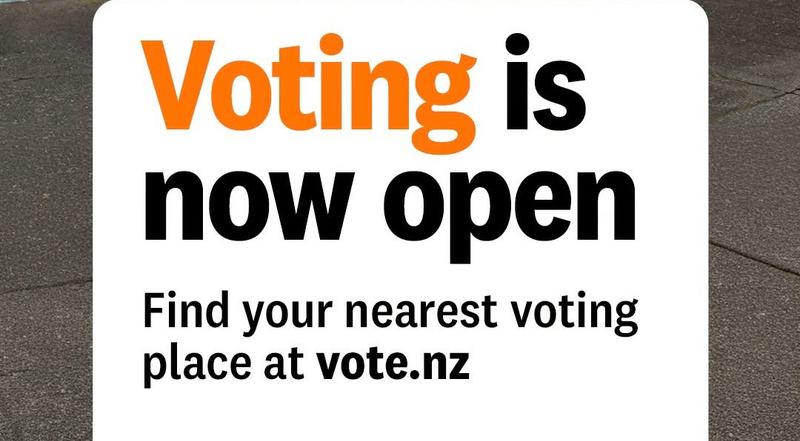
Voting locations and opening hours are available through the Electoral Commission’s official website, vote.nz, or by calling 0800 36 76 56.
Source: Electoral Commission, media release dated 30 October 2026.