Microsoft Is Moving Beyond the Chatbot
The first phase of the AI boom was largely about generating content, summarising documents and answering questions.
Microsoft's latest strategy goes further.
Nadella described a unified Copilot experience bringing together Chat, Cowork, Autopilot and Code.
The direction is clear: rather than employees switching between different AI applications, Microsoft wants a single environment capable of handling increasingly complex work.
That could include writing software, analysing company information and coordinating tasks across business systems.
Microsoft reported that daily Copilot users grew nearly 50 percent quarter-on-quarter and more than fivefold compared with a year earlier.
The number of customers with more than 50,000 Copilot seats also increased eightfold year-on-year.
These figures suggest that AI adoption is moving beyond small trials into larger corporate deployments.
However, user growth and licence adoption do not automatically demonstrate equivalent gains in employee productivity.
The next challenge for Microsoft will be proving that these tools consistently save businesses more money than they cost.
The Real Competition Is About Cost Per Task
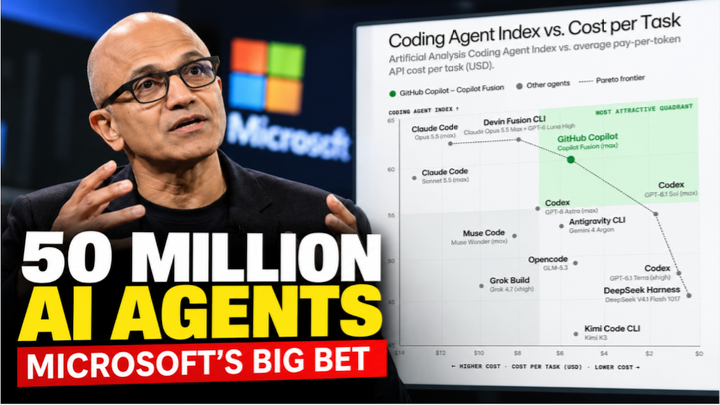
One of the most revealing parts of Nadella's update was a chart comparing coding-agent performance with the average cost of completing a task.
The chart, attributed to Artificial Analysis, placed Microsoft's GitHub Copilot Fusion among the more attractive combinations of capability and cost.
Nadella said Copilot Fusion could deliver high-end coding performance at up to 77 percent lower cost.
That claim points towards an important change in how AI products may be judged.
Until recently, much of the industry focused on which AI model could produce the most impressive answer or achieve the highest benchmark score.
Businesses are increasingly asking a different question.
How much does it cost to complete a useful task reliably?
A coding assistant that performs slightly better but costs several times more may not be the most practical option for a company deploying it across thousands of employees.
Equally, a cheaper system that requires extensive human correction may not deliver genuine savings.
The chart illustrates this trade-off, but it should not be treated as proof that one product is universally superior.
It measures a particular coding-agent benchmark and estimated task cost, not every aspect of software quality, security, maintainability or real-world developer productivity.
The comparison also does not establish that every customer will achieve Microsoft's claimed cost advantage.
Nevertheless, the underlying message is important: AI competition is shifting towards the relationship between capability, reliability and operating cost.
Why Microsoft Wants AI Agents Close to Your Business Data
Another major development is Microsoft's effort to bring Foundry, Fabric and Microsoft 365 closer together.
Nadella said Foundry revenue had more than tripled year-on-year, while the number of customers building with multiple models increased fivefold.
Revenue associated with open-source models grew tenfold.
These numbers reveal an interesting aspect of Microsoft's strategy.
The company is not relying exclusively on one AI model or one model provider.
Instead, it is building infrastructure that allows businesses to use different models within Microsoft's broader ecosystem.
This matters because an AI system becomes substantially more useful when it can work with an organisation's actual information.
A general-purpose assistant may understand how to prepare a financial report.
An enterprise agent connected to authorised company systems could potentially retrieve the relevant figures, analyse them and help prepare the report.
Microsoft is positioning its platforms to provide that connection.
Its Microsoft IQ initiative is intended to make enterprise context across Microsoft 365, Foundry and Fabric available to agentic workloads.
Nadella reported that nearly 60,000 customers were accessing context across Microsoft IQ, an increase of 25 percent quarter-on-quarter.
The commercial opportunity is considerable.
But there is also a strategic implication.
The company that controls how AI connects to business data may become as important as the company that develops the AI model itself.
That could give established enterprise software providers a powerful advantage.
Fifty Million Agents: What Does That Actually Mean?
Perhaps the most striking figure in Nadella's update was the claim that more than 50 million agents are now in Agent 365, up 30 percent from the previous quarter.
It sounds like an extraordinary milestone.
But it needs careful interpretation.
An AI agent is not necessarily equivalent to a human employee, nor does the figure mean 50 million autonomous digital workers are independently performing jobs.
Agents can range from relatively simple automated workflows to sophisticated systems capable of handling multiple steps.
The number does not, by itself, reveal how frequently those agents are used, how many tasks they complete or how much financial value they generate.
What it does indicate is the scale at which Microsoft is building infrastructure for managing AI-driven processes.
And that creates another challenge: governance.
As companies deploy more agents, they need to know what those systems can access, which actions they are authorised to perform and how mistakes can be identified.
Nadella highlighted Microsoft's work on identity, permissions, monitoring and containment, including its Perception initiative.
This is a significant part of the enterprise AI story.
The question is no longer just whether an AI agent can perform a task.
It is whether an organisation can trust that agent to operate within clearly defined boundaries.
A New Form of Dependence on Big Technology?
Microsoft describes Copilot as a potential new operating system for work.
That is an ambitious statement, and it deserves examination.
If businesses begin relying on Copilot to interact with documents, applications, databases and internal workflows, Microsoft's role could expand beyond providing software.
It could become the central interface through which employees and AI systems conduct business.
For customers, a tightly integrated platform may offer convenience, consistent security controls and simpler administration.
But greater integration can also increase dependence on a single technology provider.
Moving away from such a platform could become difficult if important business processes, permissions and automation are deeply embedded within it.
This is not unique to Microsoft. Similar questions arise across major cloud and enterprise software platforms.
The difference is that AI agents could make the relationship more consequential because they may eventually execute business processes rather than simply support them.
Businesses considering large-scale AI adoption will therefore need to assess portability, data governance and long-term operating costs alongside immediate productivity benefits.
What Does This Mean for New Zealand Businesses?
For New Zealand companies, Microsoft's announcements are relevant well beyond the technology sector.
Businesses already using Microsoft 365, Azure and related services may find it increasingly straightforward to introduce AI into existing workflows.
Potential applications include customer support, document processing, software development, reporting and administrative tasks.
Small and medium-sized businesses could benefit from capabilities that previously required larger technical teams.
But the commercial case still needs to be tested.
A business paying for AI licences should be able to identify what work is being improved, how much employee time is saved and whether the resulting output meets its quality and security requirements.
There is also a workforce dimension.
As AI systems become capable of completing more complex tasks, some roles may change significantly.
That does not establish that widespread job losses are inevitable.
It does mean businesses will need to consider employee training, accountability and the appropriate balance between automation and human oversight.
For New Zealand organisations, the practical question is not whether to follow every AI announcement.
It is which tools can solve genuine business problems at an acceptable cost.
Microsoft's Biggest Challenge Is Still Ahead
Microsoft's latest numbers show substantial momentum across cloud services, Copilot and AI infrastructure.
But several important questions remain unanswered.
How many organisations are achieving measurable returns from their AI investments?
Will lower costs per task translate into lower bills for customers?
Can AI agents perform reliably across complex business processes?
And will businesses retain sufficient flexibility to use competing technologies?
These questions will become more important as AI adoption moves from experimentation into everyday operations.
Nadella's message is that Microsoft wants to provide the infrastructure for this transition.
Its advantage lies in combining cloud computing, enterprise software, developer tools and access to business information.
Yet success will ultimately depend on whether customers see sustained value rather than simply adopting more technology.
The Bigger Picture
The most important takeaway from Microsoft's earnings update is not the US$63 billion cloud revenue figure or the reported 50 million agents.
It is the direction of the industry.
AI companies are moving from selling access to intelligence towards selling systems capable of completing work.
That changes the economics of the market.
A more capable model may attract attention, but a reliable system that completes tasks affordably, securely and consistently may prove more valuable to businesses.
The next winner in enterprise AI may not be the company with the smartest chatbot. It may be the company that can demonstrate the lowest reliable cost of getting real work done.
Microsoft is making a substantial bet that its existing business software and cloud infrastructure will give it an advantage in that competition.
The growth figures suggest strong commercial momentum.
Whether that momentum translates into lasting productivity gains for customers remains the more important test.
Sources: Satya Nadella's LinkedIn earnings commentary, 29 October 2026; Microsoft earnings update; Artificial Analysis coding-agent benchmark shared by Nadella.