A comparison with the September survey shows how party preferences have shifted.
Māori party-vote support: September vs October
| Political party | September | October | Change |
|---|
| Labour | 31% | 34% | +3 points |
| Greens | 17% | 18% | +1 point |
| NZ First | 8% | 9% | +1 point |
| Te Pāti Māori | 18% | 8% | −10 points |
| National | 6% | 7% | +1 point |
| Opportunity | 4% | 4% | No change |
| ACT | Not reported | 3% | — |
Source: Whakaata Māori–Curia surveys, September and October 2026. The comparison uses reported party-vote figures.
The most significant movement is Te Pāti Māori's 10-percentage-point decline.
In September, the party was the second-most popular choice among surveyed Māori voters. By October, it had fallen to fourth, behind Labour, the Greens and New Zealand First.
Labour now has more than four times Te Pāti Māori's reported party-vote support among respondents.
However, these are party-vote figures, not electorate-candidate preferences. Te Pāti Māori's prospects in individual Māori electorates cannot be determined from this national Māori voter survey alone.
Hipkins Emerges as Preferred Prime Minister
Labour leader Chris Hipkins has also strengthened his position among Māori respondents.
He received 26% support as preferred Prime Minister, an increase of 10 percentage points from September.
Winston Peters and Green Party co-leader Chlöe Swarbrick were tied on 11%.
Prime Minister Christopher Luxon received 7%, while Hana-Rāwhiti Maipi-Clarke registered 6%.
Preferred Prime Minister among Māori respondents
| Political leader | October support |
|---|
| Chris Hipkins | 26% |
| Winston Peters | 11% |
| Chlöe Swarbrick | 11% |
| Christopher Luxon | 7% |
| Hana-Rāwhiti Maipi-Clarke | 6% |
| David Seymour | 2% |
Hipkins' lead suggests Labour is benefiting not only from party support but also from greater personal preference for its leader among those surveyed.
Nevertheless, preferred Prime Minister polling measures a different question from the party vote and should not be treated as a direct prediction of the election result.
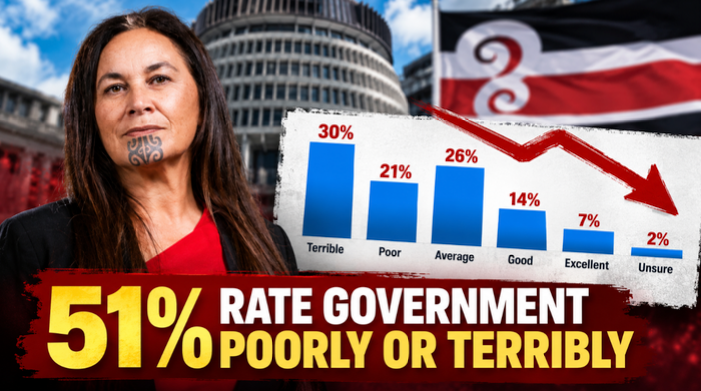
Economic Management: 51% Rate Government Poorly
One of the clearest findings concerns the coalition Government's handling of the economy.
Asked to assess its economic management, 30% of Māori respondents described the performance as terrible and another 21% as poor.
Together, that represents 51% giving a negative assessment.
Only 21% rated the Government's performance positively, comprising 14% who said good and 7% who said excellent.
A further 26% described its performance as average, while 2% were unsure.
For a Government elected in 2023 on commitments that included addressing the cost of living, the results point to significant dissatisfaction among the surveyed Māori population.
But the political implications are not straightforward.
New Zealand First, a member of the governing coalition, has increased its support among Māori respondents from 8% to 9%, despite the negative assessment of economic management.
This reinforces why dissatisfaction with government performance cannot automatically be translated into support for the opposition.
Māori Representation: 78% Express Concern
Concern about changes to local government representation is even more pronounced.
The survey asked respondents about central government decisions reducing Māori and iwi participation in local government.
The findings were:
43% very concerned.
35% somewhat concerned.
10% not very concerned.
8% not at all concerned.
4% unsure.
Combined, 78% expressed some level of concern.
The issue follows changes affecting Māori wards and the participation of unelected iwi representatives in local government decision-making.
For Māori voters, the results suggest representation and participation remain important political issues.
However, the survey does not establish that those concerns are determining party-vote choices.
That distinction matters when interpreting Te Pāti Māori's declining support.
Half Believe Racial Division Has Worsened
The poll also asked whether racial division in New Zealand had changed since 2023.
Half of respondents, 50%, believed racial division had worsened.
Another 28% said there had been no change, while 16% believed relations had improved.
The remaining 6% were unsure.
These are perceptions reported by surveyed voters, rather than an independent measurement of racial relations.
Even so, the result indicates that social cohesion is a significant concern for many Māori respondents as the election approaches.
What Worries Māori Voters About the Next Generation?
Beyond the immediate election, the survey explored concerns about the future of children and grandchildren.
Mental health and wellbeing ranked first, selected by 23% of respondents.
The growing gap between wealthy and poorer New Zealanders followed at 20%.
Access to culture and te reo Māori was third at 17%.
Artificial intelligence emerged as a concern for 15%, ahead of climate change on 11%.
Biggest concern for tamariki and mokopuna
| Concern | Respondents |
|---|
| Mental health and wellbeing | 23% |
| Wealth and income inequality | 20% |
| Culture and te reo Māori | 17% |
| Artificial intelligence | 15% |
| Climate crisis | 11% |
| Other | 10% |
| Unsure | 4% |
The findings suggest that Māori voters are thinking about more than immediate political disputes.
Economic opportunity, cultural continuity, technology and wellbeing are all part of their concerns for the next generation.
Among respondents aged 18 to 39, one quarter identified access to culture and te reo Māori as their biggest concern.
How Does This Compare With Nationwide Polling?
The Māori-specific findings present a different picture from the latest nationwide party-vote survey.
The 1News–Verian poll released on 27 October put National on 29% and Labour on 27%.
The Greens received 15%, ACT 12%, New Zealand First 10% and Opportunity 6%.
Te Pāti Māori registered 0.1% nationwide.
Latest nationwide party-vote figures
| Party | 1News–Verian, 27 October |
|---|
| National | 29% |
| Labour | 27% |
| Greens | 15% |
| ACT | 12% |
| NZ First | 10% |
| Opportunity | 6% |
| Te Pāti Māori | 0.1% |
Source: 1News–Verian nationwide poll, fieldwork 21–25 October 2026.
The difference is striking.
Labour leads National by 27 percentage points in the Māori-specific poll, but National leads Labour by two points in the nationwide poll.
Te Pāti Māori's 8% among surveyed Māori voters also contrasts with its much lower nationwide party-vote figure.
These results are not contradictory. They reflect different populations, sampling methods and political preferences.
Nor does the nationwide party-vote figure alone establish how many seats Te Pāti Māori might win. Electorate victories and New Zealand's MMP rules can materially affect parliamentary representation.
What the Results Mean for Election 2026
Three findings stand out.
First, Labour is consolidating support among Māori respondents. Its party-vote support has risen to 34%, and Hipkins has strengthened his position as preferred Prime Minister.
Second, Te Pāti Māori faces a significant party-vote challenge. Its reported support has fallen by 10 percentage points since September. The survey does not identify the cause of that decline, and it would be premature to attribute it to any single controversy, leader or policy.
Third, dissatisfaction with the coalition is substantial but politically complex. Negative economic assessments and concern about Māori representation coexist with modest gains for New Zealand First and National among those surveyed.
That complexity may prove important as parties compete for voters in the final days before polling.
Ten Days Until Election Day
New Zealanders go to the polls on Saturday, 7 November 2026.
The Whakaata Māori–Curia findings suggest Labour enters the final campaign period with a clear advantage among surveyed Māori voters.
But the national contest remains competitive, and Māori electorate races require separate consideration.
The central question is whether Labour can convert its support among Māori voters into votes on election day, and whether Te Pāti Māori can maintain its electorate strength despite declining party-vote support.
For now, the clearest message from the data is that Māori voters are concerned about the country's direction, but their political choices are not moving uniformly towards any one party.
The election will test whether those concerns translate into a change of government, a change in Māori representation, or both.
Poll methodology
Whakaata Māori–Curia October survey: 613 Māori voters aged 18 and over, enrolled on general or Māori electoral rolls. Fieldwork 15–22 October 2026, using telephone interviews and an online panel. Reported margin of error ±4 percentage points at the 95% confidence level.
September comparison: 1,000 Māori voters surveyed from 29 August to 10 September 2026. Reported margin of error ±3.1 percentage points.
The two surveys used different sample sizes. Reported changes are percentage-point movements between survey results, not confirmed individual voter switching. Margins of error do not capture every possible source of polling uncertainty.
Nationwide 1News–Verian results are included for context only and are not directly comparable to Māori-specific polling.
Sources and credits
Whakaata Māori / Te Ao Māori News — Labour leads as Te Pāti Māori support drops in latest Whakaata Māori poll, October 2026.
Whakaata Māori / Te Ao Māori News — Whakaata Māori poll: Labour leads party vote as Te Pāti Māori dominates Māori roll, September 2026.
Curia Market Research — polling conducted for Whakaata Māori.
1News–Verian — nationwide party-vote poll released 27 October 2026.
Interest.co.nz — reporting on the 27 October 1News–Verian results.
Editorial note: This report is an independent Webfit News analysis of published polling. It distinguishes survey findings from political interpretation. Polling represents a snapshot of voter preferences, not an election forecast or final result.