But there is another story worth examining.
What does it mean when a prominent international sportsman, whose relationship with India spans more than two decades, begins describing the country not simply as an emerging power but as one increasingly convinced of its own capabilities?
And does that confidence reflect a transformation being experienced across Indian society, or primarily the progress visible to international visitors?
From a Cricket Tour to a Changing Country
Pietersen’s association with India began long before his latest comments.
He first visited in 2003 and subsequently returned through international cricket, the Indian Premier League, broadcasting and personal travel.
Those repeated visits have given him an unusual perspective on India’s development.
Unlike a tourist visiting for the first time, Pietersen has experienced the country across different stages of its economic and sporting growth.
In his opinion article, titled An aspiring, achieving, & assertive new India, he described changes in airports, roads, hotels, metro systems and digital services.
He also highlighted the expansion of technology companies and India’s growing entrepreneurial ambitions.
But what appeared to impress him most was not a particular building, transport system or business.
It was the change in attitude.
Pietersen believes Indians have developed greater confidence in their ability to compete, innovate and succeed internationally.
It is an observation that deserves attention, particularly because confidence is harder to measure than economic growth or infrastructure spending.
Cricket Offers a Window Into India’s Transformation
Pietersen’s most compelling comparison comes from the sport he knows best.
For much of his playing career, India’s cricketing identity was shaped by exceptional individual players.
Sachin Tendulkar, Rahul Dravid, Sourav Ganguly, Virender Sehwag and other leading figures carried enormous expectations.
India had world-class talent, but its success often appeared closely tied to the performances of established stars.
Pietersen now sees something different.
He believes the depth of Indian cricket has expanded considerably, with younger players arriving better prepared and increasingly confident that they belong at the highest level.
That change reflects more than individual ability.
Professional leagues, improved training facilities, domestic competitions and greater financial investment have helped strengthen India’s cricketing structure.
The Indian Premier League has also changed the international cricket economy, making India a central force in the sport’s commercial future.
Pietersen highlighted another important development: the rise of women’s cricket.
The Women’s Premier League, launched in 2023, has helped create greater visibility and professional opportunities for female players.
For a former England captain who has watched Indian cricket evolve over two decades, these changes offer a tangible example of the country’s growing ambition.
Yet cricket also reveals a wider question.
India’s success has benefited from sustained investment, commercial opportunities and a large talent pool. Could similar commitment produce comparable progress in other sports, education and public services?
Why Modi’s Response Became Part of the Story
The timing of Pietersen’s article was significant.
Narendra Modi completed 25 years in government leadership in October 2026, a period that began when he became Chief Minister of Gujarat in 2001.
Pietersen reflected on that political longevity, comparing it with changes in leadership in the United Kingdom.
He also expressed admiration for Modi’s approach to development and wildlife conservation.
On 26 October, the Prime Minister’s Office shared the article on X and issued an official statement highlighting Pietersen’s observations about India’s sporting achievements, technology, infrastructure and conservation initiatives.
The response gave Pietersen’s column a political dimension beyond its original publication.
It also demonstrated how comments from internationally recognised personalities can become part of a government’s communication about national progress.
There is an important distinction here.
Pietersen’s views are those of a former international cricketer with extensive personal experience of India. They are not an independent evaluation of Modi’s policies or the government’s overall performance.
His observations are valuable as personal testimony, but their wider conclusions must be considered alongside economic data, public policy outcomes and the experiences of people living in India.
That distinction does not diminish the newsworthiness of his comments. It helps place them in context.
India’s Changing Image Is About More Than Politics
India’s international reputation has undergone significant changes over the past two decades.
For many years, global discussions about the country focused on its population, economic potential, outsourcing industry, poverty and democratic institutions.
Those subjects remain relevant, but the conversation has expanded.
India is now increasingly associated with digital payments, technology businesses, major infrastructure projects, space exploration, international sporting influence and a growing consumer market.
The widespread use of the Unified Payments Interface, or UPI, is one visible example.
Digital payments have become part of everyday transactions across much of India, from major retailers to small businesses.
The development of metro systems, airports and highways has also changed the experience of travelling through several major Indian cities.
These developments are real and significant.
However, they do not tell the whole story.
Infrastructure quality varies between regions. Employment opportunities remain uneven, and challenges involving pollution, healthcare, education and economic inequality continue to affect millions.
India’s transformation is therefore neither a story of uninterrupted success nor one in which progress can be dismissed.
It is a country experiencing substantial change while still confronting difficult structural challenges.
Pietersen’s article captures the achievements that are most visible to him. A fuller picture requires examining what those achievements mean for people beyond major cities and commercial centres.
The Unexpected Connection: Cricket, Conservation and Wildlife
One of the more personal elements of Pietersen’s article concerns wildlife.
The former cricketer has a longstanding interest in conservation, particularly efforts to protect rhinoceroses and other endangered species.
He described spending time in Kaziranga National Park in Assam and observing India’s wildlife protection work.
He also recalled discussions with Modi about conservation, including the reintroduction of cheetahs.
India launched Project Cheetah in 2022, bringing African cheetahs to the country after the species had disappeared from India decades earlier.
The programme has attracted international interest, but it has also faced scrutiny over animal deaths, habitat management and its long-term prospects.
Pietersen additionally referred to India’s conservation work involving Asiatic lions and the International Big Cat Alliance.
His interest in these subjects is important because it shows that his connection with India extends beyond cricket and celebrity appearances.
It also illustrates a broader challenge facing developing economies: how to expand infrastructure and economic activity while protecting natural habitats.
Conservation achievements cannot be measured by announcements alone. Long-term ecological outcomes, animal survival, scientific monitoring and community involvement remain essential.
What Indians Living in New Zealand May Recognise
For Indian migrants in New Zealand, Pietersen’s reflections may sound familiar.
Someone who left India 15 or 20 years ago and returns today may notice significant differences.
Airports have expanded. Digital payments are commonplace. New highways, metro systems and commercial developments have transformed parts of major cities.
There is also a visible change in the ambitions of young professionals and entrepreneurs.
But returning migrants may notice another side of the story.
Traffic congestion, air pollution, uneven public services and regional disparities remain part of everyday life.
The experience of visiting India for a few weeks can be different from living there throughout the year.
That distinction matters.
A returning visitor may see the new airport, the expressway and the modern shopping district. A resident may be more concerned about employment, household expenses, school fees or access to healthcare.
Neither perspective is necessarily wrong.
They simply measure progress differently.
For the Indian diaspora in New Zealand, this creates an interesting conversation about national identity.
Many overseas Indians take pride in India’s growing international influence while also recognising the challenges faced by relatives and communities back home.
Pietersen’s comments reflect one part of that conversation: the confidence and international recognition India increasingly commands.
When an International Voice Becomes a Political Endorsement
The response to Pietersen’s article also illustrates how sport and politics intersect.
Cricketers often become influential public figures whose opinions extend far beyond the boundary rope.
In India, where cricket commands enormous attention, comments from prominent international players can reach audiences well outside the sporting world.
Pietersen’s positive assessment of India carries additional visibility because he represented England and has maintained a close relationship with Indian cricket.
When the Prime Minister’s Office shares those comments, they become part of the public discussion about national leadership.
This does not mean Pietersen’s observations should be dismissed as political messaging.
Nor does it mean that praise from a celebrated sportsman independently establishes the success of government policy.
It means readers should understand the difference between personal experience, political interpretation and measurable outcomes.
Pietersen has described the India he knows and admires.
The government’s decision to highlight that account is a separate, politically relevant development.
Both are legitimate subjects for reporting.
The Real Test of a More Confident India
Perhaps the most revealing part of Pietersen’s reflections is his emphasis on ambition.
He sees a country whose people increasingly believe they can compete with the best in the world.
That confidence matters.
Countries need investment, infrastructure and institutions, but they also need people willing to pursue opportunities, build businesses, develop technology and challenge established limits.
India has demonstrated that ambition in cricket, entrepreneurship, digital services and several other sectors.
The next question is how widely those opportunities can be shared.
Can a talented young athlete outside a major city access the same facilities as someone in an established sporting centre?
Can technological progress improve public services in smaller towns and rural communities?
Can economic expansion generate secure employment and improve living standards across different sections of society?
And can development continue without placing unsustainable pressure on the environment?
These questions will ultimately determine how India’s progress is judged.
International recognition is meaningful, but lasting national success depends on outcomes experienced by ordinary people.
Beyond the Headlines
Kevin Pietersen’s article has generated attention because it connects three powerful subjects: cricket, India’s changing global image and Narendra Modi’s political leadership.
His admiration for India is not new. What makes his latest reflections interesting is the period over which he has observed the country.
From his first visit in 2003 to his comments in 2026, Pietersen has watched India become a dominant force in world cricket and an increasingly visible player in technology, business and international affairs.
His perspective offers a reminder that India’s transformation is noticed beyond its borders.
But the most meaningful conclusion is not that a former England captain has praised the Prime Minister.
It is that India’s progress is now being discussed in terms of confidence, capability and global ambition, not simply future potential.
For New Zealand’s Indian community, that is a conversation worth having.
There is pride in seeing India recognised internationally. There is also value in asking how much of that progress reaches the people whose lives it is meant to improve.
Pietersen sees a more confident India.
The question for the years ahead is whether that confidence can be matched by opportunity, prosperity and progress shared across the country.
References and Source Credits
- Kevin Pietersen, An aspiring, achieving, & assertive new India, Hindustan Times, 26 October 2026. Original opinion column discussing India’s sporting progress, infrastructure, technology, political leadership and wildlife conservation.
- Prime Minister’s Office, Government of India, 26 October 2026. Official statement sharing Kevin Pietersen’s article and highlighting his observations.
- Press Information Bureau, Government of India, 26 October 2026. Press release concerning the Prime Minister’s sharing of Pietersen’s column.
- News9Live, 26 October 2026. Coverage of Pietersen’s remarks, his social media post and the Prime Minister’s Office response.
- Gulf News, 26 October 2026. International reporting on Pietersen’s reflections and the response from India’s Prime Minister.
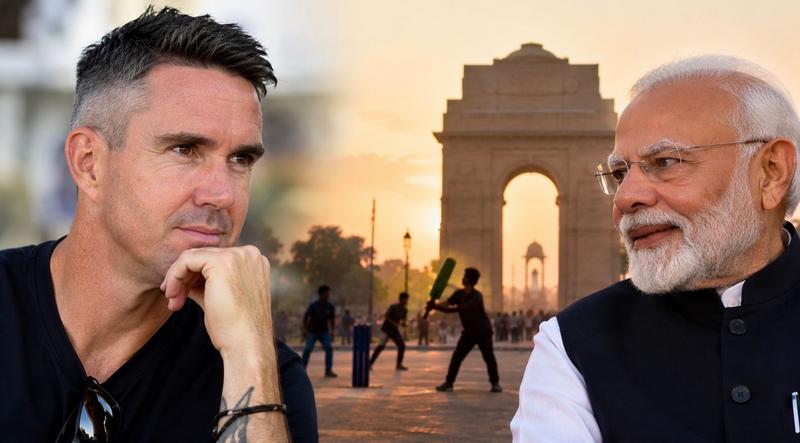
Image credit: Kevin Pietersen / Hindustan Times, subject to the rights of the original photographer and publisher.
Editorial note: This Webfit News report provides independent editorial analysis of Pietersen’s published views and the Indian government’s response. Observations about India’s development are distinguished from the author’s political assessments and from broader questions about economic and social outcomes.