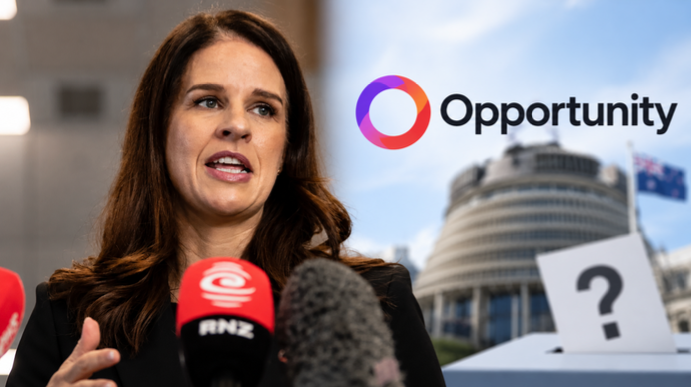
It is not currently represented in Parliament. Yet it has polled strongly enough to become a potential participant in negotiations over the next government.
That makes it both an electoral competitor and a possible parliamentary powerbroker.
Stanford's Criticism Is About More Than Personality
Stanford's central argument was that Opportunity had changed its position on policies that previously defined the party.
She questioned what it now stood for and who was directing its decisions.
That criticism has a factual basis worth examining.
Opportunity, led by Qiulae Wong, has promoted significant tax reform, including a land-value tax and a citizen's income.
But when the party announced five non-negotiable conditions for coalition negotiations in September, neither proposal appeared on the list.
Instead, Opportunity prioritised stronger competition regulation, lobbying and political donation reform, a long-term health plan, phasing out bottom trawling and renewed climate commitments.
The distinction matters.
Opportunity has not formally abandoned its flagship tax policies. It has chosen not to make them immediate conditions for supporting a government.
Wong has argued that major reforms require time and that the party should focus on changes achievable during the next parliamentary term.
Critics can reasonably question whether this represents pragmatism or a retreat from the policies that attracted voters.
But describing those policies as abandoned goes further than the available evidence supports.
The party continues to publish its wider tax reform programme.
The Five Percent Problem National Cannot Ignore
Stanford also predicted that Opportunity would fail to enter Parliament.
Recent public polling tells a less certain story.
The 1News Verian poll published on 27 October recorded the following party vote figures:
National: 29%
Labour: 27%
ACT: 12%
NZ First: 10%
Opportunity: 6%
Opportunity's result was one percentage point lower than the previous poll, but still above the 5 percent threshold.
The survey was conducted between 21 and 25 October among 1,000 eligible voters, with a maximum sampling error of approximately 3.1 percentage points.
That means Opportunity's position remains uncertain. A result of 6 percent is not a guarantee of parliamentary representation.
But neither does it support treating the party's defeat as inevitable.
For Opportunity, the difference between finishing just below and just above 5 percent is enormous.
Without winning an electorate seat, a party below the threshold receives no parliamentary seats through its party vote.
Crossing that threshold could give Opportunity several MPs and potentially a role in determining the next government.
This is why perceptions of its viability matter so much.
If voters believe a smaller party has little chance of entering Parliament, some may decide to support a larger party instead.
Stanford's prediction is therefore not merely a comment about polling. It is also a political message delivered while voters are deciding where to place their support.
Is National Trying to Protect Its Own Vote?
There is a strategic interpretation of National's position.
Opportunity is presenting itself as an alternative for voters dissatisfied with the traditional political choices.
Some of those voters may otherwise support National. Others may come from Labour, the Greens or the politically undecided.
By questioning Opportunity's credibility and ruling out cooperation, National can seek to persuade centre-right voters that supporting the smaller party risks complicating the formation of a government.
This does not prove that Stanford's criticism is motivated by electoral calculations.
Her stated objections concern policy consistency and trust.
But political statements can serve more than one purpose.
National also has a substantive policy disagreement with Opportunity, particularly over taxation.
Luxon has repeatedly said he will not work with a party proposing the land tax Opportunity supports.
That is a clearer political difference than simply questioning whether Opportunity knows what it stands for.
Opportunity Faces a Credibility Test of Its Own
The scrutiny should not stop with National.
Opportunity is asking voters to trust that it can negotiate meaningful change without abandoning the ideas that make it different.
That creates a difficult balance.
If it insists on every major policy, it may become impossible to negotiate a governing agreement.
If it compromises too readily, voters may wonder what they are actually voting for.
The decision to leave its land tax and citizen's income outside its five immediate bottom lines illustrates that tension.
Opportunity says those policies remain part of its broader programme.
But voters deserve a clear explanation of which promises the party would defend, which it would negotiate and which it might postpone.
That is a legitimate accountability question, regardless of whether Stanford's language was justified.
Luxon's Coalition Gamble
National's refusal to work with Opportunity also carries political risk.
Under New Zealand's MMP system, parties frequently need partners to form a government.
Opportunity has said it is willing to speak with both major parties, while making clear it would not simply endorse the existing National, ACT and NZ First coalition agreement.
Wong has indicated that her party would approach the largest party first and negotiate according to its priorities.
National, meanwhile, has closed that door publicly.
If the existing coalition parties secure enough seats, Luxon's position may prove politically advantageous.
But if Opportunity holds the balance of power, National could face a more difficult route to government.
That is the gamble.
The same smaller party National is dismissing could become important to the parliamentary arithmetic after election night.
Stanford Also Turns Her Attention to Hipkins
Opportunity was not Stanford's only target.
She also criticised Labour leader Chris Hipkins over his record as education minister, accusing him of taking credit for initiatives while failing to deliver sufficient results during Labour's six years in government.
She pointed to issues including temporary classrooms and structured literacy.
These are substantive education-policy disputes that deserve assessment against implementation records and measurable outcomes.
Stanford also praised Luxon's performance in the third leaders' debate.
When Garner referred to earlier speculation about National replacing Luxon, Stanford declined to engage with the remark.
The exchange underlined another reality of this election: both major parties are defending their records and leadership while smaller parties compete for dissatisfied voters.
The Bigger Question: Who Is Afraid of Losing Voters?
There is a wider story behind this exchange.
National is arguing that Opportunity lacks consistency.
Opportunity is arguing that the established parties have failed to deliver the structural changes New Zealand needs.
Both claims deserve scrutiny.
For National, the test is whether it can persuade voters that its existing coalition offers a credible programme for another term.
For Opportunity, the test is whether it can show that its ambitious policies are more than attractive campaign promises.
And for voters, the choice is not simply between a familiar party and a newcomer.
It is between competing ideas about how change should happen, who can deliver it and what compromises are acceptable.
Stanford may believe Opportunity has peaked.
She may also be right that some voters will question the party's decision to soften its immediate negotiating demands.
But with Opportunity polling above 5 percent in a recent national survey, its parliamentary prospects cannot yet be dismissed.
Calling a party 'flakes' may make a memorable headline. Explaining why its policies would fail, or why National's alternatives would work better, is a more demanding political argument.
With advance voting already underway, that is the debate New Zealanders deserve.
And on 7 November, voters rather than politicians will decide whether Opportunity has a place in the next Parliament.
Sources: RNZ reporting on Erica Stanford's Duncan Garner interview; Duncan Garner: Editor-in-Chief podcast; 1News Verian polling, 27 October 2026; Opportunity Party published policies and coalition bottom lines.