An endorsement of a National MP, renewed attacks on Māori institutions and a refusal to discuss political deals reveal a larger question about New Zealand First’s priorities after polling day.
By Webfit News | Politics | 30 October 2026
An endorsement of a National MP, renewed attacks on Māori institutions and a refusal to discuss political deals reveal a larger question about New Zealand First’s priorities after...
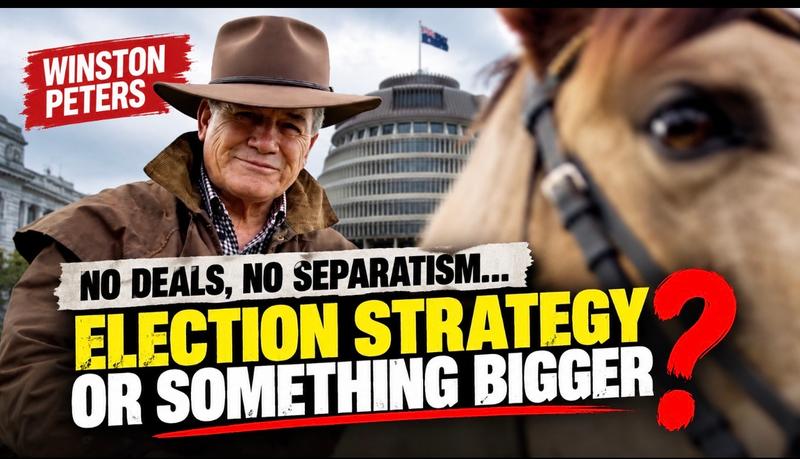
An endorsement of a National MP, renewed attacks on Māori institutions and a refusal to discuss political deals reveal a larger question about New Zealand First’s priorities after polling day.
By Webfit News | Politics | 30 October 2026
With New Zealanders already casting advance votes and the general election just eight days away, Winston Peters is making some of his strongest statements about the Treaty of Waitangi, Māori funding and political alliances.
The timing matters.
In an interview with Mihingarangi Forbes on Mata, the New Zealand First leader defended his opposition to race-based funding, described the Treaty as the “trough of Waitangi” and insisted his endorsement of National’s Chris Bishop was not a political deal.
Taken separately, these are familiar Peters positions. Together, they raise a more interesting question.
Is Peters simply repeating his longstanding beliefs, or is he also defining what New Zealand First would seek to change in the next Parliament?
There is no direct evidence that the statements form a coordinated electoral strategy. But their timing and political significance deserve examination.
Why Speak So Forcefully When Voting Has Already Started?
Advance voting began on 26 October, with election day scheduled for 7 November.
At this stage, political statements are no longer just about setting the agenda for a future campaign. They are being made while voters are deciding which parties and candidates to support.
For a party such as New Zealand First, which has previously negotiated governing arrangements with both National and Labour, the final days of an election also provide an opportunity to clarify which policies it considers important.
Peters’ latest remarks make his position on Treaty-related institutions particularly clear.
But there is a distinction between identifying a political priority and explaining how it would be implemented.
If New Zealand First wants further changes to Treaty-related arrangements, voters are entitled to know which institutions or laws it would change, what would replace them and how the effects would be measured.
Strong language communicates a position. Detailed policy explains what that position would mean in practice.
The Chris Bishop Endorsement Raises a Different Question
Peters has also publicly encouraged New Zealand First supporters to back National’s Chris Bishop in Hutt South.
He describes the endorsement as a statement of respect rather than a political deal.
There is an important distinction here.
Under MMP, voters can give their electorate vote to a candidate from one party and their party vote to another. Supporting Bishop therefore does not automatically mean Peters has entered into an agreement with National.
But the endorsement is still politically significant.
New Zealand First has its own candidate in Hutt South, Alistair Boyce, who has also endorsed Bishop while campaigning for the party vote.
This separates the contest for the local seat from the contest for party representation.
It also demonstrates that cooperation between political parties does not always begin with a formal coalition agreement.
Sometimes it takes the form of a public endorsement on a specific issue or in a particular electorate.
What it does not establish is any agreement about the formation of the next government.
That distinction matters because voters should be able to separate what politicians have publicly committed to from what commentators might infer about their intentions.
The Māori Wardens Answer May Be More Revealing Than the Treaty Remarks
Peters’ criticism of race-based funding is well established.
In the Mata interview, he again argued that government resources should be allocated according to need rather than ethnicity.
He criticised Te Aka Whai Ora, the former Māori Health Authority, and questioned whether its approach could close the gaps in health outcomes.
Yet when Forbes asked about Māori wardens and the Māori Women’s Welfare League, Peters defended their work as needs-based.
He argued that a Māori warden could be more effective than a police officer in reaching a young person because of the relationship and understanding involved.
That answer introduces an important distinction.
Peters is not rejecting every service specifically associated with Māori communities.
He appears to distinguish between community-based services he considers effective and separate institutions he regards as unnecessary.
The difficulty lies in defining that boundary.
If cultural knowledge helps a Māori warden achieve better outcomes, could the same principle justify culturally specific healthcare or social services?
If not, what makes the two situations different?
This is where the discussion becomes more useful than a disagreement over political labels.
The issue is not simply whether a service is Māori-specific. It is what the service delivers, who needs it, how it is funded and whether there is evidence that it works.
The Health Debate Has Moved Beyond the Original Decision
There is another development that makes Peters’ comments particularly relevant now.
On 25 September 2026, the Waitangi Tribunal released the second part of its report concerning the disestablishment of Te Aka Whai Ora.
The Tribunal examined the Crown’s alternative arrangements for Māori health following the authority’s removal.
It found breaches of Treaty principles, including failures relating to consultation, equity and the development of an adequate alternative plan.
The Tribunal also recommended revisiting the option of a standalone Māori health authority and basing future decisions on robust evidence.
Those findings are significant because they shift the debate from whether the former authority should have existed to whether the arrangements that replaced it are adequate.
Peters is entitled to challenge the value of a separate authority.
Equally, those defending targeted Māori health services are entitled to point to persistent disparities and question whether universal services alone can address them.
The relevant policy test is what has changed for patients.
Are waiting times improving? Are preventable illnesses declining? Are people receiving care earlier? Are disparities narrowing?
Without measurable answers, both sides risk arguing over the structure of the health system while the outcomes remain unresolved.
The Language of Accountability Carries Its Own Responsibility
Peters also referred to the Waipareira Trust and an investigation involving Manurewa Marae, using these matters to criticise aspects of Māori funding and political activity.
Questions about the use of public money deserve proper scrutiny.
But there is a difference between raising concerns, reporting an investigation and establishing wrongdoing.
An allegation against a particular organisation cannot automatically be treated as evidence against every organisation operating within the same sector.
The same standard should apply to Māori organisations, government departments, private contractors and other recipients of public funding.
If Peters’ argument is ultimately about accountability, the principle should be consistent: clear funding rules, transparent reporting, independent oversight and consequences where wrongdoing is established.
That is a more demanding test than political rhetoric alone.
Is the Real Argument About Race, Results or Political Authority?
The interview brings three different debates together.
The first is about equality: whether public services should be allocated on the same terms to everyone or include targeted approaches for communities experiencing unequal outcomes.
The second is about effectiveness: whether particular organisations and institutions deliver measurable benefits.
The third is about authority: how Treaty obligations should influence government decisions and the role Māori should have in shaping services affecting them.
These questions are connected, but they are not interchangeable.
A service can be culturally specific and still be assessed against rigorous performance standards.
A universal programme can treat everyone according to the same eligibility rules while producing different outcomes across communities.
And disagreement about Treaty obligations cannot be resolved solely by examining the administrative costs of a particular organisation.
Peters’ interview touches all three debates, but his answers do not fully explain how New Zealand First would reconcile them in future policy.
That is the gap worth examining.
What Happens After 7 November?
The political importance of Peters’ statements will become clearer after the election.
If New Zealand First participates in negotiations over the next government, its public positions on Treaty-related arrangements and Māori services may become part of those discussions.
That does not mean any particular agreement has been reached or that a specific policy change is inevitable.
It means voters have reason to examine the commitments parties are making now, before any negotiations take place.
Peters has made his opposition to certain Māori institutions unmistakable.
He has also acknowledged the value of some Māori-led community services.
The unanswered question is what consistent policy framework connects those positions.
With voting already underway, the most useful question is not simply why Peters is speaking so forcefully about these issues. It is what New Zealand First would actually do with them after the election, and how New Zealanders would know whether those decisions had improved people’s lives.
Source: RNZ, Mata with Mihingarangi, 29 October 2026; Electoral Commission and Waitangi Tribunal official records.