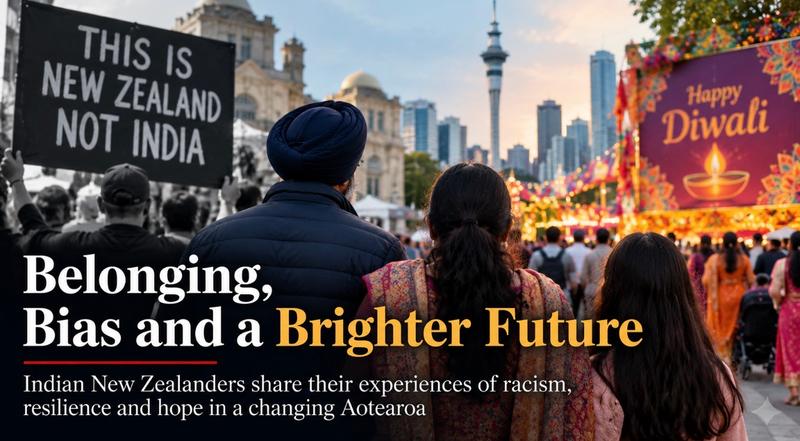
Their stories differ, but they share a concern about the impact of increasingly hostile public rhetoric towards Indians and other migrant communities.
The documentary comes amid renewed controversy surrounding Destiny Church leader Brian Tamaki, confrontations involving Sikh religious processions, inflammatory political comments and reports of threatening anti-Indian graffiti.
Yet the families interviewed by RNZ also speak about something equally important: the kindness, friendships and opportunities that continue to make New Zealand their home.
A history that did not disappear
The Indian community’s relationship with New Zealand stretches back well over a century.
In RNZ’s documentary, Harpreet Singh describes how his great-grandfather arrived around 1912 and worked clearing land for farming.
Harpreet is a fourth-generation New Zealander. His mother was also born here.
Despite those deep family roots, he recalls how earlier generations faced immigration restrictions and discrimination.
During the early twentieth century, immigration policies limited the ability of Indian families to settle and grow their communities. Organised groups, including the White New Zealand League, campaigned against Asian immigration.
Indian communities responded by organising themselves.
The New Zealand Indian Central Association was established in 1926 to challenge discriminatory policies and represent Indian interests.
Harpreet recalls how Gujarati and Sikh communities worked together to secure fairer treatment.
The consequences of discrimination were not confined to immigration.
He describes an experience involving his mother, who trained as a teacher in the 1970s. Despite receiving a positive assessment during her training, she later received an unfavourable reassessment that she believed was influenced by her Indian background.
Decades later, the experience remains with her.
Harpreet also remembers being mocked while growing up in an environment where few other children looked like him.
His family’s experiences show why current arguments about who belongs in New Zealand can resonate particularly strongly with people whose families have already spent generations establishing that belonging.
When religious celebrations become flashpoints
Recent incidents involving Indian religious communities have renewed concerns about intolerance.
In December 2025, protesters associated with Destiny Church confronted a Sikh Nagar Kirtan procession in South Auckland.
A further confrontation involving a Sikh religious procession followed in Tauranga.
Nagar Kirtan is a Sikh tradition involving devotional singing, prayer and community participation.
The incidents attracted concern because religious gatherings that would ordinarily be occasions for celebration became sites of public confrontation.
Some protesters displayed messages asserting that New Zealand was not India.
For Sikh families who regard New Zealand as home, the implication that their religious practices make them less New Zealanders raises difficult questions about acceptance.
The issue is not whether people may disagree with religious beliefs. Freedom of expression and religious criticism are protected aspects of democratic life.
The concern arises when opposition to religious practices becomes directed at communities exercising their own right to worship and participate in public life.
Brian Tamaki and the debate over religious freedom
Destiny Church leader Brian Tamaki has become a prominent figure in the controversy.
In June 2026, he publicly called for New Zealand to be purged of Hindus, Sikhs and Muslims.
He subsequently faced three charges of inciting racial disharmony and pleaded not guilty.
The charges remain before the court, and no finding of guilt has been made.
On Saturday, 31 October, Tamaki again addressed supporters in Auckland CBD while Diwali celebrations were taking place nearby.
He declared New Zealand a Christian nation, criticised Hindu religious practices and argued that his right to speak freely was under threat.
He also insisted that he did not hate people because of their race or religion, maintaining that criticism of religious beliefs should not be confused with hatred towards their followers.
Tamaki’s supporters frame his position around Christian identity and freedom of expression.
However, for communities whose religious traditions are being singled out, the debate is also about whether they can practise their faith without intimidation.
New Zealand has no official state religion. Its legal protections extend to freedom of religion, belief, expression and peaceful assembly.
These rights apply to Christians and to people of other faiths, as well as those who do not follow a religion.
When public rhetoric reaches everyday life
One of the most significant aspects of RNZ’s documentary is how it connects public debate with ordinary experiences.
A Muslim woman interviewed in the programme recalls being refused service-related interaction by a man at her workplace because she wore a hijab.
She returned home crying and questioned why her family had chosen to settle in New Zealand.
Her husband reminded her that the actions of one individual did not represent the entire country.
It was an important distinction, but the incident had already affected her sense of security.
Another participant describes encountering people using loudspeakers to deliver hostile messages while shopping in South Auckland.
Rather than continue past them, the person changed direction.
These may appear to be small decisions compared with the national debate over immigration and religion.
For the people involved, however, they illustrate how public hostility can change everyday behaviour.
The consequences are not always physical. Sometimes they involve avoiding a place, becoming more cautious in public or wondering whether others see you as belonging.
The fear parents carry for their children
The documentary becomes particularly personal when parents discuss their children’s future.
One father, who has lived in New Zealand for more than two decades, says the country feels different from the one he first arrived in.
His concern is not only for himself but also for his daughter.
He worries about the environment she may face when her parents are no longer around to support her.
Another participant reflects on the impact that threatening anti-Indian graffiti could have on young people.
The documentary refers to graffiti in Auckland containing threats of violence against Indians, including messages found near a school and on public surfaces.
For adults, such incidents can be understood within a broader social and political context.
For children, they can raise a more immediate question: why would someone threaten people who look like them?
Those concerns become especially complicated for children born in New Zealand.
They may speak with Kiwi accents, attend local schools, support New Zealand sports teams and know no other country as home.
Yet they can still encounter assumptions that they are foreigners because of their appearance, surname or family background.
Indian New Zealanders are not one community with one story
An important message from the RNZ documentary is the diversity within the Indian population itself.
The families featured include Sikhs, Hindus, Muslims and Christians.
Their languages, religious practices, migration histories and personal identities are different.
One participant, Ben, grew up Christian in Goa, India.
He recalls being asked about his supposedly real or Indian name, as though his Christian name could not be part of an Indian identity.
His experience challenges the assumption that Indian culture belongs to one religion.
India itself is home to many faiths, languages and traditions.
That diversity continues among Indian communities in New Zealand.
For some, identity is closely connected to religious institutions and cultural celebrations.
For others, it is expressed through food, music, volunteering, friendships and family life.
The documentary also highlights unexpected cultural connections.
Ben recalls recognising a Māori song that had been familiar to him while growing up in Goa, only later discovering its New Zealand origins.
It is a reminder that cultural identities are often more interconnected than public arguments suggest.
More than $37 billion in economic contribution
The discussion about immigration also has an economic dimension.
RNZ’s documentary cites research estimating that Indian businesses, households, students and visitors contributed more than $37 billion to New Zealand’s economy in the year ending March 2025.
The research also linked this economic activity to more than 220,000 full-time jobs.
According to the figures presented, Indian-related economic activity represented approximately 8.6 percent of the economy, while people of Indian ethnicity accounted for roughly 6 percent of the population.
These figures describe a broad economic contribution rather than a direct measure of the value of any individual community member.
Nevertheless, they provide important context for debates that portray migrants primarily as competitors for employment, housing and public resources.
Indian New Zealanders are also employers, workers, taxpayers, business owners, students, professionals, volunteers and consumers.
Their contribution extends beyond economic measures to community organisations, education, healthcare, hospitality and social services.
Community service tells another story
The documentary highlights the role of Sikh community organisations in helping people beyond their own religious group.
During the first COVID-19 lockdown, volunteers associated with the Takanini gurdwara distributed approximately 26,500 food bags.
The work reflected seva, the Sikh principle of selfless service.
It is an example of how religious identity can contribute to the wider community rather than separate people from it.
Other families featured in the documentary describe volunteering, cultural education and everyday acts of kindness.
One Hindu family recalls developing a close relationship with their landlord, who lived alone while his children were overseas.
They began sharing meals with him.
Over time, he became part of their extended family life, later helping them move and paint their home.
Such experiences complicate the suggestion that New Zealand society is divided into fixed groups with little connection between them.
For many migrant families, their strongest memories of New Zealand involve precisely these relationships.
Integration does not mean abandoning identity
The documentary also explores an important distinction between integration and assimilation.
Assimilation generally involves adopting the dominant culture while reducing or abandoning aspects of one’s original identity.
Integration allows people to participate in the wider society while retaining their language, religion and cultural traditions.
Harpreet argues that belonging should not require people to erase their heritage.
At the same time, participants recognise that integration involves responsibilities on both sides.
Learning about Māori culture, engaging with local traditions, understanding New Zealand society and respecting the rights of others are part of building a shared national identity.
Equally, accepting migrants as New Zealanders does not require everyone to share the same religion, food, customs or family history.
The documentary suggests that meaningful belonging develops through participation and mutual respect rather than cultural uniformity.
Not every experience defines the country
Despite their concerns, the families interviewed by RNZ do not describe New Zealand solely through incidents of racism.
Several emphasise the generosity and support they have experienced from neighbours, colleagues, friends and strangers.
One participant makes the point that a single negative encounter should not erase many positive experiences.
Another recalls reporting on the aftermath of the Christchurch mosque attacks in 2019.
He remembers schoolchildren gathering in grief and solidarity with Muslim families.
That response remains an important part of how he understands New Zealand.
The contrast between those moments of compassion and recent hostile rhetoric helps explain why some families feel unsettled.
They have experienced a country capable of extraordinary solidarity, while also witnessing public expressions that question their place within it.
Both experiences are part of the national conversation.
A question New Zealand cannot ignore
The experiences documented by RNZ do not establish that every Indian New Zealander feels unsafe or that hostility represents the views of the wider population.
They do, however, demonstrate how public rhetoric can have consequences beyond the political figures who deliver it.
Freedom of speech remains fundamental to New Zealand’s democracy.
So do religious freedom, equal treatment and the right of people to participate in public life without unlawful discrimination.
Debates about immigration levels, housing, employment and cultural change are legitimate public policy discussions.
But those debates become more difficult when entire ethnic or religious communities are treated as though their presence must continually be justified.
For families who have lived here for generations, and for those who have built new lives in New Zealand, belonging is not simply a question of ancestry.
It is shaped by relationships, contribution, shared responsibilities and the ability to live without constantly having to explain one’s place in society.
Towards the end of RNZ’s documentary, a child asks her mother about being a Kiwi Indian because she was born in New Zealand.
It is a simple question that captures the wider issue.
For the next generation, will being a New Zealander be something they can take for granted, or something they must repeatedly defend?
That question reaches beyond the Indian community.
It concerns the kind of society New Zealand is building, and whether people of different backgrounds can see themselves as part of its future.
Source acknowledgement and editorial note
This Webfit News article draws on a video documentary reported and produced by Radio New Zealand (RNZ), featuring interviews with four Indian New Zealand families about racism, religious identity, migration history and belonging.
The personal experiences, historical accounts, community examples and economic figures discussed in the documentary are credited to RNZ and its interview participants. Webfit News did not conduct those interviews.
The article also refers to publicly discussed incidents involving Sikh religious processions, Brian Tamaki’s statements and the Auckland CBD gathering on 31 October 2026.
The views and experiences described by participants are their own and should not be interpreted as representing every Indian New Zealander.
Original reporting and interviews: Radio New Zealand (RNZ). Additional editorial context and analysis: Webfit News.