Diwali celebrations become a focus of Tamaki’s speech
The BNZ Auckland Diwali Festival is taking place on 31 October and 1 November across Aotea Square, Queen Street, Rutland Street and surrounding venues.
Organised as a free public celebration, the festival features Indian cultural performances, music, food, art and family activities. It celebrates Diwali’s traditional message of light overcoming darkness and good overcoming evil.
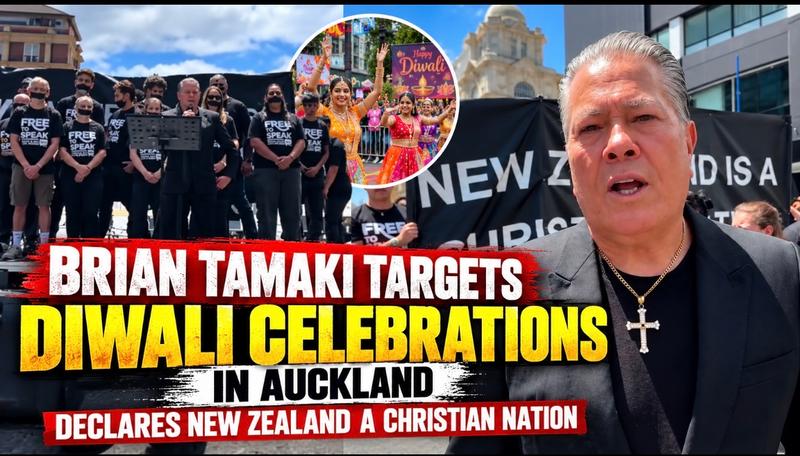
While those celebrations were underway, Tamaki addressed his supporters at a separate gathering in the CBD.
He repeatedly referred to the Hindu festivities nearby, questioning why public streets were being used for celebrations associated with religions other than Christianity.
Tamaki characterised the celebrations as religious worship rather than simply cultural entertainment. He described Hindu deities and religious practices in strongly derogatory terms and argued that such events challenged New Zealand’s Christian heritage.
His comments extended beyond the Diwali festival to other faith communities, particularly Muslims and Sikhs.
The speech raised broader questions about religious freedom, cultural identity and the place of migrant communities in modern New Zealand.
Planned march and document for Indian representatives
During his address, Tamaki told supporters that the group intended to march along Queen Street to deliver what he described as an important document to an Indian cultural organisation.
The remarks suggested that the gathering was intended to involve more than speeches, with a further action directed towards Indian community representatives.
However, the available speech transcript does not clearly identify the organisation that was to receive the document.
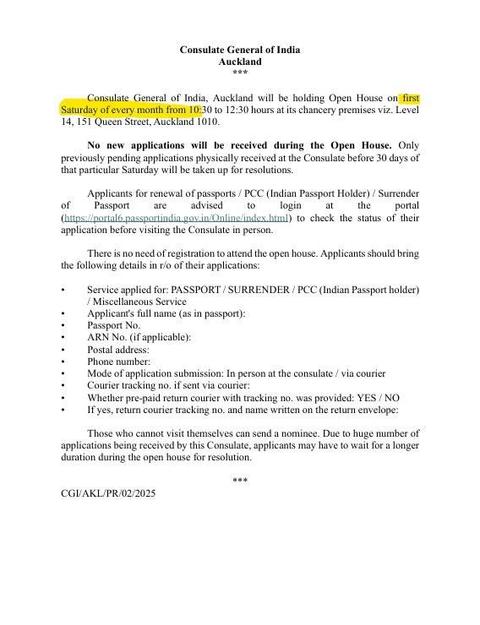
The Consulate General of India is located at 151 Queen Street, but it has not been independently established whether the diplomatic mission was the intended recipient.
It also remains unconfirmed whether the proposed document was delivered, who received it or what it contained.
These details are important given the diplomatic and community sensitivities surrounding Tamaki’s criticism of Indian religious traditions.
‘One Nation, One People, One God’
Following the gathering, Tamaki published a Facebook message describing the occasion as a significant moment for his religious movement.
Under the slogan “One Nation, One People, One God”, he said supporters had joined together to sing a song he wrote in the 1990s expressing his vision for New Zealand.
He presented the gathering as a declaration of Christian faith and national identity.
Tamaki said his beliefs had remained unchanged for decades and maintained that he would continue speaking publicly regardless of criticism or opposition.
During the speech, he went further by proclaiming Christianity to be New Zealand’s official religion.
That declaration reflects Tamaki’s religious position, not the country’s constitutional or legal status.
New Zealand has no official or established state religion. Its laws protect freedom of religion and belief, including the rights of people to practise Christianity, Hinduism, Islam, Sikhism and other faiths, or to follow no religion.
Immigration and political leaders criticised
Tamaki also used the gathering to deliver a wider message about immigration and New Zealand’s changing population.
He argued that migration had placed pressure on employment, housing and cultural identity, and called for tighter border controls.
He suggested that migrant communities were increasingly influencing political decisions and accused political leaders of placing electoral interests ahead of what he described as New Zealand’s traditional identity.
Tamaki criticised politicians who attend Hindu temples, mosques and other religious events, suggesting their participation amounted to endorsing religious beliefs that conflict with Christianity.
His speech included allegations about migrants taking jobs and businesses, and claims that religious leaders directed how entire communities voted.
Those claims were not supported by independently verified evidence in the material reviewed.
Attendance at religious and cultural celebrations is a longstanding part of public engagement by political representatives in New Zealand. Such participation does not, by itself, establish that a politician has adopted the religious beliefs of those attending.
Free speech at the centre of Tamaki’s defence
A major part of Saturday’s address focused on freedom of expression and Tamaki’s forthcoming court proceedings.
He argued that New Zealand was becoming increasingly intolerant of controversial opinions and accused authorities of attempting to silence people who challenge religious and political ideas.
Tamaki maintained that disagreement with another religion should not automatically be interpreted as hatred towards its followers.
He repeatedly insisted that he did not hate people because of their ethnicity or religious background.
At the same time, he continued to make strongly critical statements about Hinduism, Islam and immigration.
The distinction between criticism of religious ideas and language directed against identifiable communities is central to the legal debate surrounding his earlier statements.
New Zealand law protects freedom of expression, including the right to express unpopular or offensive opinions. However, those protections operate alongside legislation addressing certain forms of incitement and discrimination.
Three racial disharmony charges remain before the court
On 19 October, Tamaki appeared in Manukau District Court and pleaded not guilty to three charges of inciting racial disharmony.
The charges relate to Facebook videos and comments published on 15, 17 and 21 June 2026.
According to earlier reporting by RNZ and 1News, the prosecution concerns statements allegedly intended to generate hostility towards Indians on the grounds of race or national origin.
The controversy followed comments Tamaki made about Indian Prime Minister Narendra Modi and the treatment of Christians in India.
In those earlier remarks, Tamaki called for New Zealand to be purged of Hindus, Sikhs and Muslims and raised the prospect of retaliatory attacks against religious buildings.
He subsequently maintained that his comments concerned religious beliefs rather than race and denied advocating violence against anyone.
Tamaki has been granted bail and is scheduled to appear in court again on 25 January 2027.
The charges remain allegations, and no finding of guilt has been made.
His comments at Saturday’s rally should not be confused with the earlier statements forming the basis of those proceedings.
Police presence around Diwali weekend
Police had already indicated that officers would maintain a visible presence in Auckland during the Diwali weekend amid concerns about planned protest activity.
The reassurance followed public concern within ethnic communities about possible confrontations between demonstrators and festival participants.
Police emphasised the importance of protecting both lawful protest and public safety.
The timing of Tamaki’s gathering had attracted attention before Saturday.
Following his October court appearance, Tamaki denied deliberately choosing 31 October to coincide with the Auckland Diwali Festival.
He said the date had been selected in connection with concerns about the persecution of Christians internationally.
Nevertheless, his subsequent public statements and Saturday’s speech directly addressed the Diwali celebrations taking place in the city.
There is no independently verified information in the material reviewed establishing that Saturday’s gathering resulted in arrests, violence or disruption to the festival.
What New Zealand law says about religious freedom
The New Zealand Bill of Rights Act 1990 protects freedom of thought, conscience, religion and belief.
It also protects the manifestation of religion and belief through worship, observance, practice and teaching, alongside freedom of expression and peaceful assembly.
These protections apply across religious communities.
Christians have the right to publicly express their faith and disagree with other religious beliefs. Hindus, Sikhs, Muslims and other communities also have the right to practise their religions and participate in lawful public celebrations.
New Zealand’s legal framework does not establish Christianity as the country’s official religion, despite its significant historical influence.
The question raised by Tamaki’s speech is therefore not whether Christians may express their faith publicly, but how the rights of religious expression, public protest and community safety coexist in an increasingly diverse society.
A wider debate about New Zealand’s identity
Saturday’s events highlighted two different expressions of identity unfolding in the same city centre.
At the Diwali Festival, Aucklanders were participating in a public celebration of Indian culture and religious tradition.
Nearby, Tamaki and his supporters were asserting their vision of a nation grounded in Christianity and challenging the influence of other religions.
For New Zealand’s Indian community, the controversy carries particular significance because Tamaki’s remarks have repeatedly referred to Indian migrants and religious traditions.
For Tamaki and his supporters, the gathering was presented as a defence of Christian identity, national sovereignty and freedom of speech.
The competing positions raise questions extending beyond one protest: how New Zealand accommodates religious diversity, how political leaders engage with different communities and where the law draws boundaries around public expression.
As the Diwali celebrations continue into Sunday, Tamaki’s remarks are likely to remain part of a wider public discussion about religion, immigration and national identity.
His pending court proceedings will separately examine whether his earlier statements crossed the legal threshold for inciting racial disharmony.
Source and editorial note
This report is based on observations of activity in Auckland CBD and a publicly available Facebook post by Brian Tamaki dated 31 October 2026, and a transcript of his public address supplied to Webfit News.