Remove video
From India's Atomic Research Centre to Space Engineering
Dr Karanam said his professional journey began in 2008 when he joined the Bhabha Atomic Research Centre (BARC), one of India's major scientific research institutions under the Department of Atomic Energy.
Although widely associated with nuclear research, BARC works across several scientific and engineering disciplines, including renewable energy, robotics, materials science and other advanced technologies.
According to Dr Karanam, this multidisciplinary environment provided opportunities to contribute to complex engineering projects and collaborate with specialists from different research organisations.
He described his involvement in work connected with India's Chandrayaan-2 and Chandrayaan-3 programmes.
After moving to New Zealand in early 2020, he said he continued contributing independently as an engineering consultant, particularly in mechanical design reviews, material modelling and component qualification.
His work, as described in the interview, involved examining how engineering components behave under different conditions and whether designs meet the required standards.
A major challenge, he explained, is that advanced engineering calculations do not always produce one simple answer.
Different engineers may arrive at different technically defensible estimates because of uncertainties in materials, loads and operating conditions.
That is why comprehensive reviews are needed at the component, assembly and integrated-system levels.
Chandrayaan-2's Setback and the Lessons Behind Chandrayaan-3
India's Chandrayaan-3 mission achieved a historic lunar soft landing in August 2023, following the unsuccessful landing attempt of Chandrayaan-2 in 2019.
For Dr Karanam, the two missions demonstrate the importance of learning from engineering setbacks.
During the interview, he recalled the disappointment surrounding Chandrayaan-2's landing attempt and the determination that followed.
He described Chandrayaan-3 as an achievement made possible through scientific expertise, detailed review and continued effort.
The broader lesson, he suggested, is that an unsuccessful attempt can produce valuable information for the next design.
A mission that does not achieve every planned objective is not necessarily a wasted effort. Engineering teams can use the findings to improve systems, reassess assumptions and reduce risks.
This perspective also shaped his advice to students later in the interview.
Why Building a Rover for the Moon Is So Difficult
One of the most technically interesting parts of the conversation concerned the Pragyan lunar rover carried by Chandrayaan-3.
Dr Vinay explained that spacecraft and rover components must be designed for an environment dramatically different from Earth.
Extreme temperatures, thermal cycling and material behaviour can create serious engineering challenges.
A particular concern is what engineers call the ductile-to-brittle transition temperature, or DBTT.
In simple terms, some materials that can bend or deform under normal conditions become more brittle when exposed to very low temperatures.
A component that can withstand a particular load at room temperature may behave differently in extreme cold.
Dr Vinay compared this to the way a brittle material can fracture rather than bend.
For a lunar rover, that means engineers must carefully evaluate materials and components before they are exposed to the operating environment.
He emphasised that testing and analysis must account for individual parts as well as the complete assembled system.
The discussion provided a glimpse into the engineering work that often receives less public attention than rocket launches and lunar landings.
How Does India Deliver Complex Space Missions at Relatively Low Cost?
Webfit News asked Dr Vinay a question frequently raised in discussions about India's space programme:
Does operating within a tight budget mean compromising on innovation, testing or safety?
His response was emphatic.
“Safety is something which is absolutely paramount and non-negotiable,” he said.
Dr Vinay explained that controlling costs is not simply about reducing materials or spending less money.
It is about understanding engineering requirements precisely enough to avoid unnecessary weight, complexity and expense.
He discussed safety factors and engineering margins, using examples to illustrate how designers account for uncertainty.
When engineers have a better understanding of materials, loads and operating conditions, they can make more informed decisions about how much additional strength or capacity is required.
In aerospace engineering, unnecessary weight can have major consequences for cost and performance.
Detailed modelling, analysis and testing therefore help engineers optimise designs without treating safety as optional.
Dr Vinay argued that rigorous research, careful calculations and effective engineering reviews are central to delivering high-quality systems within financial constraints.
The bigger lesson
The discussion challenges the assumption that a lower-cost mission must necessarily involve lower engineering standards.
Cost efficiency and engineering reliability are not automatically opposing goals.
However, whether a particular mission has achieved an appropriate balance depends on its actual design requirements, verification evidence and safety standards.
The interview offered Dr Karanam's engineering perspective rather than a comparative technical audit of international space programmes.
A Message to Students: Learn the Fundamentals and Don't Fear Failure
When asked what advice he would give young people interested in science and technology, Dr Karanam returned to two themes: curiosity and strong foundations.
He encouraged students to understand the fundamentals of whichever discipline they choose, whether mechanical engineering, software development, business analysis or another field.
He also stressed that meaningful contributions to major projects come from many different professions.
His most memorable advice concerned failure.
“You have to be able to forgive yourself,” he said, encouraging young people not to be afraid of trying something new.
He described unsuccessful experiments and early-stage setbacks as part of the process through which scientific knowledge develops.
The lesson was not that every attempt will succeed, but that learning often comes from understanding why something did not work.
For students who hesitate because they believe they are not talented or experienced enough, his message was straightforward: begin with curiosity, build your knowledge and keep trying.
NASA Space Apps Challenge Comes to Hamilton
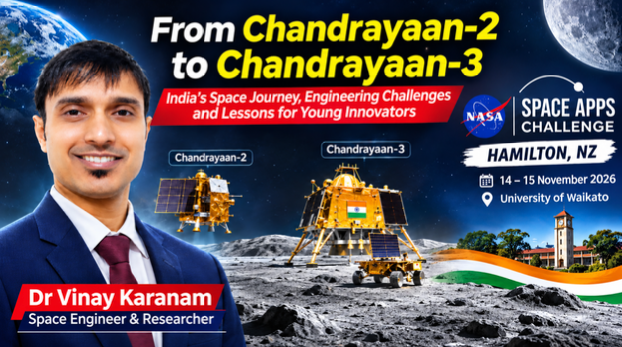
Dr Vinay is scheduled to speak at an event described in the interview as the NASA Space Apps Challenge, taking place at the University of Waikato in Hamilton on 14 and 15 November 2026.
He said the event is intended to bring together people from different age groups and professional backgrounds to work collaboratively on problems involving science, technology and innovation.
Participants will have opportunities to explore data and develop ideas through teamwork.
Dr Vinay explained that his keynote will draw on his professional experiences, including successful engineering decisions and the lessons learned when initial approaches did not work.
He also hopes to discuss how teams respond to practical constraints involving resources, budgets and technical limitations.
Event details shared during the interview
Event: NASA Space Apps Challenge, Hamilton
Dates: 14–15 November 2026
Venue: University of Waikato, Hamilton
Participation: Described by the guest as free
Audience: Students, professionals and interested members of the community
Keynote speaker: Dr Vinay Karanam
Participants should confirm the event schedule, eligibility and registration arrangements directly with the local organisers.
Do You Need Coding or Engineering Experience?
One of the questions raised during the interview was whether someone without a technical background could participate.
Dr Vinay said prior coding or engineering experience was not essential to the kind of collaborative problem-solving he described.
He emphasised imagination, creativity and the ability to think through a problem.
“The real gift of human is imagination,” he said.
According to Dr Karanam, students from different educational levels, including younger schoolchildren, can benefit from understanding how scientific and engineering teams approach challenges.
He explained that major technology projects depend on many disciplines, including administration, law, contracts, governance and business analysis.
A successful project is not built by engineers alone.
It requires people who can understand the problem, communicate effectively, organise work and develop practical solutions.
Can Students Participate Without Having a Team?
Webfit News also raised a question from a 15-year-old student interested in travelling to Hamilton.
Would someone need to arrive with an existing team, or could they join one during registration?
Dr Vinay said the registration process provides options for participants who already have a team and those seeking to join one.
He encouraged interested students to contact the event coordinator for specific questions.
His explanation suggests that not having an established team should not automatically discourage someone from exploring participation.
However, younger students and their families should confirm any age-related requirements, supervision arrangements and registration deadlines with the organisers.
What Might Participants Actually Build?
To explain the kind of thinking involved in a space-related challenge, Dr Karanam offered a hypothetical example involving a lunar rover.
Imagine a rover travelling from one location to another when it encounters an unexpected obstacle.
The team must consider several questions:
How would the rover detect the obstacle?
How could it estimate the obstacle's size?
What alternative routes might be available?
How should it decide which route to take?
How could it continue towards its destination safely?
Dr Karanam explained that the first step is not necessarily writing computer code.
It is understanding the problem and developing a logical process for solving it.
This is the foundation of algorithmic thinking.
The same approach applies beyond space technology, from robotics and transport systems to everyday engineering and business challenges.
India's Human Spaceflight Ambitions and the Role of AI
The conversation also touched on India's Gaganyaan human spaceflight programme.
Dr Vinay discussed the challenges involved in preparing systems to support astronauts safely in space.
Unlike an uncrewed spacecraft, a human spaceflight mission must account for physiological requirements and the continuous monitoring of astronaut health.
He highlighted the importance of analysing biological and operational data, including how information from different populations may need to be evaluated for specific mission requirements.
He also discussed the potential role of artificial intelligence and machine learning in identifying patterns within large scientific datasets.
These technologies can help researchers process complex information, although their use in safety-critical systems requires careful validation.
Dr Karanam said he intends to share some of these broader insights during his Hamilton presentation.
Why This Conversation Matters for New Zealand
New Zealand has a growing aerospace and technology sector, alongside universities and research institutions working across engineering, data science and advanced manufacturing.
For students in Auckland, Hamilton and other parts of the country, events involving real scientific challenges can offer an introduction to the collaborative nature of technical work.
Dr Vinay's message is particularly relevant to students who are curious about science but uncertain about pursuing it professionally.
His interview suggests that the starting point does not have to be a sophisticated understanding of rockets or spacecraft.
It can begin with asking questions, developing an idea and learning how to test it.
The ability to work with people from different backgrounds is equally important.
Free to enter, open to school students, university students and professionals, judged in separate categories.
Register here: https://www.spaceappschallenge.org/2026/local-events/hamilton/?tab=schedule
From the Moon to the Classroom
India's lunar achievements have captured global attention, but the conversation with Dr Vinay highlighted the less visible work behind such missions.
Engineering analysis, material selection, safety reviews, budget constraints, teamwork and lessons from unsuccessful attempts all contribute to technological progress.
As he prepares for his Hamilton appearance, Dr Karanam hopes to bring some of those experiences to students and aspiring innovators.
His closing advice was simple:
“Don't fail to try. Try and fail.”
For a young person wondering whether they belong in science or technology, that may be the most useful lesson of all.
This article is based on an exclusive Webfit News interview with Dr Vinay Karanam. Statements about his professional roles, consultancy work and specific involvement in space projects are attributed to his account during the interview. Webfit News has not independently verified those project appointments. Event participation details were also provided during the interview and should be confirmed with the local organisers.