
By Webfit News | 7 October 2026
Crimson Education co-founder Jamie Beaton is calling for New Zealand to lift its educational ambitions and introduce an overseas study loan scheme that would encourage talented young people to bring their skills home.
By Webfit News | 7 October 2026 Crimson Education co-founder Jamie Beaton is calling for New Zealand to lift its educational ambitions and introduce an overseas study loan scheme...
By Webfit News | 7 October 2026
Crimson Education co-founder Jamie Beaton is calling for New Zealand to lift its educational ambitions and introduce an overseas study loan scheme that would encourage talented young people to bring their skills home.
The 31-year-old, who has accumulated 12 university degrees, told RNZ’s Afternoons that New Zealand needed to prepare students more effectively for an increasingly competitive world shaped by technology and artificial intelligence.
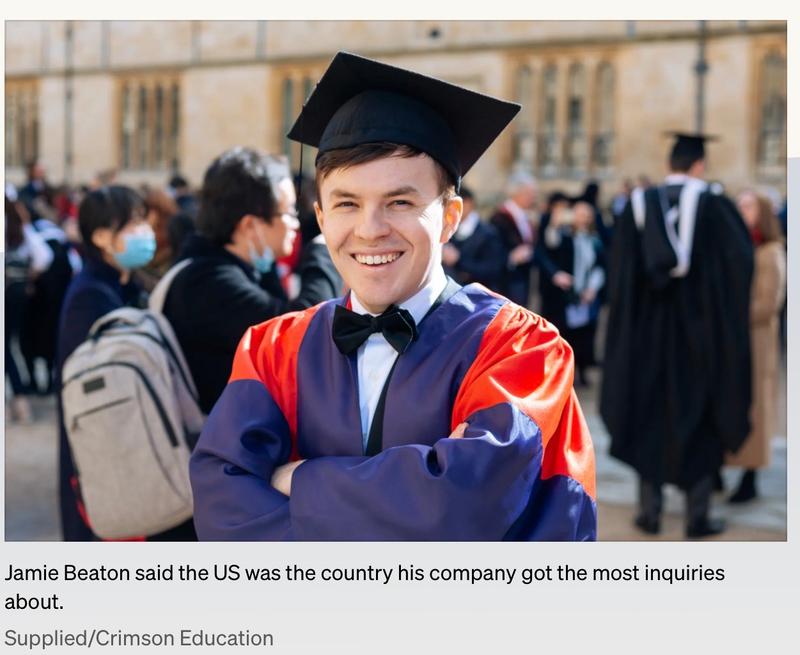
Beaton’s qualifications span institutions including Harvard, Stanford, Yale and Oxford. His company, Crimson Education, helps students gain admission to leading universities overseas and has a reported capital value of NZ$1 billion.
He argued that relatively accessible university entrance requirements in New Zealand could leave some students without enough motivation during their final years of secondary school.
In his view, students should be encouraged earlier to develop academic interests, leadership skills and ambitions beyond simply completing their school qualifications.
Beaton contrasted New Zealand with Singapore, where he said young people began preparing for demanding examinations, launching projects and taking part in community service from their early teenage years.
He said the incentives in that system helped give students a clearer sense of purpose and encouraged them to work towards future opportunities.
The most disengaged young people he encountered were those who could not see a future for themselves, he told RNZ. He wanted more young New Zealanders to feel motivated to try new things, compete and pursue their ambitions.
His comments extended beyond school achievement to the skills New Zealand would need as technology changed the global economy.
Beaton said artificial intelligence offered an opportunity for New Zealanders to build a new generation of companies. Taking advantage of that opportunity would require capable engineers, entrepreneurs and people with strong communication and debating skills.
While he believed entrepreneurship in New Zealand was improving, he argued that education needed to move faster.
As a country, he said, New Zealand needed to “crank up the intensity dramatically”.
One proposal he would like a future government to consider is a student loan programme providing partial tuition support for New Zealanders accepted into leading overseas universities.
Under the model he described, graduates who returned to work in New Zealand for three to five years could qualify for partial loan forgiveness or reduced interest.
The proposal would link public support for overseas education with an incentive to return, allowing students to gain international experience while encouraging them to contribute to New Zealand’s economy.
Beaton argued that the benefits could extend to both business and government.
He pointed to Singapore’s investment in education as a factor behind the expertise of its public leadership. He also expressed concern about what he regarded as a gap between the skills of New Zealand politicians and those in some other countries.
New Zealand needed more highly skilled people returning to contribute to government, establish technology businesses and work across other parts of the economy, he said.
Beaton argued that an overseas study scheme could offer value for taxpayers if it helped develop expertise that graduates subsequently brought home.
He said New Zealand should not assume its domestic universities could meet every educational need, and should make it easier for students to access opportunities internationally.
The scheme he outlined is a proposal for a future government to consider. The RNZ report did not set out detailed costings, eligibility rules or how participating universities would be selected.
His broader message was that education should give young people a stronger sense of possibility, while equipping them with the skills to compete internationally and contribute at home.
Source: RNZ Afternoons, “One of NZ’s most educated people: we need to ‘crank up the intensity’”, published 7 October 2026, drawing on Jamie Beaton’s interview with the programme.