NEW ZEALAND | INDIA | DIPLOMACY | IMMIGRATION | TRADE
By Webfit News | 12 October 2026
NEW ZEALAND | INDIA | DIPLOMACY | IMMIGRATION | TRADE By Webfit News | 12 October 2026 India and New Zealand are entering what could become one of the most significant periods in...
Part of our coverageNZ immigration and visa newsVisa changes, residence and citizenship rules, and migrant worker cases. →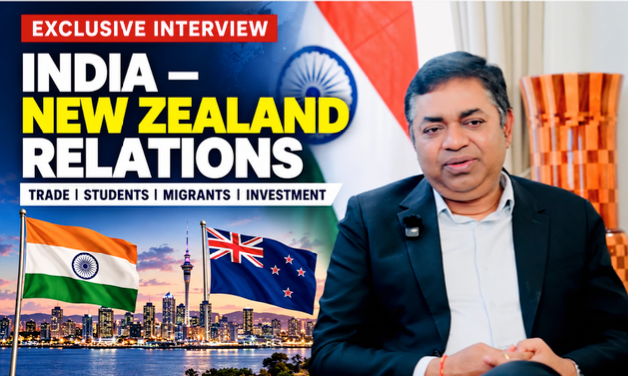
NEW ZEALAND | INDIA | DIPLOMACY | IMMIGRATION | TRADE
By Webfit News | 12 October 2026
India and New Zealand are entering what could become one of the most significant periods in their bilateral relationship, with expanding trade opportunities, closer diplomatic engagement and a growing Indian community creating new possibilities for both countries.
But beyond the political meetings and economic agreements, important questions remain. Are Indian students receiving the support they need? What can be done about migrant exploitation and fraudulent immigration agents? Is New Zealand doing enough to make immigrants feel welcome? And how can businesses in both countries benefit from closer cooperation?
These were among the subjects discussed by Dr Madan Mohan Sethi, Consul General of India in Auckland, during an interview on the YouTube programme HOTSEAT, published on 10 October 2026.
In a wide-ranging conversation, Dr Sethi shared his experiences as a diplomat, discussed challenges facing the Indian diaspora and outlined his vision for stronger relations between India and New Zealand.
Asked to rate the current relationship between India and New Zealand on a scale of one to ten, Dr Sethi gave an optimistic assessment.
He placed the relationship at approximately nine, suggesting that both countries were moving towards an even stronger partnership.
He highlighted recent high-level political engagement, including New Zealand Prime Minister Christopher Luxon's visit to India, developments in bilateral trade negotiations and greater diplomatic contact.
According to Dr Sethi, both countries are increasingly recognising the economic and strategic importance of working together.
He also revealed that the Indian Consulate in Auckland had identified approximately 14 to 15 areas for potential cooperation.
These include opportunities involving business, education, technology and institutional partnerships.
His broader message was that the relationship should extend beyond government-level diplomacy and deliver meaningful benefits to ordinary people.
One of the central topics was the proposed India–New Zealand Free Trade Agreement (FTA).
Dr Sethi described the agreement as a significant opportunity for New Zealand exporters seeking access to India's enormous consumer market.
During the interview, he referred to tariff reductions that could allow a substantial proportion of New Zealand exports to enter India without tariffs, with further reductions phased in over several years.
He also discussed opportunities for agricultural products, meat, forestry and dairy-related cooperation.
However, the practical benefits for businesses will depend on the agreement's final legally operative provisions, product-specific rules, implementation timetable and ratification requirements.
For New Zealand businesses, the potential opportunity is considerable. India offers a large and expanding consumer base, but market entry also requires careful planning.
Dr Sethi acknowledged that India can be complicated for foreign businesses, particularly those unfamiliar with its regulatory environment and regional differences.
His advice was to approach India with a long-term strategy, initially concentrating on selected states and markets rather than attempting to establish a nationwide presence immediately.
For smaller New Zealand exporters, this could be especially relevant. A targeted entry strategy may be more practical than treating India as one uniform market.
Among the sectors discussed, dairy stood out as a particular priority.
Dr Sethi expressed interest in New Zealand's expertise in livestock development, dairy technology and improving milk productivity.
He described visiting New Zealand institutions and learning about advanced breeding practices and livestock genetics.
Drawing comparisons with milk production in India, he suggested that New Zealand's technological expertise could contribute to improvements in Indian dairy productivity.
The opportunity is not necessarily limited to exporting finished dairy products.
It could also involve technology transfer, animal genetics, agricultural research, training and partnerships between institutions.
For New Zealand's agricultural sector, such cooperation could open commercial opportunities beyond traditional commodity exports.
One of the interview's most relevant discussions for Indian families concerned international students.
Every year, students travel overseas with hopes of gaining qualifications, securing employment and potentially establishing a long-term future in another country.
For some families, this involves substantial financial sacrifices.
Dr Sethi acknowledged that parents may borrow money, mortgage property or commit significant savings to support their children's overseas education.
His advice was straightforward: students should prioritise completing their qualifications rather than treating overseas education solely as a pathway to permanent residency.
He encouraged students to gain international experience, develop their skills and pursue employment opportunities where available.
However, he also stressed that students should remain open to opportunities in India or other countries if their plans do not work out in New Zealand.
The message raises an important issue for prospective international students.
An overseas qualification can provide valuable experience, but it does not automatically guarantee employment or residence.
Students and their families need to assess course quality, tuition costs, living expenses, work rights and realistic post-study opportunities before committing substantial money.
The conversation also addressed a more troubling issue: allegations involving immigration agents and the sale of employment or visa opportunities.
Asked about reports of accredited employment-related visas being sold to Indian applicants, Dr Sethi acknowledged that he had heard such accounts.
He suggested that some cases could involve cooperation between dishonest agents and individuals operating outside India.
Importantly, he indicated that specific complaints supported by information about the agents and alleged exploitation could be brought to the Consulate's attention.
He said such matters could potentially be raised with the relevant Indian authorities.
The discussion highlights the vulnerability of migrants who may pay substantial sums believing they are securing legitimate employment opportunities overseas.
For applicants, the distinction between legitimate professional fees and unlawful payments for employment opportunities is critical.
Prospective migrants should independently verify employers, immigration advisers, visa requirements and employment conditions through official New Zealand channels.
In New Zealand, allegations involving migrant exploitation can also be reported to Immigration New Zealand and the appropriate employment or law-enforcement authorities.
The interview did not establish the scale of the alleged visa-selling activity or identify specific agents involved.
Nevertheless, Dr Sethi's acknowledgement of these accounts shows why the issue deserves continued public scrutiny.
Dr Sethi also discussed the challenges involved in establishing and operating the Indian Consulate in Auckland.
He explained that setting up a new diplomatic office required administrative approvals, appropriate premises and additional staffing.
During its initial period, the office faced considerable demand from applicants seeking passport, visa and Overseas Citizen of India (OCI) services.
According to Dr Sethi, the Consulate has now processed approximately 80,000 to 85,000 applications.
He stated that no application had been lost during that period.
He also described situations involving urgent travel to India following family emergencies.
In some cases, he said, consular staff had opened the office outside normal arrangements and assisted applicants with urgent documentation.
He recalled instances where emergency visa matters were resolved within approximately 30 to 40 minutes.
These examples illustrate the importance of accessible consular services for families who may need to travel internationally at very short notice.
However, such emergency assistance should not be interpreted as a guaranteed processing time for all applications.
While discussing consular services, Dr Sethi also raised a recurring problem: incomplete or incorrectly submitted applications.
He said the office receives approximately 150 to 200 applications daily, with a proportion containing avoidable errors.
Common issues include incorrect addresses, missing names or signatures, unsuitable photographs and applications submitted to the wrong office.
These mistakes can delay processing and create additional administrative work.
His advice was for applicants to read the official instructions carefully before submitting their documents.
For Indian residents in New Zealand, the practical lesson is simple: verify passport details, supporting documents, photographs, jurisdiction and payment instructions before lodging an application.
A few additional minutes spent checking an application could prevent considerable inconvenience later.
Beyond government services, Dr Sethi discussed the cultural diversity of the Indian community in New Zealand.
He observed that Indian associations frequently organise events around their own regional languages, festivals and traditions.
However, participation across different regional communities can sometimes be limited.
For example, celebrations organised by one state-based association may attract relatively few participants from other Indian communities.
Dr Sethi said the Consulate had been encouraging events bringing together several Indian states on one platform.
He referred to programmes organised in Auckland and Hamilton where different communities had opportunities to showcase their traditions, handicrafts and cultural performances.
His ambition is to encourage a stronger collective Indian identity while preserving regional diversity.
This raises a wider question for the Indian diaspora.
As the community grows, can regional associations work more closely together on common issues such as youth development, migrant welfare, cultural understanding and engagement with New Zealand institutions?
Cultural diversity remains one of India's strengths, but greater cooperation could help the diaspora develop a more effective collective voice.
The interview also touched on immigration-related political debate and the safety of Indian migrants in New Zealand.
Asked whether immigrants felt safe and whether racist comments were becoming a concern, Dr Sethi acknowledged that negative remarks about Indian migrants had occurred.
He suggested that immigration can become a politically sensitive subject during election periods.
He also referred to discussions he had held with people associated with political parties.
Despite those concerns, Dr Sethi expressed the view that New Zealand remained a safe country for Indian migrants.
His comments reflect a diplomatic assessment rather than a comprehensive measurement of migrants' experiences.
The distinction matters.
Even where a country is generally considered safe, individual experiences of discrimination, harassment or workplace exploitation should not be dismissed.
As New Zealand approaches its general election, immigration policy, social cohesion and the contribution of migrant communities are likely to remain important subjects of public discussion.
Another issue raised during the interview was the perception that closer India–New Zealand trade relations are primarily about increasing immigration.
Dr Sethi rejected that characterisation.
He emphasised that the broader purpose of the trade relationship is to expand business, investment and cooperation between the two countries.
While the movement of people may form part of international economic agreements, he described it as only one element of a much larger relationship.
That distinction is particularly important when trade agreements become part of domestic political debate.
Trade policy can affect exporters, consumers, investors, education providers and service industries.
Any immigration-related provisions should therefore be examined separately and accurately rather than assuming that a free trade agreement automatically creates unrestricted migration pathways.
Asked why a New Zealand businessperson should invest in India, Dr Sethi pointed to three major advantages: market size, a young population and growing industrial capability.
He argued that India offers opportunities not only as a consumer market but also as a manufacturing and technology partner.
He identified sectors including biotechnology, pharmaceuticals, automotive manufacturing, renewable energy, textiles and infrastructure.
Another opportunity he highlighted was the potential for New Zealand innovation to be developed or commercialised through Indian manufacturing capabilities.
For businesses, this could mean combining New Zealand research, design and specialised expertise with India's industrial scale.
However, Dr Sethi also accepted that India's business environment can be complex.
His comments suggest that successful investment requires more than enthusiasm about population figures.
Companies must understand local regulations, competition, supply chains, intellectual property protections and the commercial realities of operating in different Indian states.
The interview also offered a personal look at Dr Sethi's career.
Before entering the Indian Foreign Service, he trained and worked in medicine.
He explained that his medical career gave him direct exposure to people from different backgrounds and helped him understand their concerns.
He later served in diplomatic assignments involving Myanmar, Italy and Vietnam before taking up his responsibilities in Auckland.
Reflecting on his experiences, he challenged the perception that diplomatic work consists mainly of formal receptions and ceremonial engagements.
He described periods of demanding work, particularly when diplomatic relationships required rebuilding or strengthening.
His experience in Myanmar appeared especially meaningful, given the country's historical and cultural connections with India.
Dr Sethi argued that diplomacy involves understanding people, building relationships and finding practical opportunities for cooperation.
Towards the conclusion of the interview, Dr Sethi encouraged Indian migrants to respect New Zealand's laws, make long-term plans and contribute positively to their adopted country.
He cautioned against taking shortcuts that could damage individual reputations or negatively affect perceptions of the wider community.
His message also emphasised integrity, education, personal ambition and responsibility towards society.
For Indian families who have built their lives in New Zealand, these comments underline the importance of balancing cultural identity with active participation in the country they now call home.
The interview presented an optimistic picture of India–New Zealand relations.
There is clear enthusiasm for stronger trade links, educational cooperation, investment and cultural engagement.
But diplomatic optimism alone will not determine whether ordinary people benefit.
For Indian students, success means receiving quality education and being protected from misleading promises.
For migrant workers, it means fair employment conditions and effective action against exploitation.
For businesses, it means predictable rules, accessible markets and genuine commercial opportunities.
For Indian families, it means reliable consular services and a community that can work together despite its regional differences.
And for New Zealand, a stronger relationship with India should be judged not simply by diplomatic visits or announcements, but by measurable improvements in trade, employment, education and people-to-people connections.
Dr Sethi's interview offers an important perspective on where the relationship is heading. The next challenge is ensuring that its potential translates into practical outcomes for people in both countries.
This article is based on Dr Madan Mohan Sethi's interview on HOTSEAT, published by the Hot Seat YouTube channel on 10 October 2026.
The interview covers his diplomatic career, India–New Zealand relations, consular services, student migration, migrant exploitation, investment and the Indian diaspora.
Full interview:
https://youtu.be/q15uj5sBGXw?si=svPBFnpXhoQP8Nyw
Source: HOTSEAT, interview with Dr Madan Mohan Sethi, Consul General of India in Auckland.
Reporting and editorial analysis: Webfit News.