ACT leader’s candid comments reveal a bigger political contradiction: New Zealand wants stronger ties with India, but how consistently are its political leaders building trust with Indian New Zealanders?
NEW ZEALAND | POLITICS | ELECTION 2026
ACT leader’s candid comments reveal a bigger political contradiction: New Zealand wants stronger ties with India, but how consistently are its political leaders building trust with...
Part of our coverageNZ Election 2026Polls, policies, candidates and how to vote, all in one place. →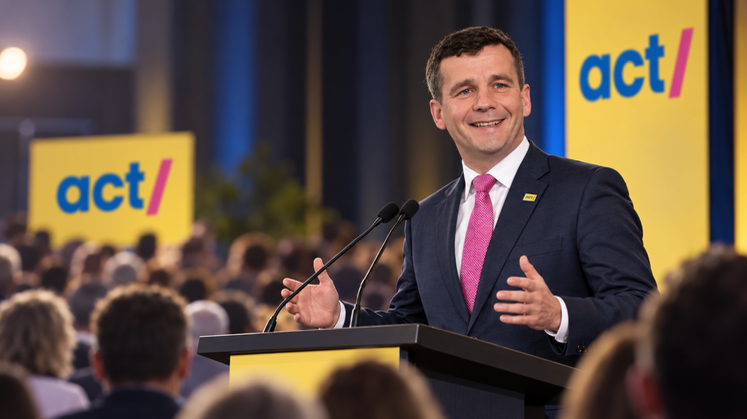
ACT leader’s candid comments reveal a bigger political contradiction: New Zealand wants stronger ties with India, but how consistently are its political leaders building trust with Indian New Zealanders?
NEW ZEALAND | POLITICS | ELECTION 2026
By Webfit News | 13 October 2026
ACT Party leader David Seymour has delivered a wide-ranging and at times sharply critical interview, defending controversial broadcaster and ACT candidate Paul Henry, highlighting India’s growing economic importance, questioning New Zealand First’s political consistency and reflecting on the challenges of coalition government.
Speaking in a recent Unbox podcast interview identified as being associated with NZICA, Seymour moved from serious political issues to unexpected moments involving Winston Peters, Dancing with the Stars and a vintage Land Rover driven towards Parliament’s steps.
But behind the humour and political exchanges lies a bigger story that deserves attention.
New Zealand is increasingly looking towards India for economic opportunity. At the same time, political parties are facing questions about how they engage with Indian communities at home.
That connection, between foreign policy, domestic political credibility and community trust, may be one of the most significant issues emerging from the interview.
1. Paul Henry, ACT and the Question That Cannot Be Ignored
One of the interview’s most revealing exchanges concerned Paul Henry, the former television broadcaster who has entered politics with ACT.
Henry’s political move attracted attention because of his high-profile media career, outspoken commentary and past controversies.
During the discussion, Seymour was questioned about Henry and whether he had addressed concerns about his views before bringing him into ACT.
Seymour defended Henry, saying his personal interactions with the broadcaster had been positive.
He indicated that Henry had never said anything to him that suggested his genuine beliefs were anti-Indian or hostile towards other communities.
That is a significant statement from a party leader.
But it also raises an important distinction.
Seymour’s confidence in Henry is a personal assessment. It does not, by itself, resolve public concerns arising from Henry’s previous statements.
Political parties have every right to recruit candidates with strong personalities and public recognition. Voters, however, have an equal right to examine those candidates’ records.
For Indian New Zealanders, the question is not simply whether Henry can attract attention or votes.
It is whether his public positions, past and present, reflect the respect and understanding expected of someone seeking a place in Parliament.
Seymour’s defence therefore creates a political test for ACT: can the party explain how its commitment to individual equality translates into its choice of representatives?
2. India: New Zealand’s Next Major Economic Opportunity?
Seymour’s remarks about India offered a very different side of the conversation.
He described the New Zealand-India Free Trade Agreement as a major economic opportunity and highlighted the country’s rapidly expanding middle class.
He also identified India as a potential counterbalance to New Zealand’s economic dependence on China.
This is not a minor observation.
China has long been one of New Zealand’s most important trading partners. That relationship remains economically valuable, but excessive reliance on one market creates risks when global demand, trade policies or geopolitical conditions change.
India offers New Zealand an opportunity to diversify.
New Zealand-India Trade: Key Facts
|
Indicator |
Position |
|
India’s population |
More than 1.4 billion |
|
New Zealand-India FTA signed |
27 April 2026 |
|
Ratification completed |
21 September 2026 |
|
Scheduled commencement |
20 October 2026 |
|
Existing NZ exports covered by tariff elimination or reduction |
Approximately 95% |
|
Major opportunity |
Market diversification and access to Indian consumers |
India’s growing consumer market offers potential opportunities for New Zealand exporters in horticulture, forestry, food products and other sectors.
However, the signing of a trade agreement does not automatically create export success.
Businesses must still overcome challenges involving distribution, competition, pricing, consumer preferences and regulatory requirements.
And there is another important distinction.
India can become a stronger economic partner without immediately replacing China as New Zealand’s largest trading market.
The realistic objective is diversification, not substitution.
A broader export base could help New Zealand reduce exposure to disruption in any single major market.
3. The Overlooked Contradiction: India Matters Abroad, But What About Indians at Home?
This is where the interview becomes particularly interesting.
Seymour’s enthusiasm for stronger economic relations with India sits alongside his defence of Paul Henry and the questions raised about Henry’s previous public commentary.
These are separate issues, but they intersect politically.
New Zealand cannot build its relationship with India solely through trade agreements, diplomatic visits and export opportunities.
Relationships between countries are also shaped by how their people experience one another.
Indian New Zealanders are part of the country’s workforce, businesses, universities, healthcare system and wider communities.
Their contribution is not limited to their cultural connections with India.
That creates a question for every political party seeking stronger relations with New Delhi.
Can New Zealand credibly promote India as an important economic partner while failing to take seriously the concerns of Indian communities within New Zealand?
This is not an allegation that Seymour or ACT holds anti-Indian views.
It is a question about political credibility and the standards applied to public representatives.
Economic diplomacy and domestic community relations are not identical, but they cannot be treated as entirely unrelated.
A trade agreement may open commercial doors. Public trust determines whether political leaders can build lasting relationships with the communities connected to those opportunities.
That is the broader issue worth examining.
4. Seymour Turns His Fire on Winston Peters and NZ First
Seymour also delivered pointed criticism of Winston Peters and New Zealand First.
The discussion turned to whether New Zealand First consistently stands by its political principles.
Seymour questioned that characterisation, referring to the party’s historical positions on oil and gas exploration, climate legislation and international climate commitments.
He then delivered one of the interview’s most memorable lines:
“It’s just a different gun every year.”
The remark was a direct challenge to New Zealand First’s political consistency.
Seymour’s argument was that a party cannot automatically claim unwavering principles when its positions have changed across different governments and political circumstances.
However, the criticism deserves context.
Political parties can legitimately change policies when economic conditions, scientific evidence or voter priorities change.
A policy change is not automatically evidence of hypocrisy.
The stronger question is whether a party clearly explains why its position has changed and how that change serves the public interest.
The Coalition’s Political Differences
|
Issue |
Main point of tension |
|
India trade agreement |
ACT emphasises trade opportunities; NZ First has raised concerns about certain provisions |
|
Immigration |
Different priorities over migration settings and economic needs |
|
Climate policy |
Disagreements over regulation and international commitments |
|
Economic policy |
Different approaches to government intervention |
|
Political positioning |
Coalition cooperation alongside competition for voters |
The disagreements highlight the unusual nature of coalition politics.
ACT and New Zealand First must cooperate to govern, yet both parties also need to convince voters that their own political approach is distinct.
As the election approaches, that balance becomes increasingly difficult.
5. The India Trade Agreement Exposes a Wider Coalition Divide
The India trade agreement provides a practical example of the political tensions Seymour discussed.
For ACT, stronger trade ties with India represent an opportunity to expand markets and reduce reliance on China.
New Zealand First has expressed concerns about aspects of the agreement, particularly provisions involving immigration and investment.
Both positions deserve examination.
Trade liberalisation can create export opportunities, but agreements can also involve commitments extending beyond tariffs.
Voters should therefore be asking what New Zealand gains, what it commits to and how the benefits will be measured.
The most important questions include whether exporters will gain meaningful access to Indian markets, whether smaller businesses can take advantage of the agreement and how any associated immigration provisions will operate.
There is also a timing issue.
With the agreement scheduled to take effect on 20 October 2026, the debate is moving beyond political announcements towards implementation.
The real test will not be how enthusiastically politicians celebrate the agreement, but how much additional trade and investment it produces.
6. Healthcare Workers: The Question That Deserves a Proper Answer
Another important moment in the podcast concerned healthcare workers.
Seymour was asked what ACT would do to support healthcare professionals and encourage them to remain in New Zealand if the party returned to government.
The question goes to the heart of a major public policy challenge.
New Zealand depends on skilled healthcare professionals, including internationally recruited nurses, doctors and allied health workers.
Recruitment is important, but retention is equally critical.
What Actually Keeps Healthcare Workers in New Zealand?
|
Factor |
Why it matters |
|
Competitive pay |
Helps reduce incentives to seek work overseas |
|
Manageable workloads |
Reduces burnout and improves patient care |
|
Career progression |
Encourages experienced workers to remain |
|
Immigration certainty |
Supports internationally recruited professionals and families |
|
Workplace conditions |
Improves long-term job satisfaction |
|
Regional opportunities |
Helps address staffing difficulties outside major centres |
The supplied interview excerpt includes the question but not Seymour’s complete response, so no specific healthcare policy commitment can reliably be attributed to him from this material.
Nevertheless, the issue raises a broader question for every party contesting the election.
Should governments measure healthcare workforce success by how many people they recruit, or how many they retain after several years?
A recruitment announcement may generate headlines.
Long-term retention is what helps hospitals, clinics and communities.
7. Dancing With the Stars, Winston Peters and a Cup of Tea
Not every moment in the interview involved serious policy.
Seymour was asked whether competing on Dancing with the Stars had been more difficult than holding together a three-party coalition Cabinet.
The question offered a humorous comparison between two very different challenges.
Seymour appeared on the television programme in 2018, well before becoming Deputy Prime Minister.
The interviewer also joked about whether Seymour would have someone else taste a cup of tea offered by Winston Peters in the Deputy Prime Minister’s office.
Seymour responded that he would be surprised to receive a cup of tea.
It was a light-hearted exchange, but it also reflected the public perception of a sometimes difficult relationship between two prominent coalition figures.
Their political disagreements are real, although disagreement does not necessarily prevent effective cooperation.
For voters, the important issue is whether coalition partners can manage those differences while delivering stable government.
8. The Land Rover Incident Had a Story Behind It
One of the more unusual exchanges revisited Seymour’s attempt to drive a vintage Land Rover up Parliament’s steps.
The interviewer jokingly asked whether the incident was intended as a political statement or whether Seymour was simply searching for a decent parking space in Wellington.
Seymour explained that the stunt was connected to fundraising for medical research involving children with heart conditions.
The incident occurred in February 2025 and involved a historic 1948 Land Rover Series I associated with Professor Julian Paton.
The charitable initiative was connected to research into heart valves for children affected by rheumatic heart disease.
The fundraising target was $300,000.
The research aimed to support development of a heart valve capable of growing with a child, potentially reducing the need for repeated surgical procedures.
Seymour’s attempt to drive the vehicle up Parliament’s steps was stopped by security because permission had not been granted.
In February 2026, he revisited the idea at the Ellerslie Car Show under authorised arrangements.
The episode illustrates how the unusual presentation of a charitable initiative can attract more attention than the underlying cause.
It also highlights a simple principle: supporting a worthy cause does not remove the obligation to follow appropriate rules.
9. Leadership Without Dividing Communities
Perhaps the most important theme emerging from the interview was Seymour’s criticism of political leadership that seeks to elevate one group by diminishing another.
He argued that New Zealand deserves better than an approach that encourages division.
That message has particular relevance in a country with a diverse population and an ongoing debate about immigration, identity and opportunity.
But leadership is not judged by rhetoric alone.
Political parties must demonstrate how their policies affect people in practice.
That includes the treatment of migrant communities, access to public services, economic opportunity and the standards expected of elected representatives.
If political leaders reject division, voters can reasonably expect them to apply that principle consistently.
The same standard should apply regardless of which political party is making the argument.
10. The Real Political Test Ahead of Election 2026
Seymour’s interview brought several important issues into the same conversation.
He defended Paul Henry while facing questions about the broadcaster’s public history.
He championed India’s economic potential while emphasising the need to reduce New Zealand’s reliance on China.
He criticised New Zealand First’s policy consistency while continuing to operate within the same coalition government.
And he spoke about leadership, fairness and opportunity while navigating the political realities of coalition government.
None of these positions automatically contradicts the others.
But together they create a test of political credibility.
Five Questions Voters Should Be Asking
These are questions that extend beyond one party or one podcast interview.
They concern the quality of political leadership New Zealanders should expect.
Webfit News Perspective: The Story Is Bigger Than Seymour Versus Peters
The easiest headline from this interview would focus on Seymour’s criticism of Winston Peters.
Another would highlight his defence of Paul Henry.
Both are newsworthy.
But the deeper story is the relationship between economic ambition, political consistency and public trust.
New Zealand wants stronger access to India’s rapidly growing economy. It also needs to maintain constructive relationships with the Indian communities that are already part of its social and economic fabric.
It wants coalition governments capable of making difficult decisions. Yet voters also expect parties to explain their disagreements and remain accountable for the promises they make.
And it needs healthcare workers, businesses and families to see practical improvements rather than simply hear another round of political arguments.
The biggest challenge for Seymour, and for every leader seeking power in 2026, is not winning an argument on a podcast. It is proving that political principles survive contact with political reality.
That is where voters should focus their attention.
Because New Zealand’s future will not be determined by who delivers the sharpest line about a coalition partner.
It will be determined by who can turn promises into measurable results.
And that is a much tougher test than Dancing with the Stars.
Source and reporting note: This article is based on excerpts from David Seymour’s recent Unbox podcast interview, identified as associated with NZICA, together with background reporting concerning ACT, Paul Henry, the New Zealand-India Free Trade Agreement, coalition politics and the Land Rover fundraising initiative. Analysis and questions raised by Webfit News are distinguished from Seymour’s reported statements.
Webfit News | Independent News, Analysis & Community Perspectives