NEW ZEALAND | AUCKLAND | INTERNATIONAL AFFAIRS
By Webfit News | 13 October 2026
NEW ZEALAND | AUCKLAND | INTERNATIONAL AFFAIRS By Webfit News | 13 October 2026 A large pro-Palestinian demonstration in central Auckland has drawn renewed attention to the...
NEW ZEALAND | AUCKLAND | INTERNATIONAL AFFAIRS
By Webfit News | 13 October 2026
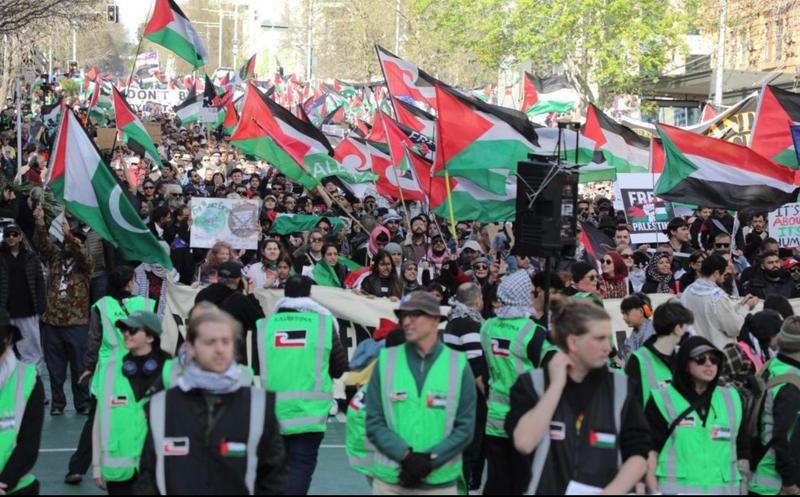
A large pro-Palestinian demonstration in central Auckland has drawn renewed attention to the conflict in Gaza, with footage circulating on social media showing protesters carrying Palestinian flags and marching through city streets.
The video, shared in an Instagram post and credited to the social media account @the_salty_one, shows a crowd of demonstrators gathered near Auckland’s central business district.
The accompanying post claims that thousands of New Zealanders participated in the march over the weekend.
While the footage confirms a visible public demonstration, the exact number of participants has not been independently verified by Webfit News.
The demonstration highlights how the conflict in the Middle East continues to resonate with communities thousands of kilometres away, including people living in New Zealand.
March Forms Part of Worldwide Day of Action
The demonstration was reported as part of the Global Day of Action for Palestine held on Saturday, 10 October 2026.
According to Asia Pacific Report, an estimated 15,000 people participated in the Auckland march, which travelled from Te Komititanga Square near Britomart, along Queen Street, to Albert Park.
The figure is a reported estimate rather than an independently verified police count.
Demonstrations were also reported in Wellington, Christchurch and more than 20 other locations around New Zealand.
The international mobilisation aimed to draw attention to the humanitarian situation in Gaza and increase pressure on governments to take diplomatic and political action.
What Were Protesters Demanding?
Organisations supporting the march called for stronger action from New Zealand, including recognition of Palestinian statehood, sanctions against Israel, greater protection for civilians and accountability under international law.
The Palestine Forum of New Zealand outlined its demands ahead of the demonstrations, arguing that international humanitarian law must be upheld and that governments should do more to prevent civilian suffering.
The march was therefore not simply an expression of sympathy for Palestinians. It was also a political message directed at New Zealand’s decision-makers.
Protesters wanted the government to move beyond statements of concern and consider stronger measures that could influence international efforts towards peace and accountability.
A Country With Different Perspectives
The demonstration also attracted opposition.
A counter-protest was organised by NZ Against Hamas, with support from the New Zealand Jewish Council, around the anniversary of the Hamas-led attacks on Israel on 7 October 2023.
Those opposing the pro-Palestinian march raised concerns about the timing of the demonstration and the need to recognise the suffering of Israeli victims and hostages.
The competing demonstrations illustrate the deeply contested nature of the conflict and the strong emotions it continues to generate.
Supporting the protection of Palestinian civilians and condemning attacks against Israeli civilians are not mutually exclusive positions.
Both populations are entitled to safety and protection under international humanitarian law.
The Bigger Question: What Can New Zealand Actually Do?
Beyond the size of the march, the demonstration raises a practical question.
Can public pressure change New Zealand’s foreign policy, or will large demonstrations continue without producing significant government action?
New Zealand is geographically distant from the conflict, but its diplomatic decisions still matter.
Recognition of Palestinian statehood, targeted sanctions, humanitarian assistance and positions taken at international institutions are all areas where governments can make choices.
However, these decisions involve diplomatic relationships, legal considerations and political consequences.
Protesters are seeking more decisive action, while policymakers must assess how proposed measures could be implemented and what impact they would have.
The distinction between expressing concern and implementing effective policy remains central to the debate.
There is also a question of accountability.
If thousands of people take to the streets demanding action, should the government be expected to explain publicly which demands it accepts, which it rejects and why?
Peaceful demonstrations are an important part of democracy, but meaningful political accountability requires more than simply acknowledging that a protest took place.
Why This Matters to Ordinary New Zealanders
For many people attending such demonstrations, the conflict is not simply another international headline.
Some have family connections to the Middle East. Others are motivated by concerns about civilian deaths, displaced families, children affected by war and the protection of human rights.
For New Zealanders watching from outside the demonstrations, the issue also raises broader questions about the country’s international identity.
New Zealand has long presented itself as a supporter of international law, peaceful conflict resolution and human rights.
The challenge is determining how those principles should translate into action when international conflicts become politically divisive.
There is another important consideration.
New Zealand is a multicultural society where people from different nationalities, religions and political backgrounds live and work alongside one another.
International conflicts can create tensions within local communities, particularly when people have strong personal or historical connections to those conflicts.
Protecting the right to peaceful protest while ensuring that Jewish, Muslim, Palestinian, Israeli and other communities feel safe is an important responsibility for both political leaders and wider society.
A Message That Extends Beyond Auckland
Saturday’s march demonstrated that the situation in Gaza remains an issue of considerable public concern in New Zealand.
Whether the reported turnout of 15,000 people leads to any policy change remains to be seen.
What is clear is that the issue continues to mobilise people across different communities, backgrounds and generations.
For the government, the question is not only how to respond to protesters but how to explain its wider approach to the conflict, humanitarian protection and international accountability.
For the public, the challenge is to maintain space for peaceful protest, informed debate and compassion for civilians affected on all sides.
The Question That Remains
Large demonstrations can capture national attention for a day. Their lasting significance, however, depends on what happens afterwards.
Will political leaders respond with clear policy decisions? Will protesters continue their campaign? And will New Zealand’s position on the conflict change as international pressure evolves?
These are questions that cannot be answered by crowd numbers alone.
The real measure of the Auckland demonstration may ultimately be not how many people walked through Queen Street, but whether their demands influence the decisions made after the crowds have gone home.
Webfit News | Independent News & Community Perspectives
Sources: Asia Pacific Report, Palestine Forum of New Zealand,