Together, these performances provided a fascinating picture of two teams with contrasting strengths.
Glenn Phillips: 341 Runs and a Record-Breaking Series
Glenn Phillips was undoubtedly one of the biggest stories of the series.
The New Zealand batter accumulated 341 runs in five matches at an extraordinary average of 113.67 and a strike rate of 185.33.
His performances included one century and three half-centuries, with 29 fours and 20 sixes.
Phillips' finest moment came at Eden Park in Auckland on 30 October, where he smashed 107 runs from just 49 deliveries against India.
The innings demonstrated his ability to combine aggressive stroke play with remarkable consistency.
He continued his impressive form in the final T20 international at Hamilton, finishing unbeaten on 65 as New Zealand completed a seven-wicket victory.
Phillips' aggregate surpassed the previous men's bilateral T20I series record of 331 runs held by England's Phil Salt.
Although New Zealand lost the series, Phillips' performance was a reminder that individual excellence can stand apart from the overall team result.
His consistency against India's bowling attack was particularly impressive, especially in a format where maintaining such high scoring rates across multiple matches is exceptionally difficult.
Abhishek Sharma: India's Young Batting Talent Delivers
While Phillips dominated the run-scoring charts, India's Abhishek Sharma produced one of the most explosive innings of the series.
Abhishek finished with 197 runs at a strike rate of 223.86, reflecting his aggressive approach at the top of the batting order.
His defining performance came during the third T20 international in Wellington on 27 October.
Chasing New Zealand's total of 198, Abhishek smashed an extraordinary 113 runs from just 38 deliveries, including 11 sixes.
India reached the target in only 13.2 overs, winning by six wickets and securing an unassailable 3–0 lead in the series.
The innings was a remarkable display of attacking cricket.
Rather than allowing New Zealand's bowlers to settle, Abhishek attacked from the beginning, putting immediate pressure on the home side.
His performance also highlighted India's growing confidence in younger players who are prepared to take risks and play fearless cricket.
For India's coaching staff, the series offered another encouraging indication of the talent available for the future.
Daryl Mitchell and Michael Bracewell Make Their Mark
Although Phillips attracted much of the attention, several other New Zealand batters made important contributions.
Daryl Mitchell finished as the third-highest run-scorer of the series with 176 runs.
His unbeaten 89 in Wellington helped New Zealand reach 198, although the total was eventually overhauled by India's aggressive batting.
Michael Bracewell also delivered one of the most entertaining innings of the contest.
During the fourth T20 international at Eden Park, Bracewell scored 65 runs from just 25 balls, including six sixes.
His explosive contribution helped New Zealand post an imposing total of 259 for seven.
The BLACKCAPS subsequently defeated India by 87 runs, ending the visitors' hopes of completing a series sweep.
Bracewell's innings demonstrated the importance of powerful middle-order batting in modern T20 cricket.
A player capable of scoring quickly during the final overs can dramatically change the outcome of a match, even without facing a large number of deliveries.
Mitchell Santner Leads the Bowling Performances
While the series was dominated by big scores and aggressive batting, the bowlers also produced several important performances.
New Zealand captain Mitchell Santner finished as the leading wicket-taker with nine wickets.
His economy rate of 7.37 runs per over was particularly noteworthy considering the high-scoring nature of the matches.
Santner's best bowling performance came in Christchurch, where he claimed four wickets for 21 runs during the second T20 international.
Although India eventually won the match, his spell demonstrated the importance of disciplined spin bowling against aggressive batters.
India's Arshdeep Singh and New Zealand's Adam Milne finished with six wickets each.
Jacob Duffy also made a significant contribution during the fourth T20 international at Eden Park, claiming four wickets for 23 runs.
His performance helped New Zealand restrict India to 172 for nine while defending their imposing total.
The bowling statistics highlight an important reality of modern T20 cricket.
Taking wickets remains essential, but controlling the scoring rate is equally important.
A disciplined four-over spell can have a significant impact, particularly when batters are consistently looking for boundaries.
Five Matches, Two Very Different Stories
The series effectively unfolded in two phases.
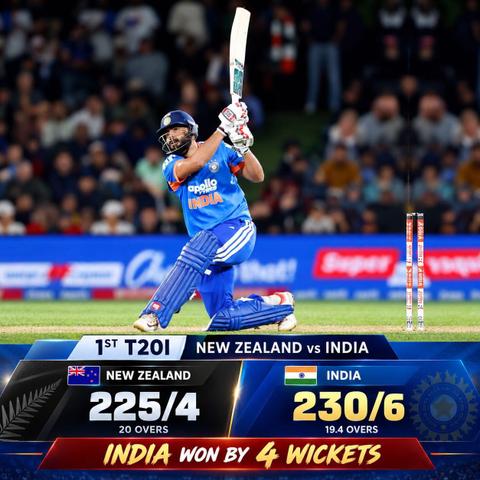
First T20I, Christchurch, 22 October: India won by four wickets.
Second T20I, Christchurch, 24 October: India won by four wickets.
Third T20I, Wellington, 27 October: India won by six wickets, securing the series.
Fourth T20I, Auckland, 30 October: New Zealand won by 87 runs.
Fifth T20I, Hamilton, 1 November: New Zealand won by seven wickets.
India's opening three victories demonstrated their ability to chase targets successfully under pressure.
The third match in Wellington was particularly significant, with Abhishek Sharma's extraordinary century ensuring that India secured the series before travelling to Auckland.
However, New Zealand's response in the final two matches was equally noteworthy.
At Eden Park, the BLACKCAPS produced their highest-ever T20 international total of 259 for seven.
Phillips' century and Bracewell's explosive batting proved too much for the Indian side.
The final match in Hamilton provided another impressive performance from the hosts.
Tim Seifert struck 93 runs from 50 balls, while Phillips remained unbeaten on 65 as New Zealand successfully chased India's total of 191 for eight with two overs remaining.
Although the series had already been decided, New Zealand's back-to-back victories demonstrated their resilience and batting depth.
What the Statistics Reveal About Both Teams
Beyond the individual performances, the series offered several insights into the strengths of both teams.
For India, the most encouraging aspect was the aggressive batting approach displayed by their younger players.
Abhishek Sharma's remarkable strike rate and match-winning century demonstrated how quickly a game can be transformed by attacking cricket.
India's ability to win three consecutive matches also reflected the effectiveness of their batting combinations during the opening phase of the series.
For New Zealand, Phillips' consistency was the standout achievement.
Scoring 341 runs in five matches is an exceptional accomplishment, particularly against an international bowling attack.
The contributions of Daryl Mitchell, Michael Bracewell and Tim Seifert also highlighted New Zealand's batting depth.
However, both teams experienced periods when their bowling attacks struggled to contain the opposition.
The high-scoring encounters demonstrated how difficult it has become for bowlers to maintain control when batters attack from the opening over.
Fielding also remains an important part of the equation.
In a format where matches can be decided by small margins, a difficult catch, a direct-hit run-out or a few runs saved near the boundary can prove just as important as a big innings.
Individual Brilliance Versus Team Success
Perhaps the most interesting aspect of the series was the contrast between individual statistics and the final result.
India won the series 3–2, but the leading run-scorer belonged to New Zealand.
Phillips' record-breaking campaign demonstrated that a player can produce extraordinary individual performances even when his team does not win the overall contest.
At the same time, India's early dominance showed the importance of delivering results collectively.
Abhishek Sharma's century in Wellington was a decisive contribution because it directly secured the series.
New Zealand's late comeback provided another reminder that international cricket can change quickly.
After losing the opening three matches, the BLACKCAPS responded with two convincing victories, ensuring the series ended on a positive note for the home supporters.
What Comes Next for India and New Zealand?
For India, the series victory will provide confidence in the team's developing T20 combinations.
The performances of younger players suggest that the country has considerable batting depth and several exciting options for future international competitions.
For New Zealand, the challenge will be converting outstanding individual performances into consistent team results.
Phillips has demonstrated his importance as a leading international T20 batter, while Mitchell, Bracewell and Seifert have shown that the BLACKCAPS possess the firepower to challenge strong opposition.
The final two matches also demonstrated that New Zealand can respond effectively after difficult results.
Both teams will take important lessons from the series, particularly in balancing aggressive batting with disciplined bowling.
The Final Word
India deserved their series victory after winning the opening three matches and producing one of the most remarkable run chases of the contest.
However, New Zealand's late resurgence ensured that the series ended with plenty of positives for the home side.
Glenn Phillips' extraordinary 341 runs will remain one of the defining achievements of the five-match contest.
Abhishek Sharma's breathtaking century demonstrated the excitement surrounding India's emerging batting talent.
And New Zealand's victories in Auckland and Hamilton reminded cricket supporters that the BLACKCAPS remain a dangerous opponent, particularly in familiar conditions.
The series trophy belongs to India, but the individual performances tell a much broader story.
Ultimately, the India–New Zealand T20 series was a celebration of attacking cricket, outstanding talent and the unpredictable nature of the shortest international format.
Webfit News Sports Desk | Auckland, New Zealand