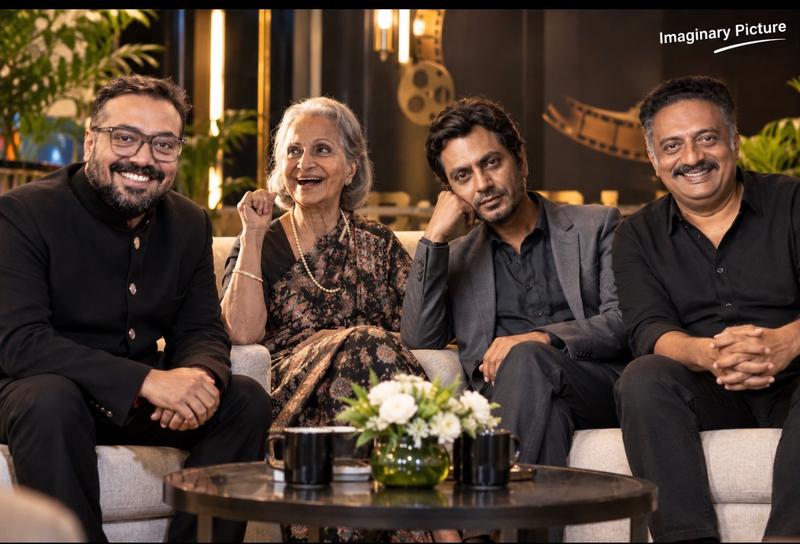
Yet, judging by some of the photographs circulating on social media and conversations emerging from Auckland, one cannot help but wonder whether we missed an opportunity to make their visit something truly memorable.
Four names that deserve a standing ovation
Waheeda Rehman: A living legend of Indian cinema
For generations of film lovers, Waheeda Rehman represents the golden era of Hindi cinema. From Pyaasa and Kaagaz Ke Phool to Guide and Chaudhvin Ka Chand, her performances remain timeless.
A recipient of the Padma Shri, Padma Bhushan and the prestigious Dadasaheb Phalke Award, she is among the most respected personalities in Indian film history.
For many Indians, she is not merely an actress. She is part of their childhood memories, their parents’ favourite films and an era of cinema that continues to inspire.
Anurag Kashyap: The filmmaker who challenged conventions
Anurag Kashyap helped reshape contemporary Indian cinema through bold, unconventional storytelling. Films such as Black Friday, Dev.D, Gangs of Wasseypur and Ugly established him as one of India’s most influential filmmakers.
His work has earned international recognition and inspired a generation of aspiring directors and storytellers.
Nawazuddin Siddiqui: From struggle to international recognition
Nawazuddin Siddiqui’s journey from years of struggle to international acclaim is a remarkable story of determination.
With memorable performances in Gangs of Wasseypur, The Lunchbox, Manto and Sacred Games, he has established himself as one of India’s finest character actors.
His journey continues to inspire young performers who dream of making their mark in cinema.
Prakash Raj: A powerhouse of Indian cinema
A multiple National Film Award winner, Prakash Raj has delivered memorable performances across Hindi, Tamil, Telugu, Kannada and Malayalam cinema.
His versatility, commanding screen presence and contribution to Indian filmmaking have earned him admiration across generations and language barriers.
Having personalities of this stature associated with a cultural celebration in New Zealand is an achievement in itself.
But where was the excitement?
With such extraordinary artists visiting New Zealand, one might have expected enthusiastic audiences, packed interactions, aspiring actors eager to learn and widespread community interest.
However, some photographs shared on social media, particularly from Auckland, appeared to tell a different story.
Conversations within the community have also raised questions about attendance at certain gatherings. Some accounts suggested that particular interactions attracted as few as 15 to 20 people.
These figures are informal estimates, not confirmed attendance numbers, and they should not be taken as representative of the entire programme across three cities.
Nevertheless, the impressions raise a fair question.
When artists of this calibre travel all the way to New Zealand, could we have done more to bring people together?
The concern is not simply about numbers. It is about whether the opportunity reached the people who would have valued it most.
How many families would have loved to meet Waheeda Rehman? How many aspiring filmmakers would have wanted to hear Anurag Kashyap speak? How many young actors would have treasured an interaction with Nawazuddin Siddiqui or Prakash Raj?
Perhaps many never knew enough about the opportunities available.
Where was the mainstream media attention?
Another concern is the apparent lack of substantial mainstream media visibility surrounding the actual gatherings.
There was some advance publicity, including radio interviews about the upcoming festival. But advance promotion is different from journalists attending events, documenting celebrity interactions and reporting on what took place.
From the social media material and community conversations that prompted this editorial, a significant mainstream media presence was not apparent at the Auckland interactions being discussed.
That does not establish that no journalists attended or that no subsequent reports appeared. It does raise questions about the scale of coverage the visit received.
These artists have contributed enormously to Indian cinema and international storytelling. Their presence offered an opportunity to engage not only the Indian community but also New Zealand’s wider film and arts audiences.
Bringing the stars is an achievement. Bringing people together matters just as much.
Organising an international cultural event is no small task. It requires financial commitment, coordination, relationships and considerable effort.
Those who make such visits possible deserve appreciation.
But bringing celebrated artists to New Zealand is only half the opportunity. Ensuring that people know about their arrival and can meaningfully participate is equally important.
New Zealand has a vibrant Indian community, supported by cultural associations, businesses, students, volunteers and media organisations.
We regularly come together in large numbers for concerts, festivals and community celebrations.
Surely a visit by some of India’s most respected cinematic personalities deserves similar enthusiasm.
A cultural event should not be remembered only for its guest list or photographs with celebrities. Its lasting value lies in the connections it creates and the people it inspires.
Community pride must come before individual differences
There is a larger lesson here.
When internationally respected artists visit New Zealand, the occasion should be bigger than any one organisation, group or individual.
It should be an opportunity for the wider community to unite.
Too often, community initiatives risk becoming isolated when collaboration takes a back seat to organisational boundaries, personal differences or the desire for individual recognition.
We are not suggesting that this necessarily happened in the recent programme. But it is a principle worth remembering for future cultural events.
Imagine the impact of community associations, student groups, businesses and media organisations working together well before such a visit.
Greater publicity, broader participation and more opportunities for public interaction could help turn an important cultural programme into a memorable community celebration.
At Webfit News, we would have welcomed the opportunity to support wider awareness of these visiting artists and encourage greater participation.
Not for individual recognition, but because moments like these deserve to be shared.
When the opportunity is to honour legends of Indian cinema, community pride should always be bigger than personal or organisational differences.
A reflection from Auckland, not a verdict on New Zealand
It is important to recognise that the observations prompting this editorial relate primarily to Auckland.
The photographs and conversations discussed here do not establish what happened at every gathering, nor do they reflect the experiences of audiences in Wellington and Christchurch.
The wider programme may have created meaningful experiences and valuable connections that are not visible through a handful of social media posts.
But even limited community feedback can highlight opportunities for improvement.
Could publicity have started earlier? Could local organisations have been more actively involved? Could student groups, film enthusiasts and community media have helped bring larger audiences to public interactions?
These are constructive questions, not personal accusations.
The real disappointment is what could have been
Imagine a hall filled with film lovers applauding Waheeda Rehman.
Imagine young filmmakers listening to Anurag Kashyap discuss his creative journey, or aspiring actors learning directly from Nawazuddin Siddiqui and Prakash Raj.
These are the experiences that create lifelong memories and inspire the next generation.
For many Indians living in New Zealand, these are artists they grew up admiring. Their films were part of family evenings, conversations with friends and memories of home.
To have them visit our country is special.
To imagine that some opportunities to celebrate them may not have reached their full potential is disappointing.
And that is precisely why this conversation matters.
Let the next visit be a celebration for everyone
This editorial is not intended to diminish the efforts of those who brought these distinguished artists to New Zealand.
Their work deserves recognition.
But appreciation should not prevent reflection.
We can celebrate the achievement while asking whether stronger collaboration, earlier promotion and greater community involvement could have made the experience even more successful.
New Zealand’s Indian community has the people, passion and resources to make major cultural occasions truly memorable.
What matters is our willingness to work together.
When legendary artists travel thousands of kilometres to visit our country, let us welcome them with the respect, enthusiasm and unity their contribution deserves.
Because such occasions belong not just to those who organise them, but to everyone whose life has been touched by their work.
The legends came to New Zealand.
The question is not whether we were fortunate to have them here.
The question is whether we made the most of that opportunity.
From the Editor’s Desk
This editorial reflects the writer’s personal perspective, informed by community conversations and photographs circulating on social media following the recent Indian cinema celebrations in New Zealand, particularly in Auckland.
It is intended to encourage constructive discussion about cultural pride, community collaboration and the importance of giving visiting artists the recognition they deserve. Observations concerning individual gatherings should not be interpreted as an assessment of the entire nationwide programme.
The views expressed are those of the writer and are shared in the spirit of community unity and respect for Indian cinema.
Webfit News | Editorial Opinion
Image caption: Conceptual illustration featuring four celebrated personalities of Indian cinema. This is an imaginary composition, not a photograph of an actual gathering.