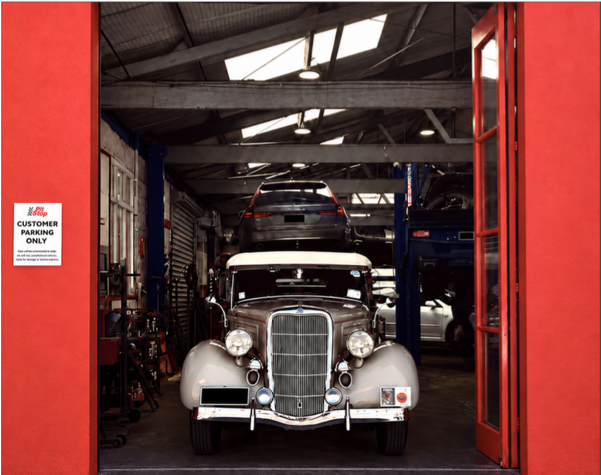
New Zealand's first locally assembled Buick rolled off a Petone production line in January 1927. A century later, the American marque will take centre stage at Napier's vintage-car parade. Behind the polished chrome lies a story of Kiwi manufacturing, a farming co-operative and a garage that survived the 1931 earthquake.
By Webfit News | Heritage & Events | 25 October 2026
On 21 January 1927, a Buick sedan rolled off the General Motors assembly line in Petone, near Wellington.
It was the first Buick assembled in New Zealand.
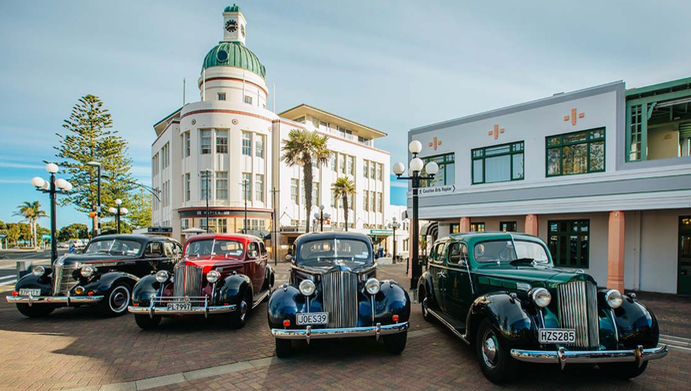
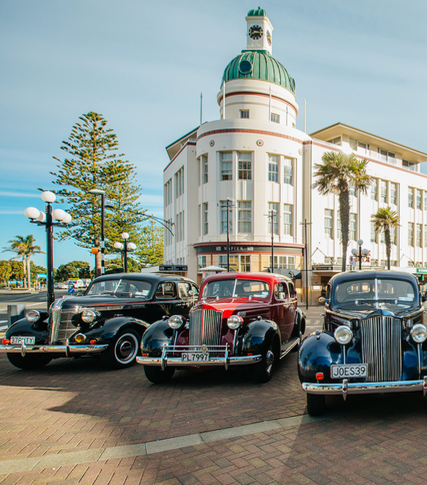
A century later, the marque will be celebrated on the streets of Napier, where Buick has been selected as the feature marque for the 2027 Art Deco Festival's Vintage Car Parade.
The festival, running from 18 to 21 February 2027, will bring vintage vehicles, period fashion, music and heritage celebrations back to Hawke's Bay.
For visitors, it promises an enjoyable summer spectacle. But the Buick anniversary also reveals a lesser-known part of New Zealand's industrial history.
These were American cars, assembled by New Zealand workers and sold through local businesses — including a Hawke's Bay farming co-operative whose former garage still stands in Hastings.
The Day Buick Became Part of New Zealand Manufacturing
General Motors opened its Petone assembly plant in 1926, initially producing Chevrolet vehicles before adding Pontiac and Buick.
A contemporary newspaper account, published in Auckland's Sun in September 1927 and preserved through the National Library's Papers Past collection, records that the first Buick was assembled on 21 January that year.
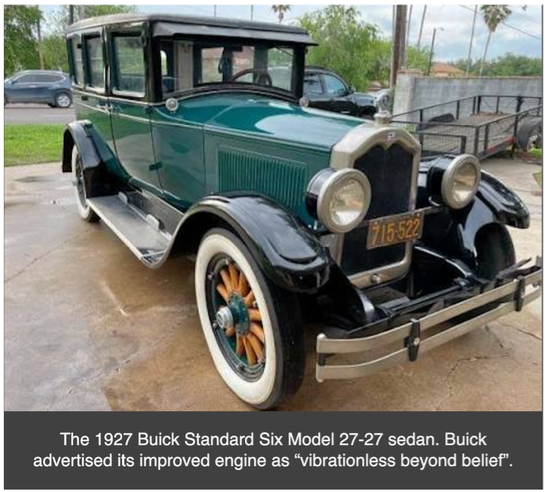
The vehicle was a 1927 Buick sedan, part of the company's six-cylinder range.
Unlike a modern car factory that manufactures many components on site, the Petone operation assembled vehicles from imported parts.
Bodies, mechanical components and other materials arrived from overseas. Assembly and finishing work were undertaken locally.
That distinction matters.
The Buick was not designed or wholly manufactured in New Zealand. But assembling it here created local employment, technical skills and business opportunities.
According to Te Ara, General Motors' Petone factory was part of a growing New Zealand motor-assembly industry that later included a range of American, British, Australian and Japanese brands.
The first Buick was therefore more than an expensive new vehicle. It represented an emerging industrial sector that would become familiar to generations of New Zealand workers.
A Luxury Car With a Serious Price Tag
The 1927 Buick was not an everyday purchase for most households.
Festival background material describes the first locally assembled sedan as finished in Washington blue with black mudguards and carrying a price of £525.
At the time, Buick promoted its improved six-cylinder engine as offering unusually smooth performance.
The manufacturer's advertising claimed it was "vibrationless beyond belief".
The phrase captures the excitement surrounding motoring technology in the 1920s, when comfort, reliability and mechanical refinement were major selling points.
Buyers were paying not simply for transport but for a machine that represented modernity, status and convenience.
The festival material also lists other Buick models available through Hawke's Bay dealers, from a £472 roadster to a £755 seven-seater limousine.
Those prices illustrate the substantial investment involved in buying a new Buick.
They should not, however, be mistaken for a direct comparison with today's car prices. A meaningful modern equivalent would require considering wages, household purchasing power and changes in vehicle ownership.
The Unexpected Connection: A Farming Co-operative Selling Buicks
One of the most interesting parts of the story lies not in Petone but in Hastings.
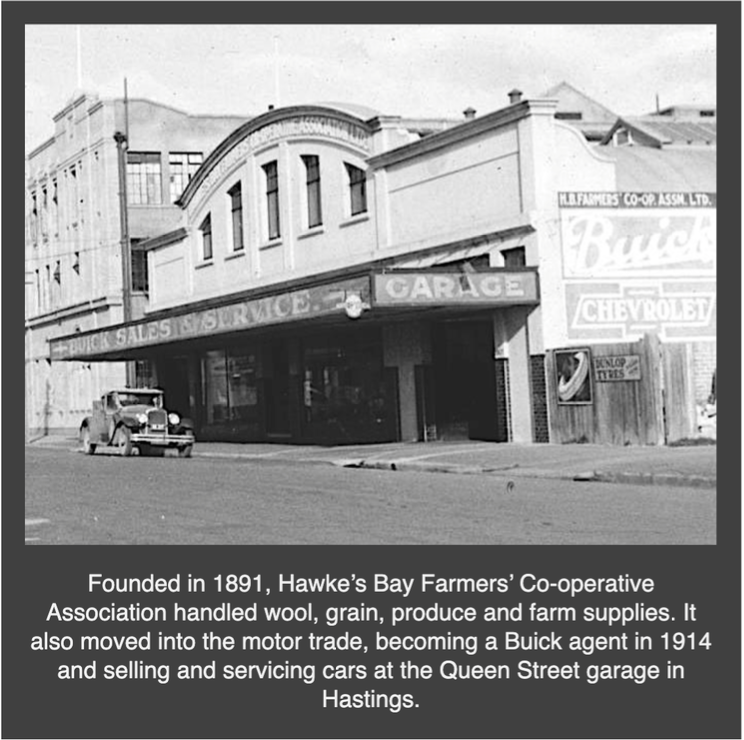
The Hawke's Bay Farmers' Co-operative Association was established in 1891 to serve the region's agricultural economy.
Its business included wool, grain, produce and farming supplies.
Yet it also became involved in selling and servicing motor vehicles.
Historical research published by Hastings District Council confirms the association was selling cars by 1912 and added Buick to its range in 1914.
By 1925, the co-operative was planning a purpose-built garage in Queen Street West, Hastings.
An advertisement the following year promoted the premises as a new home for Buick cars.
The business was part of a wider transformation in rural New Zealand.
Farmers and rural businesses were increasingly adopting motor vehicles for travel, commercial activity and access to markets.
For a co-operative already supplying agricultural customers, the motor trade offered another way to serve a changing regional economy.
It is a reminder that New Zealand's early automotive industry was not confined to major cities.
A farming organisation in Hawke's Bay helped connect imported American motoring technology with local buyers, mechanics and businesses.
A Garage That Survived the 1931 Earthquake
The former Hawke's Bay Farmers' garage at 206 Queen Street West, Hastings, provides a physical link to that era.
The building's history took a dramatic turn on 3 February 1931, when the devastating Hawke's Bay earthquake struck.
The earthquake killed 256 people across the region, according to the Ministry for Culture and Heritage, and caused widespread destruction in Napier and Hastings.
A historic photograph held by the National Library shows earthquake damage to the garage, including cracks to its eastern wall and parapet.
The accompanying archival description indicates that the building could be reinstated.
Hastings District Council records that the garage survived with damage and was later expanded as the motor trade developed.
Over subsequent decades, the property changed uses and owners.
In more recent years, the council has highlighted its history through a mural celebrating the site's connection to the district's rural and commercial past.
That gives the 2027 Buick celebration an additional dimension.
Visitors interested in the history of the marque can explore not only the cars but also the places where New Zealanders once bought and maintained them.
Why Napier Is the Right Place for This Anniversary
Napier's Art Deco identity emerged from tragedy.
Following the 1931 earthquake and subsequent fires, much of the central city had to be rebuilt.
Architects adopted contemporary styles, particularly Art Deco and Spanish Mission, creating a distinctive streetscape that remains a major heritage attraction.
Heritage New Zealand recognises the significance of the city centre's historic area, while the Art Deco Trust works to protect and celebrate the city's architectural heritage.
Vintage cars have become an important part of that experience.
They help visitors picture the streets as they might have appeared during the 1920s, 1930s and later decades.
But the vehicles are more than decorative props.
Each represents a combination of engineering, ownership, maintenance and preservation.
Keeping a car from that period operating requires mechanical knowledge, specialist parts, patience and often substantial personal expense.
The annual parade provides an opportunity for owners to share that work with the public.
What Visitors Can Expect in February 2027
The 2027 Art Deco Festival Napier will run from Thursday 18 February to Sunday 21 February.
The Art Deco Trust has confirmed the festival dates, with its full programme scheduled for release on 28 October 2026.
According to the festival information supplied to Webfit News, the Vintage Car Parade is planned for Saturday 20 February.
The announced arrangements are:
Vintage Car Parade — Saturday 20 February 2027
From 12.30pm: Vehicles are scheduled to travel from Clive Square through Emerson Street towards the Napier Soundshell.
From approximately 1pm: Visitors can get a closer look at vehicles parked along Marine Parade.
Admission: Public viewing of the parade is advertised as free.
Vehicles: The parade is expected to accommodate up to 250 registered vintage vehicles, with a special provision allowing feature-marque vehicles dating up to 1959.
Buick will be the feature marque, recognising the centenary of its first New Zealand assembly.
The Hawke's Bay Vintage Car Club is involved in bringing the vehicles and their owners together for the parade, presented with the Art Deco Trust.
Progressive Meats is identified in the festival material as a long-standing sponsor.
These parade details come from advance festival communications and should be reconfirmed against the final programme, particularly any route changes, road closures or updated timings.
A Week of Motoring for Buick Enthusiasts
For Buick owners, the celebrations are expected to extend beyond Saturday's parade.
A dedicated rally is being planned for 17–23 February 2027.
The proposed programme includes regional drives, visits to private vehicle collections and other activities around Hawke's Bay.
The rally would give participating owners an opportunity to explore the region and meet others who maintain vehicles from the same marque.
For information about the proposed rally, organisers have provided:
The rally is a separate activity from simply attending the public festival, and owners should contact organisers for participation details.
Beyond the Cars: What Makes a Visit Worthwhile?
Visitors do not need to own a vintage vehicle — or even be particularly interested in cars — to enjoy the festival.
Napier's Art Deco architecture is itself a major attraction.
A guided heritage walk can explain how the city was rebuilt after the earthquake and why its architecture differs from that of many other New Zealand centres.
Vintage-car tours offer another way to experience the streets.
The wider Hawke's Bay region also provides opportunities to explore coastal scenery, local food, wineries, cycling trails and surrounding towns.
For visitors travelling from outside the region, the practical appeal is the chance to combine a free public spectacle with a broader weekend away.
However, accommodation and transport costs still need to be considered, particularly during a major festival.
Booking early and checking the final programme before committing to travel would be sensible.
The Bigger Story: When New Zealand Built Its Own Cars
The centenary also invites reflection on an industry that no longer operates here in the same way.
During much of the twentieth century, New Zealand assembled vehicles from imported components.
Factories provided jobs and technical training while supporting local suppliers and associated services.
The Petone plant eventually closed in 1984 as General Motors consolidated operations at Trentham.
The wider vehicle-assembly industry later declined as New Zealand's economic and trade settings changed.
Today, New Zealand imports its passenger vehicles rather than operating the large-scale local assembly industry familiar to earlier generations.
That history raises an interesting question.
How many New Zealanders driving imported vehicles today realise that cars bearing international badges were once assembled by workers in places such as Petone?
The Buick anniversary provides an accessible way to revisit that part of the country's industrial past.
It also highlights the role of local dealers, mechanics and businesses that made motoring possible well beyond the factory gates.
Why Preserving These Cars Matters
A century-old car can tell several stories at once.
There is the history of its design and engineering.
There is the story of the factory workers who assembled it, the dealership that sold it and the people who drove it.
And there is the continuing work of enthusiasts who preserve vehicles that might otherwise disappear.
That preservation matters because industrial history is not found only in archives or museums.
Sometimes it survives in a working engine, a carefully restored dashboard or a vehicle that still makes its way along a public road.
The 2027 parade will be a celebration of polished chrome and classic styling.
But behind the spectacle is a more enduring New Zealand story: how overseas technology was assembled locally, distributed through regional businesses and woven into everyday life.
One hundred years after the first New Zealand-assembled Buick left Petone, its legacy will return to the streets — not as a new car for sale, but as a piece of history worth keeping.
Planning Your Visit: Art Deco Festival Napier 2027
Festival dates: 18–21 February 2027
Vintage Car Parade: Saturday 20 February 2027, with the advance programme indicating a 12.30pm start
Public viewing: Free, according to the festival's advance information
Contemporary reporting in Sun (Auckland), September 1927, documenting the General Motors Petone assembly operation and the first Buick assembled on 21 January 1927.
Editorial note: This article combines historical research, publicly available records and advance festival information. Webfit News has not independently inspected the featured vehicles or interviewed the rally organisers for this report. The event programme remains subject to confirmation.