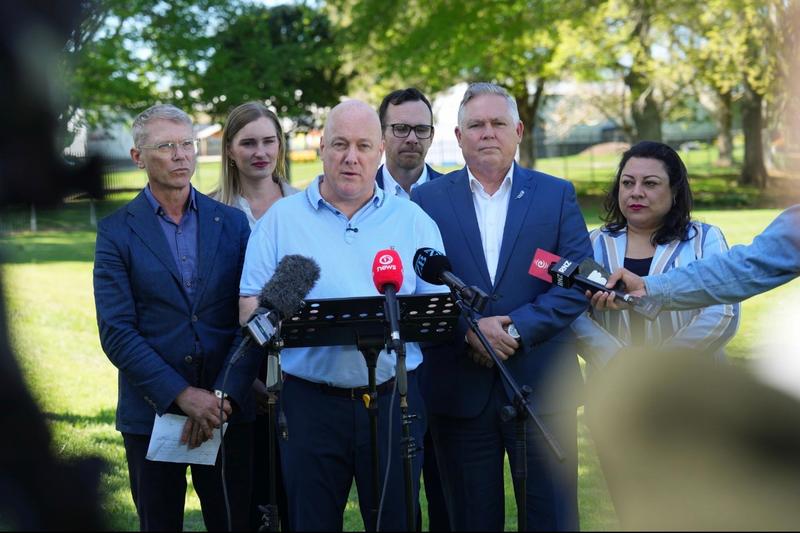
RNZ has reported the announcement and published the complete list.
But beyond the political timetable lies another question worth asking: who would be accountable if the first 100 days produced plenty of government activity but little immediate change in people’s lives?
A Deadline Can Measure Activity Without Measuring Success
National’s plan combines different kinds of promises.
Some involve passing laws. Others involve introducing legislation, requesting reports, starting policy work or launching initiatives.
Those are legitimate government activities, but they are not equivalent outcomes.
Consider three examples:
|
National’s commitment
|
What could be achieved in 100 days
|
What would still need to be demonstrated
|
|
Investigate separating Foodstuffs
|
Establish a legal process requiring a Commerce Commission report
|
Whether any resulting reform improves competition and grocery prices
|
|
Extend paid parental leave
|
Introduce legislation
|
Whether eligible families receive the additional entitlement from the proposed commencement date
|
|
Launch a trade mission to India
|
Organise and undertake the mission
|
Whether businesses subsequently secure sustainable export opportunities
|
A government could complete each initial action while the economic or social benefits remain months or years away.
That does not automatically make the commitment meaningless. Some reforms require substantial preparation.
But it means voters should distinguish between a delivery deadline and a starting deadline.
The Supermarket Question: Can Government Promise Competition It Does Not Control?
National’s proposal to strengthen the Commerce Commission and require a report on separating Foodstuffs is among the most consequential items.
It also raises a question about institutional independence.
The Government can legislate, set regulatory frameworks and require investigations. The Commerce Commission must still undertake its work within the law and assess the evidence.
A six-month report is therefore not a guarantee that New World and PAK’nSAVE will become separately owned competitors.
Nor would separation automatically establish that grocery prices would fall.
The outcome would depend on how the market is structured, how suppliers and distributors operate, the cost of any transition and whether consumers gain meaningful alternatives.
For shoppers, the eventual question is straightforward: would a weekly grocery basket become more affordable?
For independent grocers and suppliers, the questions may be different: would they gain fairer access to wholesale supply, better commercial terms or more opportunities to compete?
Those are the measures against which a future supermarket reform should be assessed.
Council Rates: What Happens When the Bill Is Capped but the Work Remains?
National proposes legislation to limit council rates increases to a range of 2 to 4 percent.
For households facing repeated increases, a cap may appear attractive.
But council expenditure does not disappear when revenue growth is restricted.
Local authorities still face costs associated with roads, water infrastructure, waste services, libraries, parks and other facilities.
The unanswered practical questions are where savings would come from and what happens when essential infrastructure needs exceed the permitted increase.
Would councils reduce services, postpone maintenance, seek alternative revenue or qualify for exceptions?
A rates cap could provide greater predictability for households. It could also create difficult trade-offs for local government.
Both possibilities deserve scrutiny.
Paid Parental Leave: The Extra Week Is Only Part of the Story
National has promised to begin extending paid parental leave from the existing 26 weeks to 30 weeks over the next parliamentary term.
Its published policy sets out a staged timetable: 27 weeks from July 2027, 28 weeks from July 2028 and 30 weeks from July 2029.
The party also proposes allowing parents to share or overlap leave more flexibly.
For many families, flexibility may be as significant as the additional weeks.
But another issue deserves attention: the amount parents actually receive.
New Zealand’s maximum paid parental leave payment for the period beginning July 2026 is $811.05 per week before tax.
For someone whose normal income is substantially higher, paid parental leave can still involve a significant reduction in household earnings.
The policy may increase the time parents can spend caring for a newborn. Whether it makes that time financially manageable will vary considerably between families.
A fuller assessment should therefore examine both the duration of leave and the adequacy of payments.
Student Loans: More Take-Home Pay, but What Happens to the Debt?
National proposes reducing student loan repayments from 12 cents to 10 cents in the dollar.
For an eligible borrower earning $70,000 annually, the reduction would mean approximately $120 less deducted each year for every $6,000 of income above the repayment threshold — or, more simply, a saving of $20 for each $1,000 of income subject to repayment.
That is an improvement in immediate cash flow.
But there is a trade-off: if everything else remains unchanged, repaying a loan more slowly generally means carrying the balance for longer.
For New Zealand-based borrowers with interest-free loans, the implications differ from those faced by borrowers overseas who may incur interest.
The policy’s effect should therefore be assessed across different borrower circumstances, not solely by the increase in take-home pay.
Healthcare: What Is the Opportunity Cost?
National plans to boost Pharmac funding by redirecting money from foreign aid.
For patients waiting for access to medicines, additional funding could be significant.
However, a funding transfer involves two policy decisions, not one.
The first is how much additional money Pharmac would receive and what it could purchase.
The second is which overseas assistance programmes would receive less funding.
New Zealand has relationships and commitments across the Pacific and internationally. Changes to aid allocations may have diplomatic and humanitarian implications.
That does not establish that the proposal is right or wrong.
It means voters deserve to see both sides of the budget decision, including the programmes affected and the expected domestic health benefits.
The same principle applies to National’s proposed cancer clinical trials target: setting a target is one step; ensuring hospitals have the staff, research infrastructure and patient access needed to meet it is another.
The India Trade Mission: A Flight Is Not an Export Contract
National’s proposed trade mission to India is an important opportunity for New Zealand’s food, beverage and seafood exporters.
India is a large and complex market, and the recently implemented free trade agreement provides a new setting for commercial engagement.
But trade missions should be assessed beyond their itinerary and publicity.
New Zealand exporters may still need to navigate distribution networks, product standards, consumer preferences, logistics and local competition.
The more useful questions are how many participating businesses secure buyers, how many commercial relationships become repeat orders and whether smaller exporters can participate alongside established companies.
There is also a wider opportunity for New Zealand businesses and entrepreneurs with connections to India.
Their knowledge of language, consumer behaviour and business practices could support market entry, although the extent of that contribution would depend on how the mission is organised.
The mission’s success would be measured in commercial relationships and export results, not simply its launch.
The Overlooked Issue: Some Promises Depend on Other Institutions
A recurring feature of the plan is that delivery would not rest with Cabinet alone.
The Commerce Commission, local councils, Police, schools, healthcare providers, Immigration New Zealand and businesses would all play roles in implementing different proposals.
That creates a challenge for any government: announcing a policy is centrally controlled, but delivering its benefits often requires coordination across organisations with different responsibilities and constraints.
For example, establishing an Auckland Transport Police Team would require more than a ministerial announcement.
Its effectiveness would depend on staffing, deployment, coordination with transport operators and measurable changes in passenger and staff safety.
Likewise, reducing screen use in junior classrooms would involve schools, teachers, parents and curriculum expectations.
A useful 100-day report card should identify not only which commitments were started, but also which institutions are responsible for the next stage.
What Is Missing From a Conventional 100-Day Scorecard?
Governments commonly report whether they have completed promised actions.
A more informative approach would also publish a second set of measures showing what happens after the initial deadline.
|
Policy area
|
A meaningful follow-up measure
|
|
Grocery competition
|
Price trends, market entry and access for competing retailers
|
|
Paid parental leave
|
Eligibility, uptake and financial support received by families
|
|
Student loans
|
Changes in take-home pay and average repayment duration
|
|
Healthcare
|
Treatment access, waiting times and funded medicines
|
|
Immigration
|
Actual visa processing times and backlogs
|
|
Public transport safety
|
Reported incidents, response times and passenger confidence
|
|
India trade
|
New commercial agreements and realised export sales
|
|
Council rates
|
Household costs alongside service and infrastructure outcomes
|
These measures would not all be available within 100 days.
That is precisely the point.
The first deadline should mark the beginning of public accountability, not the end of it.
What About Labour and the Other Parties?
National’s plan deserves examination on its own terms, but the same standard should apply to every party seeking office.
Labour and other parties also make commitments that may depend on legislation, funding, consultation and implementation beyond an election cycle.
A fair comparison would ask each party to specify what it would complete immediately, what would take longer, how proposals would be funded and how outcomes would be independently measured.
Voters should not have to rely solely on the number of promises made or the speed with which they are announced.
The Question Beyond Election Day
National’s 26-point plan gives voters a picture of what the party would prioritise if returned to government.
Some proposals could bring tangible benefits to families, borrowers, patients and businesses. Others involve significant legal, financial or institutional questions that remain to be resolved.
The value of a 100-day plan lies in making priorities visible and giving the public an early opportunity to test progress.
But the more important accountability test comes afterwards.
If grocery competition does not improve, who explains why?
If council rates are capped but services deteriorate, how will that be addressed?
If a trade mission produces contacts but few contracts, how will its effectiveness be assessed?
And if a bill is introduced within 100 days but takes years to deliver its promised benefits, what should count as success?
New Zealanders deserve more than a checklist of government activity. They deserve to know what changed, who benefited, what it cost and whether the result justified the promise.
That is the accountability test worth carrying beyond the first 100 days — whichever parties form the next government.
Sources and Editorial Acknowledgements
RNZ: National sets out first actions if re-elected in 100 day plan, 25 October 2026. Webfit News acknowledges RNZ’s parliamentary reporting of the announcement and its publication of National’s 26 commitments.
New Zealand National Party: 2026 election policy statements, including paid parental leave, grocery competition, student loans, healthcare and trade.
https://www.national.org.nz/policies
Employment New Zealand: Paid parental leave payment rates effective 1 July 2026.
https://www.employment.govt.nz/news-and-updates/parental-leave-payments-to-increase-from-1-july
Editorial disclosure: This is an independent Webfit News analysis based on publicly announced policies and official information. Questions about implementation, trade-offs and accountability are editorial analysis, not statements attributed to RNZ or the National Party. Webfit News has not conducted a separate interview with National representatives for this report.