Should politicians be judged simply for appearing alongside gang members, or should the circumstances and purpose of those interactions determine whether a line has been crossed?
How the controversy unfolded
The dispute gathered momentum earlier this month when Green and Te Pāti Māori politicians attended a Mongrel Mob gathering described as a whānau health and wellbeing election hui.
Those attending included Te Pāti Māori MPs Oriini Kaipara and Hana-Rāwhiti Maipi-Clarke, Green MP Hūhana Lyndon and Green candidate Michel Mulipola.
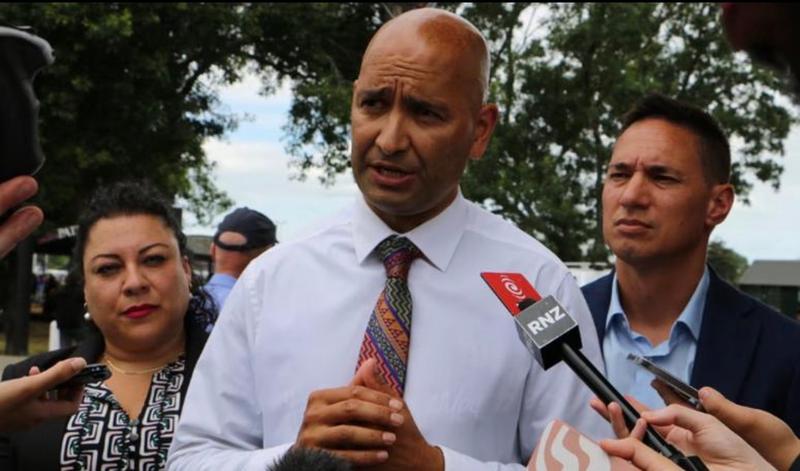
Photographs of the visit prompted criticism from both National and Labour.
Labour leader Chris Hipkins described the decision to attend as a serious error of judgment and said he would not allocate police or corrections portfolios to those parties in a future government.
But Labour soon faced questions about one of its own candidates.
Kerrin Leoni, who was standing in Tāmaki Makaurau, acknowledged attending a gathering where some of her whānau were gang members.
Footage subsequently emerged showing her wearing Labour-branded clothing, displaying campaign material and encouraging people to enrol and vote.
Leoni maintained that she had attended a whānau gathering rather than visited a gang pad.
On Friday, 23 October, she resigned as Labour’s candidate after Hipkins said the footage was inconsistent with the standards he expected.
Then a photograph of a National minister emerged
On Saturday, attention turned to National after a photograph surfaced showing Māori Development Minister Tama Potaka alongside patched Mongrel Mob members.
Potaka told Stuff the picture was taken in January 2024 at a Hui ā-motu organised by the late Māori King Tūheitia.
He said one of the men was a former schoolmate who had asked for a photograph.
Prime Minister Christopher Luxon defended Potaka, arguing that a photograph at a public event was different from deliberately campaigning at a gang gathering.
Police Minister Mark Mitchell made a similar distinction.
Mitchell said politicians regularly encounter members of the public whose backgrounds they may not know, and that agreeing to a photograph at a public event should not automatically be treated as political support.
Hipkins accused Luxon of applying different standards to National and opposition politicians.
That disagreement is now at the centre of the controversy.
Four situations, four different questions
The incidents should not automatically be treated as equivalent.
|
Situation
|
The question it raises
|
|
A politician is approached for a photograph at a public event
|
Does agreeing to a photograph imply support?
|
|
A politician attends a community or whānau gathering where gang members are present
|
Is the purpose community engagement or political campaigning?
|
|
A politician attends an event hosted by a gang
|
Does attendance lend legitimacy to the organisation?
|
|
A candidate uses party branding and campaign material while addressing gang members
|
Is the candidate actively seeking electoral support through the gathering?
|
These distinctions matter.
A photograph cannot, by itself, establish what was discussed, who arranged the encounter or whether any political support was sought.
At the same time, politicians cannot expect every appearance to be treated as harmless simply because they describe it as community engagement.
The purpose of the event, the candidate’s conduct and the wider context all deserve scrutiny.
Gang members are also voters and family members
There is another aspect of the debate that risks being overlooked.
Gang membership does not remove a person’s right to vote, maintain family relationships or seek assistance from an elected representative.
Politicians may encounter gang members through community events, family connections, rehabilitation programmes or discussions about employment and social services.
Those encounters can be legitimate without amounting to support for gang-related offending.
The harder question is how representatives maintain those connections while avoiding the appearance of endorsing organisations associated with violence, intimidation or criminal activity.
That requires judgment, transparency and consistency.
It also requires recognising the interests of victims, whose experiences must not disappear from the discussion.
What standard should apply to everyone?
The events of the past week suggest that New Zealand’s political parties have not established a shared understanding of acceptable engagement.
National argues that Potaka’s public-event photograph is different from campaigning at a gang gathering.
Labour argues that National must apply the same scrutiny to its own MPs that it demands of others.
The Greens and Te Pāti Māori have defended engagement with gang members as part of community representation.
Each position raises questions that deserve answers.
For voters, a consistent standard could begin with three straightforward considerations.
Was the encounter incidental or deliberately arranged?
Was the politician carrying out a community responsibility or actively seeking electoral support?
And did their conduct create a reasonable impression that they were endorsing the gang rather than engaging with individuals?
Those questions are more informative than treating every photograph as identical.
The issue is bigger than one photograph
New Zealand’s election campaign has turned images of politicians with gang members into political weapons.
But a photograph captures only a moment. It does not necessarily explain the relationship, the conversation or the purpose of the encounter.
Nor does it excuse conduct that may reasonably raise concerns about political judgment.
The public is entitled to expect politicians to take organised crime seriously, respect victims and explain their interactions openly.
It is also entitled to expect the same questions to be asked of every party.
The real test is not whether a politician has ever stood beside a gang member.
It is whether that politician can explain why they were there, what they were doing and how their actions were consistent with the standards they expect of others.
Sources: Reporting published on 23 and 24 October 2026 by Stuff, RNZ, 1News and the New Zealand Herald. This article distinguishes reported events and politicians’ statements from Webfit News analysis.