Her personal experience does not establish that driving under the influence of cannabis is safe. Cannabis can impair reaction time, attention, coordination and judgement, and drug-impaired driving presents a road safety risk.
The exchange was one of several revealing moments in an interview that examined Herbert's political ambitions, her party's economic proposals and the challenges facing communities in Northland.
Cannabis Legalisation as an Economic Policy
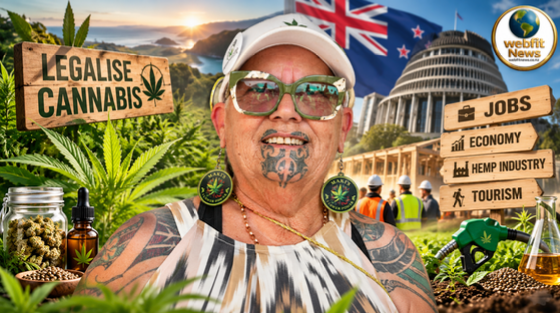
Herbert, who is standing in Te Tai Tokerau, described the Aotearoa Legalise Cannabis Party (ALCP) as a single-issue party with ambitions extending beyond changing drug laws.
She argued that legalising and regulating adult cannabis use could create opportunities in tourism, retail, agriculture and manufacturing.
Herbert placed particular emphasis on industrial hemp, which she believes could support employment and economic development in Northland.
She identified potential opportunities in construction, engineering, science, resource management, product design and biofuels.
Her central argument was that a legal industry could generate jobs for communities experiencing unemployment.
However, the interview did not establish how many jobs would be created, what infrastructure would be required or how much revenue the proposed industries could realistically generate.
Those questions would need to be addressed in any detailed economic assessment of legalisation.
Why Herbert Entered Politics
Herbert traced her political involvement to cannabis activism in Auckland.
She recalled participating in activities associated with the Daktory, a cannabis advocacy and social club in New Lynn, where she became involved in discussions about medicinal cannabis and law reform.
Herbert said she was encouraged to stand in a 2010 by-election to represent the cannabis community.
Sixteen years later, she remains committed to the same central objective.
She described ALCP as a protest-oriented political party, offering voters an alternative to established political parties.
For Herbert, legalisation is not simply a matter of personal freedom. She sees it as an opportunity to establish industries that could benefit smaller communities.
‘Jobs, Jobs and More Jobs’: What Makes ALCP Different?
Webfit News asked Herbert what her party could offer that Te Pāti Māori, Labour and the Greens could not.
Her answer was straightforward: cannabis legalisation and the employment opportunities she believes would follow.
She argued that political parties frequently promise thousands of jobs without explaining what those jobs would involve.
Herbert said voters needed more specific information about employment opportunities, including the types of work available.
But her own proposal also faces that test.
Although she identified several possible industries associated with cannabis and hemp, she did not provide a costed employment plan or evidence demonstrating the scale of the opportunities.
The distinction matters because industrial hemp and recreational cannabis are different markets, with different products, regulations and commercial considerations.
Legalising adult cannabis use would not automatically guarantee the development of a profitable hemp industry.
Cost of Living: Power Bills, Wages and Families Under Pressure
The interview moved beyond cannabis to the financial pressures facing New Zealand households.
Asked why people were working hard but still struggling financially, Herbert pointed to the cost of living.
She argued that communities needed greater economic independence, including local food production and stronger support networks.
Herbert also highlighted the role of marae as community hubs.
When asked whether working New Zealanders should earn enough to live without government assistance, she agreed.
She questioned whether existing wage levels were sufficient and suggested that hourly rates of $25 or even $30 could make a meaningful difference to workers.
However, she did not outline a specific minimum-wage policy or explain how businesses would manage the additional costs.
Asked which household expense she would reduce first, Herbert chose electricity.
"Power," she replied, describing it as one of the essential costs households face.
Would She Leave New Zealand for Australia?
Herbert was asked what she would say to young Northlanders who believed Australia offered a better future.
She said she understood why people considered leaving.
"I don't blame them for looking somewhere else," she said.
Herbert acknowledged that higher wages overseas could be attractive to people struggling to make ends meet in New Zealand.
"I know if I was younger, I'd be in Australia," she added.
Her comments reflected frustration with the limited opportunities she believes are available to younger people in Northland.
She also linked unemployment and financial hardship to the pressures that can contribute to offending.
However, the relationship between unemployment, poverty and crime is complex, and financial hardship should not be treated as evidence that individuals will engage in criminal activity.
A Direct Challenge to Te Pāti Māori's Leadership
When asked what Te Pāti Māori had failed to deliver and what she would do differently, Herbert gave a brief response.
"Change their leadership."
She went on to criticise the party's handling of internal political matters, referring to the treatment of two MPs.
Herbert questioned what that situation meant for the confidence voters could place in the party's leadership.
The interview did not establish the full circumstances of the dispute or include a response from Te Pāti Māori.
Her remarks therefore represent her political criticism rather than an independently established assessment of the party's conduct.
Māori Representation and Te Tiriti o Waitangi
Herbert also discussed Māori representation, sovereignty and the relationship between tangata whenua and the Crown.
Asked whether public funding should be based on ethnicity, individual need or a combination of both, she emphasised inclusion and the recognition of tangata whenua.
She argued that New Zealand's multicultural identity should not diminish the position of Māori as the country's Indigenous people.
Herbert also spoke about Te Tiriti o Waitangi as the foundation for a relationship between Māori and the Crown.
When asked how she would respond to opposition to policies benefiting Māori communities, she emphasised the right of communities in Te Tai Tokerau to determine their own priorities.
Her comments reflected her political perspective on Māori rights and representation, rather than a detailed proposal for changing funding arrangements.
New Zealand Rejected Cannabis Legalisation in 2020. Why Revisit It?
One of the central questions put to Herbert concerned the 2020 cannabis referendum.
New Zealand voters rejected the proposed Cannabis Legalisation and Control Bill, although the result was relatively close.
Webfit News asked why Parliament should revisit the issue when the public had already voted against the proposal.
Herbert argued that attitudes had changed since 2020 and that the referendum had helped make cannabis a subject people could discuss more openly.
She also pointed to people seeking alternative treatment options and criticised what she regarded as restrictions and costs within the medicinal cannabis system.
Herbert acknowledged that cannabis products do not work for everyone.
Her wider argument was that the debate should continue rather than be considered permanently settled by the referendum.
However, the interview did not establish that public opinion had shifted sufficiently to support a different outcome today.
Should Cannabis Be Advertised?
Asked whether cannabis advertising should be permitted or restricted in a manner similar to tobacco advertising, Herbert supported restrictions.
She said substances capable of causing health harm should not be promoted.
Herbert argued that removing the glamour associated with cannabis could reduce its appeal, particularly among young people.
She also supported a regulated retail system in which businesses would be required to comply with relevant rules and pay taxes.
The discussion highlighted an important distinction between legalising a product and allowing unrestricted promotion of it.
A legal market could still impose controls on advertising, packaging, age verification and sales.
The Road Safety Question Herbert Did Not Resolve
The interview's most contentious exchange concerned drug-impaired driving.
Asked how legalisation would protect children and reduce impaired driving, Herbert questioned whether cannabis use contributed to road accidents.
She then disclosed her own history of driving under the influence.
The comments raise an important distinction between personal belief and road safety evidence.
A driver may believe their abilities are unaffected, but that perception cannot reliably establish whether their reaction time, attention or judgement has been impaired.
Cannabis impairment can increase driving risk, particularly when combined with alcohol or other substances.
Herbert's remarks also left several policy questions unanswered.
She did not explain what impairment thresholds she would support, how roadside enforcement should operate or what penalties should apply to drivers found to be impaired.
Those issues would be central to any serious proposal for a regulated adult-use cannabis market.
Who Should Profit From Legal Cannabis?
Herbert said she wanted the economic benefits of legalisation to remain within local communities.
Asked whether large corporations, small businesses or communities should profit from a legal market, she favoured local ownership.
"Communities, keep it localised," she said.
She expressed concern that large corporations could dominate the industry and reduce opportunities for smaller operators.
Her preference was for a model in which communities could develop their own businesses and retain more of the economic benefits.
However, she did not explain how such a system would be structured or how competition, licensing and ownership rules would operate.
Would She Tighten the Law if Addiction Increased?
Despite advocating legalisation, Herbert said she would support tightening regulations if addiction-related harm increased.
She argued that addiction should primarily be addressed as a health issue.
Herbert suggested redirecting resources currently spent on prohibition towards rehabilitation and support services.
Her response indicated that she did not regard legalisation as a reason to abandon regulation or public health oversight.
Nevertheless, the interview did not establish what evidence or thresholds would trigger tighter controls.
Rapid Fire: Politics, Drug Testing and Personal Freedom
The conversation concluded with a rapid-fire round.
Asked to describe New Zealand politics in one word, Herbert responded with an expletive.
She said she could not identify anything she admired about a political opponent.
When asked whether cannabis legalisation was primarily about personal freedom or public health, she chose personal freedom.
Herbert also supported drug testing for politicians.
Asked whether she would rather win a debate or change a law, she chose changing the law.
Now 67, she reflected on the financial difficulties facing pensioners, saying life had not become easier.
And when asked what she wanted to be remembered for, even if she never entered Parliament, her answer was immediate.
"Legalising cannabis."
A Single-Issue Party Facing Questions Beyond Cannabis
Herbert's interview demonstrated the determination that has sustained her involvement in cannabis law reform for more than a decade.
She sees legalisation as a route towards employment, community development, personal freedom and a different approach to drug-related harm.
But the conversation also exposed gaps between that vision and the practical details needed to deliver it.
Herbert did not provide a costed employment strategy, a detailed framework for community ownership or a clear explanation of how drug-impaired driving would be prevented.
Her willingness to reconsider regulations if addiction increased showed an acknowledgement that legalisation would not eliminate the need for public health safeguards.
Yet her personal comments about driving under the influence are particularly significant because road safety is one of the issues any future legalisation proposal would need to address.
For voters considering the Aotearoa Legalise Cannabis Party, the interview offers a clearer picture of its co-leader's priorities, experiences and political philosophy.
It also leaves a fundamental question: how would the party translate its commitment to cannabis legalisation into a workable system that creates economic opportunities while protecting public health and road safety?
Source: Exclusive Webfit News Election 2026 interview with Maki Herbert, co-leader of the Aotearoa Legalise Cannabis Party and candidate for Te Tai Tokerau.
Reporting note: Statements about employment opportunities, medicinal cannabis, political parties and driving experiences are attributed to Herbert. They should not be interpreted as independently verified findings or medical and road safety advice.