Because patients entered the study at different times, their follow-up periods varied.
Researchers reported three significant findings:
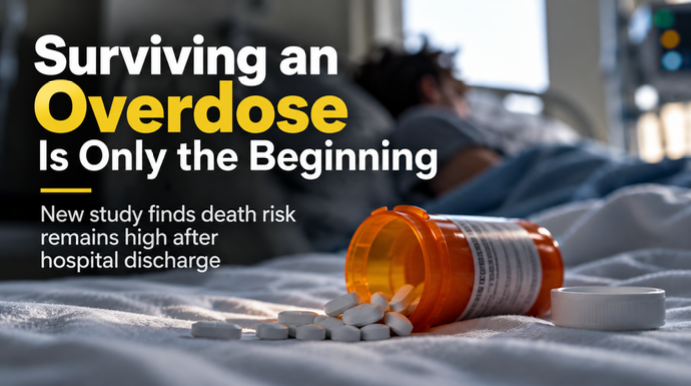
People hospitalised after accidental overdose had a mortality rate 3.5 times higher than the general population.
The greatest risk of subsequent death occurred in the first month after leaving hospital.
Overdoses involving heroin, methadone and stimulants were associated with particularly high subsequent mortality risks.
The relative risk of death was especially elevated among women aged 20 to 50 when compared with women of the same ages in the general population.
The researchers also found that subsequent mortality risk after accidental overdose was comparable to, or in some comparisons greater than, that observed following intentional self-poisoning.
These findings challenge the assumption that an accidental overdose is necessarily an isolated event.
Why the First Month Matters
Lead researcher Associate Professor Rose Cairns, from the University of Sydney's School of Pharmacy, said an accidental overdose should be recognised as a warning sign of continuing health risks.
“This research shows that accidental drug overdose is not an isolated event but is a strong warning sign that a person faces a much higher risk of death following hospital discharge compared to the general population.”
Cairns said the particularly high risk immediately after discharge highlighted the need for timely follow-up.
Researchers identified subsequent deaths from causes including repeat overdose, suicide and heart disease.
This means the danger does not necessarily come from another overdose alone.
A person who survives an overdose may also have underlying physical or mental-health needs requiring further assessment and care.
Importantly, the study demonstrates an association between hospitalisation for overdose and subsequent mortality. It does not establish that the initial overdose directly caused every later death.
Not Just Illegal Drugs
The study's definition of accidental overdose covered both prescription medicines and illicit substances.
These included prescribed opioids, benzodiazepines, antipsychotic medicines and antiepileptic medicines, as well as drugs such as heroin and GHB.
Patients were included whether or not they had a diagnosed substance-use disorder when admitted to hospital.
The research did not include accidental poisoning from household or agricultural chemicals.
That distinction matters because the findings are not limited to people who use illegal drugs or those already receiving treatment for substance dependence.
They concern a broader group of patients who have experienced serious drug-related poisoning.
Nearly One in Five Died — But Over Different Periods
The finding that 2,588 patients died is striking.
However, it needs to be understood correctly.
Nearly one in five died during the study's follow-up period — not within one month of discharge.
The study followed patients for different lengths of time, depending on when they were first admitted.
Someone admitted in 2011 could be observed for substantially longer than someone admitted near the end of the study period.
The 3.5-times-higher mortality figure is a comparison of death rates with the general population, not a prediction that an individual survivor is 3.5 times more likely to die within a particular month or year.
The research identifies a group at elevated risk, rather than predicting what will happen to any particular patient.
A Wider Australian Public Health Concern
The findings come amid broader concerns about overdose deaths in Australia.
The Penington Institute's 2026 Annual Overdose Report recorded 2,596 drug-induced deaths in Australia in 2024, up from 2,345 in 2023.
The report also found that unintentional drug-induced deaths exceeded 2,000 for the first time in its historical series.
These figures describe deaths directly attributed to drugs and are separate from the University of Sydney study's measure of deaths from all causes after a hospitalised overdose.
Taken together, the two sources point to different dimensions of the same public-health challenge: preventing fatal overdoses and supporting people who survive serious poisoning.
What Should Happen After Hospital Discharge?
The University of Sydney researchers argue that an overdose admission should create an opportunity for continued healthcare intervention.
Depending on the patient's circumstances, follow-up could involve reviewing medicines, assessing substance-use concerns, arranging mental-health support and addressing existing physical-health conditions.
For patients at risk of opioid overdose, appropriate overdose-prevention support may also be relevant.
The study does not establish that one particular follow-up programme would eliminate the excess mortality risk.
But its findings suggest that the period immediately after discharge deserves particular attention.
For hospitals and community healthcare providers, this raises practical questions.
Is a follow-up appointment arranged before the patient leaves?
Is there a clear handover to their GP or relevant specialist service?
Are mental-health and substance-use concerns assessed alongside physical health?
And is someone responsible for checking that the patient can access the recommended care?
Those are important questions because discharge from hospital is a transition between services, not necessarily the end of a patient's health needs.
What Does This Mean for New Zealand?
The research was conducted in New South Wales, not New Zealand.
Its findings therefore cannot be used to claim that New Zealand overdose survivors experience exactly the same mortality rates.
However, the questions it raises are relevant to healthcare systems on both sides of the Tasman.
A hospital can successfully treat an acute overdose while the patient continues to face significant health risks after discharge.
For New Zealand, the research provides a reason to examine how overdose survivors are supported once they return to the community, particularly during the first weeks.
It also highlights the importance of considering prescription medicines, illicit substances, physical health and mental health together rather than treating them as entirely separate issues.
Further New Zealand-specific research would be needed to establish the scale of the risk locally and assess the effectiveness of existing follow-up arrangements.
The Real Warning Is What Happens Next
The most important finding is not simply that overdose survivors face an elevated risk of death.
It is that the risk is greatest soon after hospital discharge — a period when patients may be moving from intensive medical attention back into everyday life.
An accidental overdose can be survived, treated and recorded as a successful emergency intervention.
But that does not necessarily mean the underlying health risks have disappeared.
The study's central message is that saving someone from an overdose should not be the end of their care. It should be an opportunity to prevent the next medical emergency.
Research and Sources
Original research: Noghrehchi, F. et al., Accidental overdose admissions and premature death: A large population-based data-linkage cohort study in New South Wales, Australia, Addiction.
DOI: https://doi.org/10.1111/add.70604
University of Sydney: Media release supplied directly to Webfit News, October 2026, including findings and comments from Associate Professor Rose Cairns.
Penington Institute — Australia's Annual Overdose Report 2026
https://www.penington.org.au/australias-annual-overdose-report-2026/
Australian Institute of Health and Welfare — Illicit Drug Use
https://www.aihw.gov.au/reports/illicit-use-of-drugs/illicit-drug-use
Editorial note: This article reports findings from a University of Sydney research media release and adds independently sourced Australian overdose statistics and explanatory context. The underlying study's full statistical tables were not independently reproduced for this report. The findings describe an observational association, not proof that the original overdose caused subsequent deaths. No New Zealand-specific mortality estimate is inferred from the Australian data.